



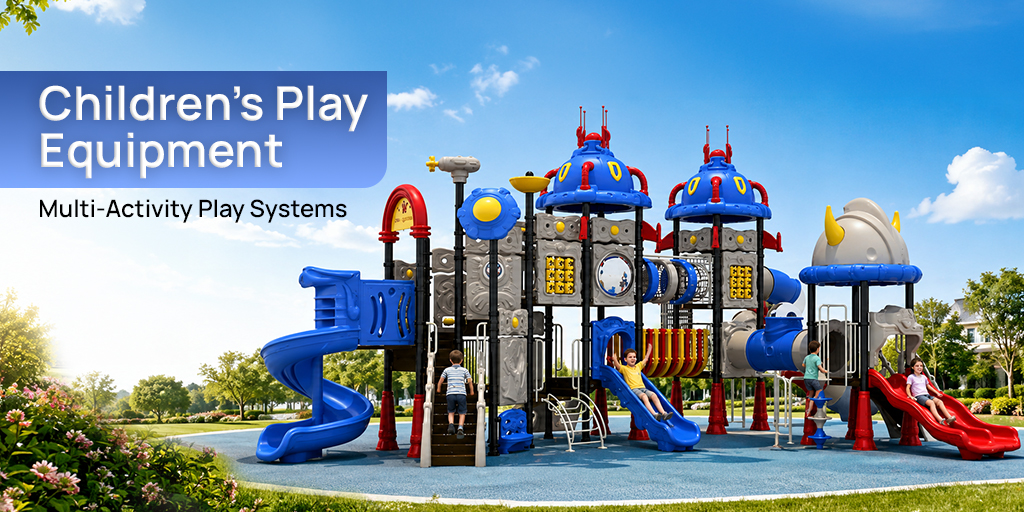
Children's Play Equipment: The Complete Guide to Multi-Activity Play Systems
Play equipment is probably the backbone of a park or recreational project. When you start planning, a major decision should always be choosing the right children's play equipment. A poorly planned equipment set not only affects normal operation, but it also increases long-term upkeep costs.
To help park stakeholders plan more effectively, this guide covers everything there is to know about outdoor playground equipment. It pays special attention to multi-activity play systems (playground multi-play stations). This equipment is considered the single biggest investment decision in most playground projects. It presents ideas too, ideas on how to evaluate playground equipment manufacturers before planners or park owners sign a purchase order.
What Counts as Children's Play Equipment?
When planning a recreational or play park, a good place to start is to know what counts as play equipment for kids. To help you understand the category better, here's a brief explanation.
Children's play equipment could include structures designed for outdoor or semi-outdoor recreational use. Broadly, this kind of equipment falls into these categories:
Motion & Momentum Equipment
- Swings: Including belt swings, full bucket toddler seats, tire swings, and tandem multi-user swings.
- Slides: Ranging from straight and wave slides to spiral chutes, tube slides, and embankment slides.
- Spinners & Roundabouts: Traditional merry-go-rounds, orbital standalone spinners, and rotating dishes.
- Spring Riders: Animal or vehicle-shaped seats mounted on heavy-duty steel springs for rocking back and forth.
- See-Saws: Classic multi-user balancing levers and modern spring-assisted teeter-totters.
Climbing & Elevation Structures
- Monkey Bars: Overhead horizontal ladders, ring treks, and parallel bars that test upper-body strength.
- Geodesic Domes & Space Nets: Complex, geometric rope matrix webs and metal grid matrices.
- Climbing Walls: Simulated rock walls, pegboards, and vertical cargo nets.
- Post-and-Platform Systems: Modular decks interconnected by suspension bridges, ramps, and crawl tunnels.
Sensory & Imaginative Play Elements
- Activity Panels: Wall-integrated tic-tac-toe games, maze tracks, steering wheels, and gear setups.
- Outdoor Musical Instruments: Built-in marimbas, metallophones, chimes, and interactive drums.
- Sandboxes & Water Tables: Dedicated containers constructed for tactical moulding, pouring, and sensory exploration.
- Playhouses & Forts: Ground-level or elevated micro-structures designed for role-play and quiet socialisation.
How to Plan Around Play Equipment for Kids
Now that you have understood what the categories and types of children's play equipment are, the next step is assessing how to use them effectively within a dedicated play space.
Experts will always tell you that having one or two multi-activity play systems provides variety and multiple play options in a single structure. This configuration establishes visual balance, optimises foot traffic flows, and significantly increases the play zone's overall capacity.
Utilising this specific layout is a vital consideration for high-footfall environments, particularly public parks and school grounds. Implementing this dispersed setup ensures the playground remains accessible and reduces wait times for popular play items. It allows more children to play together safely without overcrowding the site.
That's why a good design idea is to use these multi-play systems as the base and install standalone units around it. Recommended side installations could be swings and seesaws.
Multi-Activity Play Systems: The Centrepiece of Modern Playgrounds
These systems (sometimes called playground multi-play stations) do more than just increase space; they deliver a variety of play experiences. With it, children can climb, slide, balance, crawl, and engage in social play, all within a single connected framework. It's a great medium for encouraging play activity amongst children.
These multi-activity play systems do more; they provide many functions in a fraction of the space and installation time. These practical solutions work best for parks, schools, and residential spaces where efficiency and variety are equally important.
If you want to choose the best, go for our multi-activity play systems and duplex multi-activity play systems. These are engineered for varied play experiences, all within a single space.
For smaller sites, such as housing societies and community parks, Arihant Play's multi-activity combination sets deliver maximum play value in a compact layout. In contrast, the duplex range is engineered for larger spaces like schools, public parks, and gated townships. These two-tier structures allow more children to play at once while preventing bottlenecks at access points.
Why Arihant Play's Multi-Activity Systems Are the Smarter Investment
- Space Efficiency: One multi-activity structure replaces multiple separate units, saving valuable space in tight urban parks and crowded residential zones.
- Age-Inclusive Play: By blending easy and challenging activities into one structure, these systems allow toddlers, children, and pre-teens to play together safely.
- Reduced Maintenance: Fewer separate concrete foundations and smaller safety surfacing spaces mean routine inspections and upkeep are faster and less costly.
- Better Budget Value: A single system offers slides, climbers, and panels together. This variety keeps children engaged longer than basic standalone swings or seesaws.
- Easier Site Planning: A central multi-activity unit gives playgrounds an organised, cohesive look, acting as a focal point that simplifies the rest of the layout design.
Beyond selecting multi-activity systems, effective design requires matching outdoor playground equipment to the available space while adhering to safety and operational guidelines.
Outdoor Playground Equipment: Design and Safety Considerations
Whether you are investing in a massive multi-activity jungle gym or picking out a few classic children's outdoor play equipment pieces, the same principles apply to every single project. Over the years, it has been found that stretching a budget and maximising park fun comes down to these five non-negotiable details:
- Material and Finish: Hot-dip galvanised steel and heavy-duty plastics brave the outdoor elements best. Industrial powder coatings protect this equipment investment from fading, rusting, and cracking through brutal monsoons and peak summer heat.
- Safety Compliance: Safety standards require strict adherence. Certified equipment handles the complex layout math automatically, covering critical safety rules for fall heights, gap sizes, and guardrails to meet safety standards.
- Safety Surfacing: Thick rubber tiles or poured rubber flooring around fall zones represent an absolute necessity. Investing in these specialised materials drastically reduces impact injury risks and creates a much safer environment.
- Age Zoning: Smart layouts separate toddler play zones from equipment built for older children. This simple configuration keeps the playground orderly, prevents older kids from accidentally bumping into toddlers, and ensures everyone has fun.
- Maintenance Access: Successful designs feature components engineered for quick inspections and fast part replacement. A long playground lifespan requires a high-quality initial setup, but it relies equally on painless, regular upkeep.
While these five non-negotiables are important, an even more critical point of contention in the planning phase is choosing the right supplier and manufacturer.
How to Choose the Right Outdoor Playground Equipment Manufacturer
As schools, builders, and municipal bodies plan new projects, there's always a demand for playground equipment manufacturers and outdoor playground equipment manufacturers. While these playground makers offer a wide range of products, not all manufacturers deliver the same quality. Park planners need to use a checklist before shortlisting a playground equipment manufacturer. Here's one to note:
- In-House Manufacturing: Trading firms just resell boxes from overseas warehouses. Working with a company that actually cuts the steel changes everything. Direct builders tweak deck heights, add extra shade roofs, and ship replacement parts years down the road without delay.
- Compliance Papers: Public safety relies on paperwork. Checking material test sheets and certified fall-height stamps before buying protects the park from future liability. True certification ensures the metal and plastic handle outdoor wear before the first child climbs up.
- Real Project Experience: Intense heat, rain, and foot traffic break cheap hardware. Choosing a partner with a deep history in schools and busy apartment complexes ensures the system survives daily outdoor use. Experienced teams know exactly how rain drainage and odd corners ruin standard layouts.
- Flexible Design: Rigid catalogue models rarely fit real land. A manufacturer who shifts a climbing wall to save a mature oak tree or avoid a muddy slope delivers genuine value. The best layouts wrap around the natural shape of the ground.
- Setup and Support: The partnership lasts long past delivery day. Securing an annual upkeep contract keeps the chains greased and the swings moving safely through every season. Regular check-ups preserve the playground so it stays open every weekend.
- Clear Pricing: Hidden costs ruin budgets midway through construction. Getting a breakdown separates the actual outdoor play equipment from the rubber flooring and labour fees. Honest numbers and clear timelines mean the grand opening happens right on schedule.
Arihant PLAY has been designing and manufacturing outdoor playground equipment across India for schools, public parks, housing societies, and commercial developments. Our in-house manufacturing is capable of customising every multi-activity system to the site rather than force-fitting a standard model.
For an insight into what it takes to select the right playground equipment, our complete buyer's guide to playground equipment manufacturers is worth a read.
Matching Play Equipment to Your Space
Every area, whether it is a park, a school, or a housing society recreational area, needs a unique play equipment design. For optimal land use, planners must match end-user needs to the physical layout of available space. Here's what you need to know to achieve this.
- Schools need durable, high-footfall equipment with age-zoned play areas and equipment that supports gross motor and social development. For a complete framework, get our school playground equipment guide.
- Housing societies and residential projects typically have tighter footprints and benefit from compact multi-activity combination sets. Large-format systems do not really work here. If you need more information, our guide to playground equipment for housing societies covers space-efficient options in detail.
- Public parks and recreational spaces need equipment built for continuous, high-traffic use across age groups. These spaces often combine a large multi-activity system with standalone swings, see-saws, and fitness stations. For an in-depth understanding, read our park play equipment guide.
Common Mistakes to Avoid When Buying Children's Play Equipment
If the planning fails, a line of frustrated parents forms because twenty kids are fighting over two swings. Avoiding these headaches requires catching a few common missteps before the concrete pours.
- Misjudging Footfall: Sizing a playground wrong causes instant chaos. A tiny tower bottlenecks quickly in a public park where hundreds of families visit each weekend. Conversely, a massive jungle gym crammed into a small housing courtyard wastes money and crowds out the grass.
- Forgetting the Flooring: Safety surfacing requires its own budget, but buyers frequently overlook this cost until the last minute. Thick rubber tiles under the swings prevent broken bones and keep the park legally compliant. Budgeting for the flooring early ensures the ground is ready when the trucks arrive.
- Chasing the Lowest Bid: Cheap prices usually mean thin steel, weak plastics, and missing safety certificates. These material shortcuts show up within months as rusted chains, faded slides, and cracked decks. Spending a bit more upfront prevents the park from looking abandoned by next summer.
- Mixing All Age Groups: Toddlers and teenagers rarely play well on the exact same platform. Older kids run fast and accidentally knock over toddlers when a layout lacks clear separation. Smart parks use a layered system or spread standalone pieces around to give everyone their own space.
- Skipping the Maintenance Plan: Outdoor hardware breaks down without regular care. Chains stretch, bolts loosen, and weather takes a toll. Locking in a solid upkeep plan keeps the moving parts quiet and ensures the gates stay open every day.
- Rushing the Installation: Poor ground preparation and sloppy foundation pouring ruin great equipment. Rushed assembly in the field leads directly to loose posts and tilting structures. Taking time to cure the concrete foundations properly guarantees a long playground lifespan.
Catching these missteps during the early blueprint phase protects the budget and ensures a smooth setup. This careful approach creates a welcoming, durable space where children play safely for years.
Frequently Asked Questions
1. What is the difference between a multi-activity play system and a playground multi-play station?
Both terms describe the same type of equipment. They refer to a single, connected structure that combines multiple elements like slides, climbers, and activity panels. Multiplay station is simply a common alternative commercial name for a multi-activity play system.
2. How much space does a multi-activity play system need?
Space requirements vary by model. Compact sets suit residential courtyards and small community parks, while larger configurations require schools and public parks with open ground areas. A manufacturer can recommend the exact dimensions based on your specific site layout.
3. What age group is children's play equipment designed for?
Most commercial play equipment serves children aged 2–12. High-quality structures feature separate zones based on physical ability, providing low-height areas for toddlers alongside challenging climbing setups for older children.
4. How do I know if a playground equipment manufacturer is reliable?
Verify their production capabilities by checking that they manufacture in-house. You should request safety compliance documents, review their project history, and secure annual maintenance support before signing a contract.
5. Is safety surfacing necessary under multi-activity play systems?
Yes. Installing rubber tiles, EPDM flooring, or engineered wood fibre around fall zones is essential for liability and risk management. Taller structures with slides and climbing elements require this impact-absorbing material to lower the chance of injury.
Conclusion
The right mix of children's play equipment shapes the long-term success of your school, housing society, or public park. Anchoring your layout with a well-designed multi-activity system creates an inviting space that children return to every day.
Explore Arihant PLAY's full range of multi-activity play systems, duplex multi-activity play systems, and combination sets. You can also get in touch with our team to design the optimal equipment configuration for your site layout.