



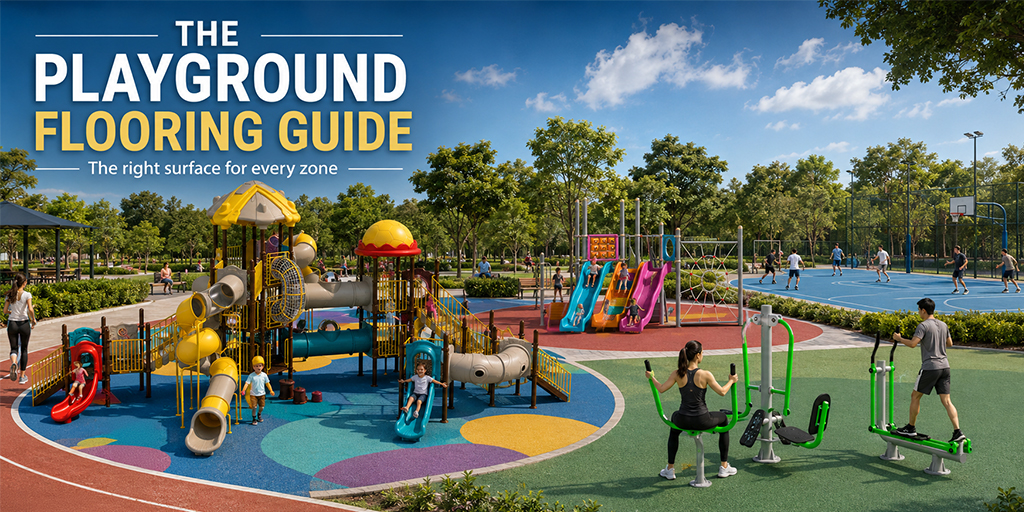
Playground Flooring & Fall-Safety Standards: Rubber Flooring, Sports Courts & Jogging Tracks Compared
You can have equipment that passes every test. Anchors hold up well and the torque settings are perfect. But if the surface under that swing doesn’t meet impact attenuation standards, the whole system fails.
Too often, teams focus on the visible hardware. It is noticeable that often flooring gets treated like decoration instead of what it really is - a certified safety system. That oversight has been known to drive compliance scores down.
Since falls cause nearly 80% of playground injuries, flooring becomes the deciding factor. Equipment design helps, but the surface determines whether a fall from 2.5 metres ends in a bruise or a head injury. That’s why this guide walks through a playground flooring safety standards comparison across rubber flooring, sports courts, and jogging tracks.
For how certification connects equipment and flooring, see our playground safety standards guide.
Why Flooring Matters in Certification
Playground equipment and flooring are certified separately. Compliance for one does not transfer to the other, but each carries its own performance obligations.
Impact attenuation standards such as ASTM F1292 (US), EN 1177 (Europe), and IS 16620 (India) define maximum fall heights. The key metric is Head Injury Criterion (HIC). Values must stay below 1000. If they exceed that threshold, the surface fails regardless of equipment condition.
Moreover, equipment height and flooring thickness follow a direct curve. A 1.5-metre CFH usually requires 30mm surfacing, while a 3.0-metre CFH requires 70mm. Choosing the wrong thickness creates liability no waiver can cover.
Rubber Flooring: The Fall Zone Standard
Rubber surfacing dominates playgrounds because it delivers predictable impact performance. SBR crumb rubber provides cushioning, while EPDM granules add UV stability and colour retention. Together, they form a dual-layer system built for durability.
Installation formats include:
- Wet pour rubber: Seamless, customisable, wheelchair accessible. Higher upfront cost but lower long-term maintenance.
- Interlocking tiles: Easy installation, replaceable tiles, budget-friendly. Seams can lift over time.
Thickness directly impacts CFH ratings. EPDM poured systems protect up to 3 metres. The premium buys seamless coverage and higher fall protection. B
Sports Courts: Different Standards
Sports courts are designed for athletic performance, not falls. Standards such as IS 16740:2018 and EN 14904 cover shock absorption, traction, and ball rebound. Thickness ranges from 15–25mm depending on use. These values do not meet playground fall requirements. Consequently, installing sports flooring in a fall zone creates compliance failure.
Jogging Tracks: Built for Movement
Jogging tracks focus on resilience, traction, and weather resistance. They use the same SBR/EPDM family but at thinner layers. Typical thickness is 8-15mm. Standards address joint stress and running efficiency, not playground falls. Browse our jogging track flooring range.
Comparison Table
Here's how the three flooring lines compare on the factors that actually differentiate them:
| Flooring Type | Primary Purpose | Typical Setting | Maintenance |
|---|---|---|---|
| Rubber Flooring | Impact absorption in equipment fall zones | Under/around swings, climbers, thrillers | Low - occasional cleaning, periodic inspection |
| Sports Courts | Multi-use recreational surface, ball bounce | Dedicated games/sports areas | Low to moderate - surface cleaning, line upkeep |
| Jogging Tracks | Durable traction for repetitive-motion activity | Park/campus perimeter loops | Low - periodic resurfacing over time |
The Flooring Decision Framework
Playground rubber absorbs falls. Sports courts enable play. Jogging tracks support movement.
Procurement teams must specify by application, certify by standard, and test by zone. Standardising on one surface across a property creates compliance gaps. The cost of getting it wrong is not just inspection failure. It is a preventable injury.
FAQs
Q: Does flooring need separate certification from equipment?
A: Yes. Equipment certification covers structure and entrapment hazards. Flooring certification covers impact attenuation, slip resistance, and shock absorption. A playground can pass equipment inspection but fail on surfacing compliance. Always request separate documentation.
Q: Can different flooring types be combined in one facility?
A: Yes. Many facilities use rubber surfacing in play zones, sports court flooring in multi-use areas, and jogging tracks around the perimeter. Each zone must meet its own standards. Transition points between surfaces should be detailed to avoid trip hazards and maintain drainage.
Q: What thickness is required for my equipment height?
A: Match thickness to the tallest equipment fall height. For example, 30mm for 1.5m CFH and 70mm for 3.0m CFH. These values apply to rubber safety surfacing. Sports courts and jogging tracks follow different thickness standards based on activity type.
Q: How do I verify compliance after installation?
A: Schedule periodic impact attenuation testing. This detects hardening, compression set, and UV degradation. High-traffic outdoor sites usually need annual testing. Indoor facilities may extend to every two years.