



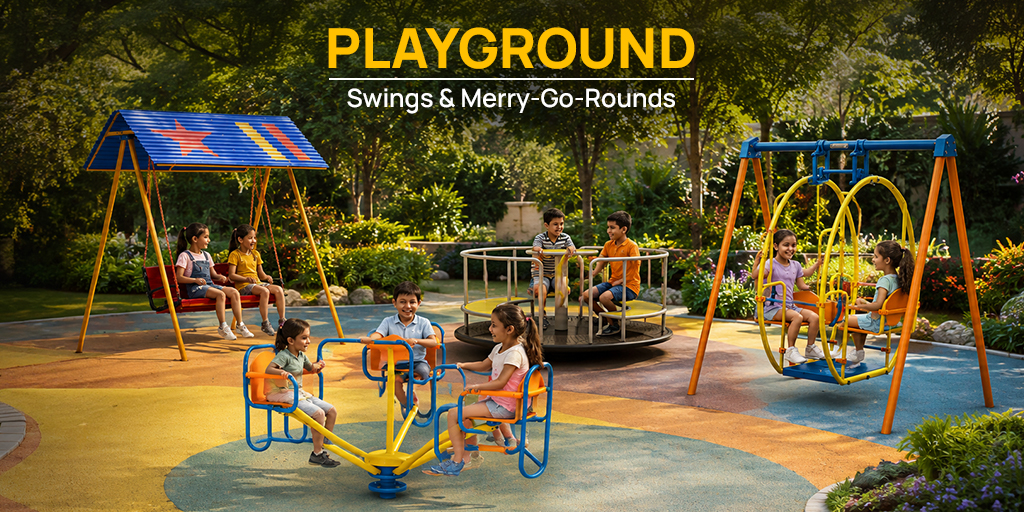
Playground Swings & Merry-Go-Rounds: A Buyer's Guide
Every successful public space contains an invisible magnet: the pure, mechanical joy of the playground swing and the merry-go-round.
Modern park design often chases complex aesthetic trends. Yet, these two classic pieces of playground equipment remain unmatched in their universal appeal.
For generations, they have succeeded because they fulfill a fundamental human need for vestibular movement. Far from being space fillers, they actively draw communities together, creating active social hubs where children learn cooperation and adults experience a rare moment of nostalgic freedom.
For a planner, integrating these kinetic anchors is the most reliable way to transform a passive green space into a vibrant, high-traffic community asset. As you map out your next community project, give preference to these timeless kinetic structures to ensure your play area delivers immediate engagement. Here's a comprehensive guide to all that you need to look out for before you plan installations.
Playground Swings: Key Considerations
Balancing safety, compliance, and functionality makes installing playground swings a tough task. Before deciding which one to install, buyers and planners need to know which one suits their site and meets their needs. They can generally choose from these commercial swing formats to suit different age groups and site capacities:
Types of Playground Swing Sets
Toddler swings:
These use enclosed, high-back bucket seats. They are designed for children who are too young to safely grip a standard swing seat. They are engineered to minimize fall risks.
Standard belt swings:
Featuring flat, flexible seats, these are best suited to children aged five and above. They are designed to balance comfort with freedom of movement.
Multi-bay swing sets:
Built with two or more swing bays on a single frame, they maximize simultaneous play. This design keeps the play space compact. The design is best suited for high-traffic playgrounds.
Accessible/inclusive swings:
With supportive seat designs, these swings allow children with mobility differences to play safely alongside peers. Factoring these options into your park design promotes inclusive play.
Once buyers are familiar with the categories, the next step is to examine the technical details that determine long-term performance.
Key Checks Before Buying Playground Swings
Frame Material and Coating:
Look for hot-dip galvanized steel finished with a UV-stable powder coating. This combination protects the investment against rust and fading far better than standard painted steel.
Chain and Seat Hardware:
For safety, use coated chains to eliminate pinch injuries. For durability, pair chains with impact-resistant, UV-stabilized seats instead of rigid plastic or wood that cracks quickly, often needing early replacement.
Fall Zone and Surfacing:
Swings require a wide safety zone due to their motion. For user well-being, park planners should install certified safety surfacing that extends well past the equipment structure.
Bay Spacing:
If your project has multi-bay playground swing sets, ensure there is adequate room between adjacent sections. Good spacing keeps the play area orderly and prevents accidental collisions.
Ground Anchoring:
Swing frames endure heavy physical stress. To ensure long-term stability and liability protection, anchor the frame into a poured concrete foundation.
Arihant PLAY's swing range is designed for high-footfall use in schools, parks, and residential projects and is available in toddler, standard, and multi-bay configurations.
Why Merry-Go-Round Playground Equipment Is So Popular
Merry-go-round playground equipment delivers a play experience built on rotational motion. However, unlike swings that move in a predictable line, this spinning movement offers a shared thrill that children rarely find elsewhere. For you as a planner, this high engagement serves a vital physical and structural purpose. They remain popular for several reasons.
Why Merry-Go-Rounds Remain Popular
High-capacity group play:
Most designs accommodate multiple children at once. This makes them efficient and an ideal choice for high-footfall parks and schools.
Rotational balance development:
Spinning motion helps build balance, spatial awareness, and core stability in ways static equipment cannot.
Compact footprint relative to capacity:
A single unit serves more children per square foot than most other equipment types, maximizing space efficiency.
What to Check Before Buying Merry-Go-Rounds
While merry-go-round playground equipment is a popular choice for busy play areas, you do have to keep certain things in mind before making a purchase.
Bearing and Rotation Mechanism:
The central bearing governs how smoothly the merry-go-round rotates and directly influences the frequency and cost of maintenance. It is therefore better to choose a sealed system. Doing this protects your budget from high upkeep costs and ensures long-term reliability.
Platform material and grip surface:
Platforms should feature a textured, slip-resistant surface. These surfaces maintain safety in outdoor settings. This is especially important for surfaces exposed to rain and moisture.
Handhold Design:
Safe equipment requires secure, well-spaced handholds around the platform edge. These handrails give children a firm grip, protecting users from slipping when the equipment spins at higher speeds.
Speed Limiting Design:
High-quality systems include built-in speed governors. These mechanical brakes prevent excessive rotation. This lowers risk and ensures safe operation during play hours.
Arihant PLAY's merry-go-round range is built for durability and safety. The range is best suited to parks, schools, and residential common areas.
Pairing Swings and Merry-Go-Rounds with a Multi-Activity System
Swings and merry-go-rounds are almost always installed as standalone equipment around the perimeter of a playground. But when these playground spinners are installed to complement a central multi-activity play system, they help spread out activity. Children can climb and slide on the central structure. Meanwhile, others can swing or spin on the perimeter equipment. This layout reduces congestion because children do not have to compete for the same structure.
Conclusion
Playground swings and merry-go-rounds remain two of the most popular categories of outdoor play equipment. Ensuring material quality, safety hardware, and proper spacing guarantees years of reliable use, avoiding early replacement.
To know more about planning a complete playground, see our pillar guide to children's play equipment and multi-activity play systems, or explore Arihant PLAY's full product range to start planning your project.
FAQ's
1. How much space does a swing set need?
In playground design, swing sets require one of the largest fall zones. Plan for clear, surfaced space that extends well beyond the swing's resting position on both sides, along with side clearance between multiple bays.
2. Are merry-go-rounds safe for younger children?
Yes, provided they include speed-limiting design and secure handholds. Many models are suitable across age ranges, though very young toddlers are better matched to slower rotational equipment or supervised use.
3. What's the difference between a swing set and playground swing sets (multi-bay)?
A swing set typically refers to a single-frame unit with one or two seats. Playground swing sets cover multi-bay configurations that combine several swing types on one frame, maximizing simultaneous play in schools and parks.
4. How often do playground swings need maintenance?
Inspect chains, seat hardware, and bearing points regularly at least quarterly for high-footfall sites. Safety surfacing should also be checked and topped up as needed to maintain proper depth and impact protection.