



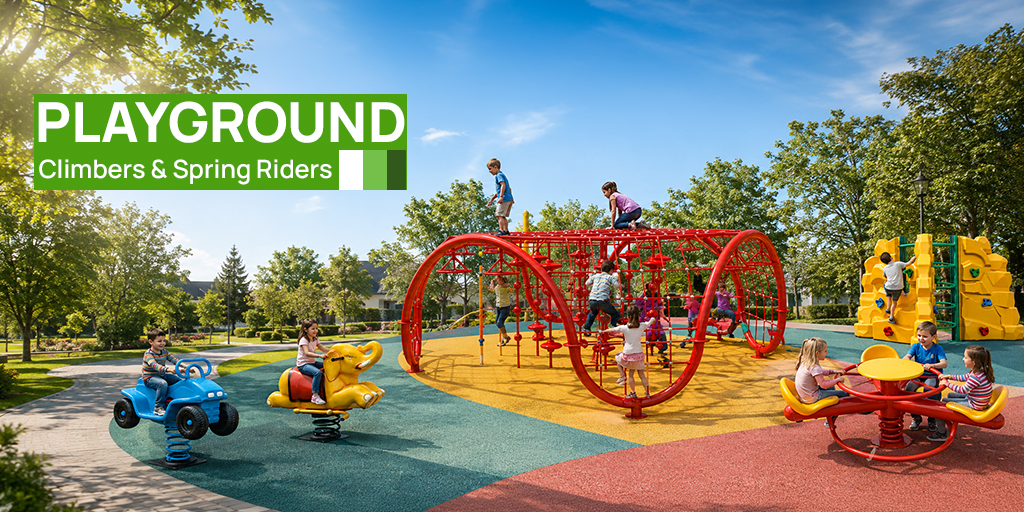
A Complete Buying Guide to Playground Climbers and Spring Riders
A common problem plagues most play parks and recreational spots in India: restless children queue up at the slides while the swings are perpetually occupied, yet the rest of the children's play equipment often sits less crowded or completely empty.
For planners or stakeholders, this is not a good sight. When they invest in a play area, they want every square metre to serve a purpose instead of sitting idle. So, what then is the solution to this commonly faced problem? Well, the answer lies in the optimal use of climbers and spring riders.
Selecting them is probably the best way to go for optimal space usage. But you need to remember that not all spaces are the same, so installing this type of kids' play area equipment doesn't guarantee it's the right fit for every project. Besides, picking the wrong equipment can affect safety, play value, and long-term maintenance. That's why park planners and owners need to get the selection of climbing structures and spring riders absolutely correct.
Whether you need safe, age-appropriate equipment or a long-lasting, well-fitted layout, this guide covers everything about playground climbers and spring riders.
Why Climbing Playground Equipment Matters
Think of a climber as the centerpiece of a playground layout. If the shape is wrong, the whole park falls flat. Planners have to watch out here because different shapes appeal to completely different age groups. Pick the wrong style, and that expensive equipment just sits ignored by the kids. While land dimensions and budgets set the boundaries, matching the right climber to the right age group keeps the whole space busy and fun. These are the four main climber styles seen on playgrounds today:
- Step and Pod Climbers: These are low, staggered blocks that focus on simple balance. They look clean and sit close to the ground, making them perfect for toddlers who are still figuring out how to walk steadily.
- Geodesic Domes: These are the classic, interlocking metal grids that give a playground a striking geometric look. They challenge hand-eye coordination for a wide mix of ages, making them a great anchor piece for a busy park.
- Net and Rope Climbers: These look like giant spiderwebs made of thick, steel-core rope. Because they sway and shift when kids climb them, they require a lot of core strength and draw in the older, braver kids.
- Overhead Monkey Bars: The traditional, hand-over-hand bars that take serious upper-body strength to cross. They are still a huge hit for older kids, as long as planners keep them far away from the toddler area.
Many climbing equipment installations integrate directly into extensive multi-activity play systems. Instead of functioning as standalone pieces, these features provide climbing challenges as elements within connected structures.
Important Checks Before Buying Playground Climbers
Think of these checks as the practical guidelines that keep a play area running smoothly. If you ignore them, you end up with equipment that is either unsafe or completely ignored. Planners need to focus on a few basic choices to make sure the equipment handles the weather and the kids safely.
- Fall Height and Flooring: Taller climbers mean bigger falls, so they need thicker rubber flooring underneath. This protective surface has to spread out all around the climber's drop zone, rather than just sitting right under the frame.
- Grips and Bar Spacing: Bars, nets, and handholds have to match the size of the kids' hands and feet. Getting the spacing right stops kids from getting their heads or limbs trapped and helps them grip the bars easily.
- The Right Metals: Outdoor play equipment takes a beating from the weather. Choosing frames made from hot-dip galvanized steel paired with fade-resistant plastics ensures the playground survives heavy monsoon rains and hot summer sun.
- Fun for Different Ages: A single climbing wall rarely works for both a two-year-old and a ten-year-old at the same time. It is usually best to find a manufacturer who can build separate play zones or layer different difficulty levels into the same space.
Playground Spring Riders: Small Footprint, High Play Value
A spring rider for playground layouts saves valuable space and fits tight budgets. These bouncing seats shaped as horses, cars, or colorful animals sit on heavy-duty steel springs at ground level. Because they stay low, they suit toddlers who are too small for big climbing towers.
Why a Spring Rider for Playground Layouts Remains a Staple
- Space-Saving Design: A spring rider for playground installations fits tight spots easily. For example, a single horse-shaped rider tucks neatly into a corner beside a sidewalk or fills a narrow school courtyard.
- Low Cost, High Value: Playground spring riders offer a cheap way to add fun. Buying three separate animal riders costs much less than a large jungle gym, but the units still keep children busy for hours.
- Sensory and Balance Development: The rocking motion teaches physical control. When a toddler rocks a plastic car back and forth, the movement builds leg strength, improves balance, and sharpens physical coordination.
- Social and Solo Play: These units adapt to changing crowd sizes. A child can ride a lone dinosaur seat quietly alone, or planners can cluster three riders together so friends can race each other.
Choosing the Right Spring Rider for Playground Use
- Single Versus Multi-Seat Models: Seating choices alter how children interact. A toddler rides a lone puppy seat quietly, finding their own rhythm, while a multi-seat fire truck forces three kids to negotiate, push, and laugh together at once.
- Spring Quality: Heavy steel mechanisms handle intense energy. High-quality coils withstand years of violent slamming and baking summer heat without losing their stiffness, ensuring the unit never sags to one side or pinches tiny fingers.
- Seat and Handle Design: Proportions matter to a child. Low, wide seats and textured plastic handles let two-year-olds climb up without help, providing the firm grip they need to feel completely secure during wild rocking movements.
- Anchoring and Stability: Hidden foundations create real safety. Pouring thick concrete deep underground locks playground spring riders firmly into the earth, preventing the metal base from loosening or tilting when older kids test its limits.
Planners and park stakeholders can explore Arihant PLAY's range of climbers and spring riders. These playground equipment pieces are engineered and manufactured in-house for schools, parks, and residential projects.
Climbing playground equipment and spring riders serve very different age groups and play styles, but both deliver outsized play value relative to their footprint. For an in-depth look at how these fit into a complete playground plan, read the guide to children's play equipment and multi-activity play systems. You could also browse through Arihant PLAY's full product range to better plan your next project.
FAQs
1. What is the recommended age limit for climbing playground equipment?
Suitability depends entirely on the specific structure. Low arch and dome climbers fit toddlers aged two through five, while taller net and combination climbers target children aged five through twelve.
2. Is a spring rider safe for toddlers?
Yes, a spring rider is safe for toddlers. These units feature low seating heights and secure handholds that are specifically designed for younger children. For complete safety, you must anchor the base firmly into concrete and install thick, impact-absorbing safety surfacing underneath to protect against accidental falls.
3. How much space does a playground spring rider need?
A single spring rider requires only a compact footprint plus its surrounding fall zone. Consequently, it represents one of the most space-efficient playground equipment options available.
4. Can climbers be combined with other play equipment?
Climbing elements frequently integrate directly into multi-activity play systems alongside slides and activity panels. Alternatively, facilities install them as standalone structures based on spatial constraints.