



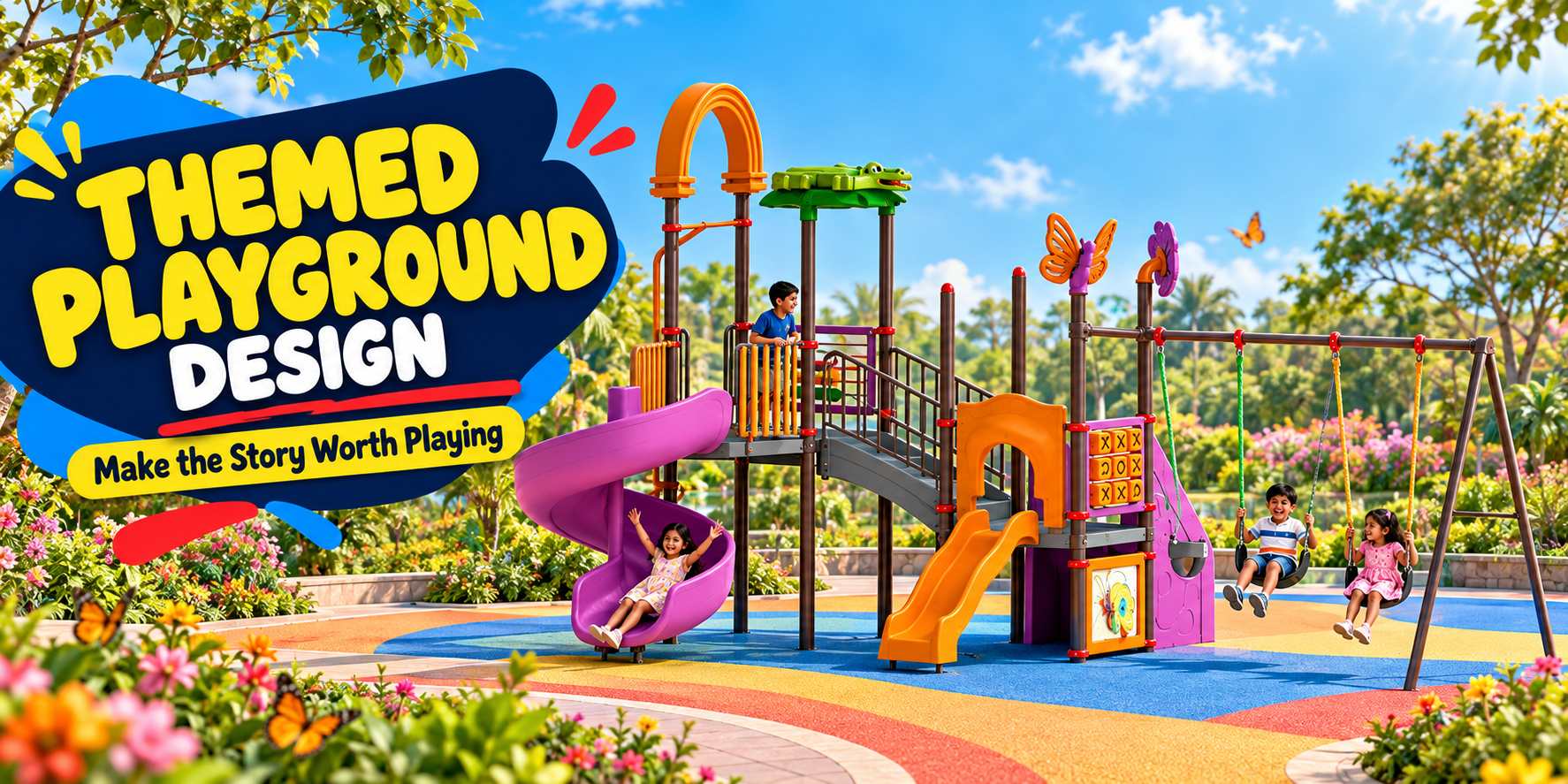
Themed Playground Design: Make the Story Worth Playing
Imagine two playgrounds described as “space themed.” In one, a standard slide has rockets printed on its panels. In the other, children choose a route to a launch platform, operate a ground-level control station, cross a make-believe meteor field and invent the mission together. Both have a theme. Only one uses it to shape what children can do.
That distinction matters to an architect, school, developer or resort planning a custom themed playground. A memorable visual can attract families, but the investment must also work as an age-appropriate, accessible and maintainable play environment. The strongest brief connects the story, equipment and site.
UNICEF India describes play as an opportunity to imagine, explore and develop social and other skills. A theme can invite those opportunities, provided children have room to invent stories of their own.
Start with actions rather than artwork
Before choosing a jungle, castle or ocean look, ask what children will do. Explore? Navigate? Make up a community? Solve a problem together? These verbs reveal the play value behind the aesthetic.
A “forest expedition” could offer route choices, a quiet observation spot and a shared gathering place. A “city makers” setting could support ground-level pretend shops and cooperative games. Neither needs printed graphics on every surface. If the concept stops working when its artwork is removed, the play experience may need more thought.
Write a one-page brief covering intended ages, three or four play actions, atmosphere, site constraints and an opening-day budget. Keep the premise simple enough for a child to recognise and open enough for children to change. A school may draw on local ecology; a residential community may want a story that ages well; a resort may need a landmark families can find easily.
Give that brief to both the landscape designer and the playground manufacturer. A theme chosen after the equipment order may be reduced to signs and paint. Discussing the idea early allows the route, seating, shade and equipment to contribute to the same experience. Ask what a child could do there on a second or tenth visit.
Decide what actually needs to be custom
Customization comes in degrees. Buyers might select colours and signs, combine standard outdoor playground equipment into a site-specific layout, commission decorative features or develop a new engineered structure. Each step changes design time, technical review, price and maintenance.
Never assume that a catalogue unit can be stretched, raised or fitted with a bridge without reassessment. A change to a platform, opening, connection or slide exit can alter loads, fall height, clearances and supporting safety evidence. Ask the playground equipment manufacturer which choices are standard options, which need engineering and which are unavailable.
List requested changes beside exact product codes and drawing revisions. If a custom element is declined for technical reasons, the team can find another way to express the story without asking installers to improvise on site. Written boundaries also protect the original product's documented performance.
Arihant Play lists multi-activity systems, climbers, slides and other categories. Its FAQ page refers to a design team using 3D tools. The selected model's current drawing and written proposal should establish exactly what customization is offered for your project.
Give the story a route across the site
Themes are often judged from a perspective rendering. Test them in plan view. Where does a child enter? What attracts them first? Where does a fast activity end? Can two groups play without queuing in the same narrow area? Is there space to stop and watch?
A landmark can draw people in, a route can offer discovery, and a shared destination can support group games. Yet the plan still needs equipment footprints, use zones, gates, accessible routes and supervision points. A dramatic gateway cannot narrow a needed path; a decorative rock cannot occupy a fall area.
The U.S. CPSC Public Playground Safety Handbook addresses age suitability, use zones, surfaces and equipment hazards. It is a design reference, not automatic approval for an Indian project. Coordinate the landscape, civil work and equipment on one drawing before fixing scenic details.
Give every child a way into the narrative
If the only “ship deck” begins above a ladder, some children will watch from below. A stronger scheme offers meaningful roles and activities at different levels. A ground-level control station, shared game or reachable sensory feature lets more children help create the story.
The U.S. Access Board play-area guide explains why accessible routes and varied ground-level play matter. Its legal framework is American; check the Indian project's requirements separately. Speak with carers and intended users where practical. A rendering can look inclusive while leaving little to do for someone who cannot reach its centrepiece.
Variety also means allowing quieter play. Not every child wants noise, height or constant movement. A nook for observation or storytelling can belong to the same theme as an energetic climb.
Use a restrained visual language
A recognisable silhouette, coherent palette and a few deliberate details often carry a story further than graphics on every panel. Distinguish features children will actually touch from those chiefly seen by adults at a distance. Decorative elements should not create confusing handholds, sharp projections or difficult cleaning pockets.
Use text sparingly. A school crest or local motif might work best on an entrance sign; it need not be repeated on every climbing surface. For cultural themes, involve people with knowledge of the place or tradition so the result has meaning beyond a generic costume graphic.
Agree on finish samples when colour matters. Outdoor materials face sun, rain, cleaning and daily contact. Record approved artwork and colours in the contract so damaged pieces can be matched later.
Try a simple design review with children before fabrication. Show them a plan or model without explaining every symbol. Listen to the games they imagine and where they expect to climb or gather. Their interpretations are useful: a theme should be understandable, but it need not control the story.
Let the surface support the story safely
Steel, polymer, rope and timber can create very different feelings, but a themed appearance cannot replace engineering. Ask about structural performance, weather exposure, grip, inspectability and replacement parts. A rustic-looking bridge still needs sound connections and a service plan.
The ground can extend a story through colours, pathways and markings. Its first jobs are safe movement and appropriate impact protection. Specify protective surfacing for the chosen equipment and fall heights. Decorative turf or ordinary paving is not a universal substitute. Arihant Play offers a rubber flooring category; the actual system, base and installation should be specified for the site.
Draw the edges as carefully as the centre. Can soil wash over a route? Will a raised themed planter obstruct a use zone? Where does rainwater go? These small details decide whether a playground remains pleasant after the first monsoon.
Budget for the complete experience
Custom fabrication is only one cost. Include concept work, drawings, foundations, surfacing, drainage, shade, delivery, installation, inspection, replacement graphics and long-term care. Request separate prices for the core playable elements and optional scenic details. If the budget changes, the play value should survive.
Test each extra feature: does it add a choice, improve access or comfort, clarify the story, or simplify operations? If none applies, it may be decoration better spent elsewhere. A modest, coherent theme often feels more complete than an expensive assortment of unrelated motifs.
Plan for time as well as money. Unique panels may take longer to replace. A complex sculpture may be harder to clean. If the project will grow in phases, reserve future space now and obtain engineering approval before altering the installed product.
Approve a review package, not a render
Before fabrication, ask for a concept statement, scaled plan, product schedule, intended ages, use zones, platform and fall heights, surface plan, material samples, accessibility approach, installation scope and maintenance guidance. A specially engineered feature should come with the technical assessment relevant to that variation.
Include the eventual operator in the review. Can staff see across the structure, reach enclosed areas for inspection and replace a damaged decorative piece? Does the theme remain enjoyable when many children play differently from the way shown in the rendering?
The purpose of custom themed playground design is to create a place children remember because they played there. Begin with their actions, resolve the technical plan, and let the visual identity strengthen both.
Explore Arihant Play's product range or share your project brief for a site-specific discussion.
FAQs
1. What parts of a themed playground can be customized?
Possible choices include layout, equipment selection, colour, graphics, signs, landscape, surface markings and, where technically supported, particular components. The critical distinction is between selecting an established option and changing an engineered play structure. A new panel colour may be straightforward on one product; a changed platform or extra bridge may need fresh structural review and assessment.
Start with ages, the actions children should be able to perform, site dimensions and the visual story. Ask an outdoor playground equipment manufacturer to classify each request as standard, configurable, specially engineered or unavailable. Get drawings showing the product footprint, required clearances and accessible routes alongside the proposed finish.
Arihant Play lists a broad equipment range, and its FAQ describes a design capability. Those pages do not promise that every model can take every alteration. Obtain written confirmation of the chosen model's specifications, approval process, lead time, warranty and replacement-part implications. The best customization changes something children can experience; visual identity also has value when it is thoughtfully integrated and maintainable.
A useful sign-off question: Which choices remain after the artwork is removed? If the answer is “none,” reconsider the component mix before approving the visuals.
2. How do I choose a theme that children will not outgrow?
Choose a premise with many possible stories rather than a script with one correct role for each child. “Exploration” can become a journey, rescue, expedition or entirely new game. A playground tied closely to a short-lived character trend may feel old before the equipment wears out.
Test the concept with different ages. Younger children may enjoy recognisable forms and pretend play, while older children often value routes, physical challenge and social space. Ask whether a child could use the same structure for different games on different visits. If so, the theme supports repeat play.
Keep durable structures broadly useful and place details likely to date on replaceable signs or panels. The colour palette and landscape can give a place identity without dictating every story. UNICEF India's discussion of play supports the value of imagination and interaction; it does not prescribe a particular motif. Show children the concept and ask what they would do there. Their answers can reveal more than an adult vote on which picture looks best.
Try the idea with both younger and older children. Ask them to describe what happens next in their game; repeatable answers matter more than initial excitement.
3. How much does a custom themed playground cost?
There is no useful fixed price or premium without a site and scope. Selecting colours for a standard product differs from commissioning a new engineered form. Site preparation, protective surfacing, drainage, foundations, transport, shade and installation also affect the complete cost.
Ask for an itemised quotation separating core play equipment, custom design or artwork, ground works, surface and installation. Request a second option that keeps the main play actions while reducing scenic extras. That shows whether additional spending creates better play, stronger identity or simply more decoration.
Compare lifecycle costs as well. Unique replacement parts may have longer lead times, and specialist finishes may need particular cleaning or repair. Clarify the warranty, inspection plan and availability of matching components. Give each playground equipment supplier the same surveyed site and design brief so bids can be compared fairly. A memorable scheme does not require every piece to be newly fabricated; standard units arranged well with selected custom features can produce a coherent place.
Include a contingency for unforeseen ground conditions. An itemised allowance makes it easier to protect critical surfacing and play functions if the site needs extra work.
4. How long does a themed playground take to design and install?
The schedule depends on the degree of customization, design reviews, production, site readiness and installation conditions. A palette change on an existing model is different from a new sculptural component requiring engineering, prototypes or testing. Civil work and surface preparation may govern the programme even after equipment is manufactured.
Ask for dated stages: survey, concept approval, coordinated drawings, finish sign-off, fabrication, site work, installation, inspection and handover. State who can approve each stage. A late change to a platform or site layout can affect foundations and protective surface; a late change to a sign usually has a different impact.
Schools should coordinate work with breaks and safe segregation from children. Resorts and residential developments should align equipment installation with landscaping and paving so completed areas are not reopened. Confirm the lead time for bespoke and replacement parts in writing. Do not set an opening date solely from a conceptual rendering; use the supplier's agreed programme and the site's construction sequence.
Ask for one named decision-maker on the client side. Faster, consistent approvals often save more time than rushing the manufacturing stage.
5. Can a custom theme work in a small courtyard?
Yes, if the required play and circulation areas fit the actual courtyard. A coherent theme can live in one compact unit, a ground-level activity and a thoughtful ground pattern. Filling the site with products often weakens both play and safety.
Measure walls, gates, drains, columns, trees and routes that must remain clear. Ask for the selected model's product dimensions and full safe play area. A slide exit or moving swing can need considerably more room than its frame suggests. Trace where children queue and where adults watch. If the theme leaves no room for movement, simplify the equipment rather than reducing necessary clearances.
A name, recognisable silhouette or single landmark may carry the story without bulky props. The CPSC handbook explains general use-zone and surfacing principles; follow the applicable local project requirements and selected manufacturer's drawing for final approval. Insist on a scaled plan as well as a perspective view. In a small site, one clear playable idea is more useful than ten decorative references.
Check sunlight and rain as well as dimensions. A perfect fit on paper can still be unpleasant to use if the only waiting space is exposed or prone to ponding.
6. How can a themed playground include children with different abilities?
Give children multiple meaningful ways into the story. If all the important action takes place above a ladder, a ground-level observer has no role. Shared games, reachable controls, sensory elements and social spaces can make a child part of the narrative without requiring everyone to take the same route.
Connect activities with suitable surfaces and circulation. Put ground-level experiences among the main play features rather than in a separate token corner. Consider children who seek energetic movement and those who prefer quieter exploration. Keep carers nearby without blocking routes or exits.
The U.S. Access Board play-area guide explains accessible routes and ground-level components. Its legal requirements concern the U.S.; check the local Indian project's rules separately. Seek input from intended users and carers before fixing the plan. Inclusion is not achieved by a ramp alone if its destination offers no real play. The concept should give different children choices and ways to play together.
Check how users reach the activity during ordinary busy periods. A theoretically accessible route that becomes blocked by a queue will not support shared play.
7. Are themed playgrounds as safe and durable as standard equipment?
They can be, provided the exact completed structure is designed, installed and maintained appropriately. A decorative shape does not excuse a sharp edge, trapping hazard, obstructed use zone or inadequate surface. A standard product also needs to be selected for the right ages and site conditions.
Request the proposed age range, product and use-zone dimensions, fall heights, material and structural information, surfacing requirements, installation guidance and evidence relevant to the specified standards. Clarify whether a custom attachment changes load, openings, handholds or the original product's documented performance. Treat substantial changes as engineering matters rather than artwork.
The CPSC Public Playground Safety Handbook is useful for reviewing layout and common hazards but is not a certificate for any Indian installation. Durability also depends on weather-appropriate finishes, inspection access and obtainable replacement parts. Ask how unique components will be repaired after years of use. A beautiful playground that cannot be maintained promptly loses play time and trust.
Assess each unusual detail after installation, not just in the factory. Site levels and adjacent objects can create new conditions that were absent from the component drawing.
8. Should a theme be educational, cultural or imaginative?
Any of these can work if the environment still invites child-led play. An educational idea may prompt counting or observation without turning the playground into a worksheet. A cultural idea can connect a place to its community when people who know that heritage help develop it. A fantasy story can leave children free to invent characters and rules.
Choose according to audience and setting. Teachers can describe what becomes a game rather than a lesson label. Public parks should be understandable across different languages and backgrounds. Resort themes can relate to their location without requiring visitors to know the brand's history.
Do not make text the only way to participate. A route, shared prop or recognisable shape can communicate across reading abilities. UNICEF India's play resource explains why imagination and interaction matter; it does not say one theme is developmentally superior. A strong motif gives children a starting point, and children supply the story.
For a public setting, involve community representatives early. Their response can reveal whether a cultural symbol is welcoming or needs a more thoughtful treatment.
9. What should I request before approving a manufacturer's custom design?
Request a package that ties the concept to a buildable site: scaled layout, exact products, ages, footprint and use zones, platform and fall heights, access and surfacing plans, materials, colours, artwork, anchoring, installation scope and maintenance instructions. If a component is specially engineered, ask how the supplier assessed that variation.
Clarify the commercial details: design revisions, artwork ownership, approvals, production lead time, civil works, transport, warranty and replacement of unique parts. Ask who coordinates shade, drainage, planting and the handover inspection. These items are easily overlooked when reviewing a headline equipment price.
Include the operator in approval. Can staff clean behind scenic panels and see children throughout the site? Can a worn graphic be replaced? Arihant Play's FAQ refers to its design team, and its product range offers a starting point, but only the site-specific proposal can answer these questions. Approve drawings and specifications alongside the render, so the visual promise matches what will be built.
Compare the final installed scope with the approved drawing at handover. Document any substitutions and ask the designer to assess their effect on the complete play environment.
10. Can a themed playground be expanded or refreshed later?
Sometimes, but do not assume “modular” means every installed model can be moved or extended. A replaceable sign may be simple to refresh; an extra bridge or slide can change structural loads, fall height, use zones and surfacing. Even a separate new unit needs space and coordinated circulation.
If future phases are likely, reserve an expansion area and plan the ultimate paths, drainage and utilities from the outset. Keep the original colour references, artwork files and product drawings. Ask the supplier what extensions are permitted for the exact model and whether replacement parts will be available.
An open-ended story can accept a new chapter without making the original structure seem incomplete. Budget for inspections and renewal of finishes; treat later engineering changes as new work requiring technical review. The most resilient themed playground has a strong core play experience and decorative details that can be cared for or updated without rebuilding everything.