



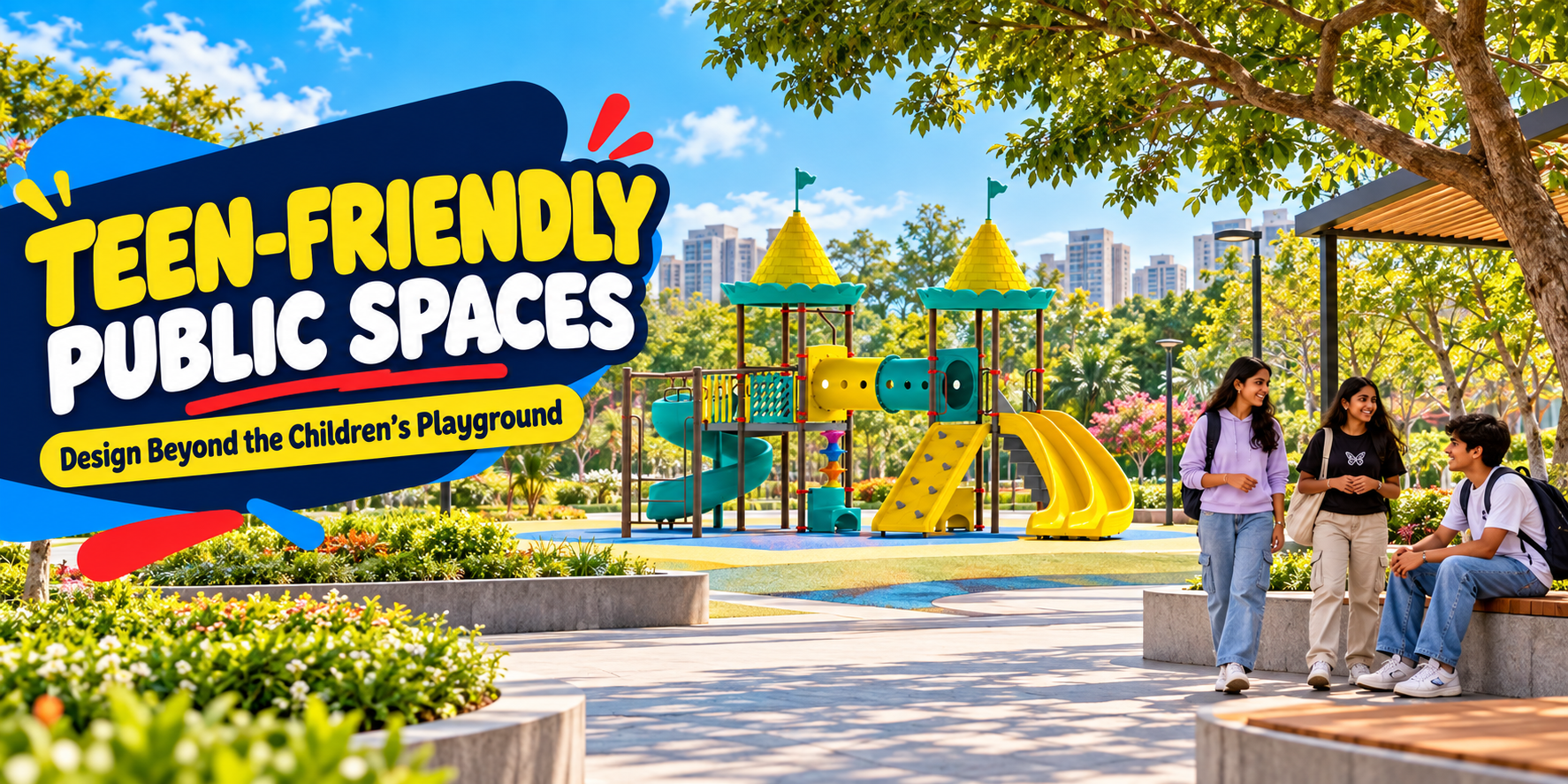
Teen-Friendly Public Spaces in India: Design Beyond the Children’s Playground
Where does a teenager go after the playground?
A child can spend an hour on a slide and climbing frame. Years later, the same person may want to meet friends, shoot a basket, practise a new physical skill or simply sit somewhere outside home. Yet many residential plans still show one play area and assume it will meet every age group’s needs.
Designing for teenagers begins by acknowledging that being outdoors together is a legitimate use of a park. A group talking on a bench is using the space. A young person watching a game before joining is also participating. The design should make these activities comfortable while giving active users suitable challenges.
UNICEF and UN-Habitat’s child-responsive urban guidance calls for children’s needs and voices to shape urban decisions. For a housing society, school campus or public park, the practical step is to ask adolescents what they actually do outside, then test those answers against the site, budget and safety requirements.
Arihant Play supplies play equipment, outdoor fitness products and sports surfaces. These categories can inform a wider amenity plan, but none of them is a substitute for a teenage user brief.
Begin with an evening, not a catalogue
Visit the proposed site when teenagers are likely to be there: after school, on weekends and near dusk. Where do they meet? Which paths do they take? Do they wait beside a court because there is no place to sit? Are girls, younger teens or disabled young people absent? Absence is a prompt to ask questions, not proof of a single cause.
Speak to different groups separately when that helps people answer honestly. Ask what activities they want, which places feel awkward, and how much distance from adults they prefer while still feeling secure. UNICEF’s adolescent participation guidance advises consulting young people about activities that interest them and giving them room to take the lead.
Record practical findings: preferred hours, group sizes, routes, seating needs, sports demand, quiet activities and points of conflict with younger children. Note the limits of your sample. One school council or one boys’ sports team cannot speak for every teenager in the neighbourhood.
Give the site more than one reason to visit
A full-size sports court is useful where demand, area and management support it. It is not a complete teen space on its own. Some adolescents want an informal kicking area, some want a demanding climb, others want a bench where conversation is possible without standing in a path. Several modest options can serve a wider mix than one dominant activity.
Think in linked zones: a place to gather, an active area, a quieter edge and a route through the site. Locate seating near activity so friends can watch and join, while leaving enough room for people who do not want to perform in front of an audience. Provide choices between sun and shade when possible. Position drinking water and toilets where the wider site can support them.
The WHO physical activity guidance recommends an average of at least 60 minutes per day of moderate to vigorous activity for children and adolescents aged 5–17. A public space can offer opportunities for activity; it cannot guarantee that a particular teenager meets that recommendation. Social comfort is part of whether the opportunity is used.
Design age-appropriate challenge
Teenagers may want more complex movement than a young child’s climbing unit offers. That can mean a suitable climbing challenge, a multi-use sports surface, a walking or jogging route or a carefully specified fitness station. The exact choice depends on site conditions and the manufacturer’s stated age and height range.
Arihant Play’s product catalogue includes equipment tagged for different ages as well as outdoor fitness and surfacing. Ask for the current datasheet of each proposed model. A label such as “13+” on one product does not apply to the whole range. Outdoor fitness equipment may have a different intended user group and safety framework from children’s play equipment.
An engaging challenge still needs a technically sound installation: appropriate foundations, fall protection, movement clearances, suitable surfacing and inspection. Avoid placing a high-energy activity beside a toddler entrance or a busy pedestrian shortcut. If the site cannot fit the safe operating area, reduce the number of units instead of squeezing them together.
Make room for teenagers who do not play sport
A park designed only around a court may leave many users on its edge. Provide small groups of seats that face each other or an activity, a quiet place to talk, and a table or usable flat surface where appropriate. The design can welcome art, reading, board games or informal performances without forcing a programme on every visit.
Check who feels entitled to use each zone. If one group repeatedly occupies the only shaded seating, others may have nowhere to go. Offer several visible places to gather, ideally with varied sizes and degrees of openness. Consult girls, disabled adolescents and younger teens directly; their priorities should shape the layout rather than be guessed from a generic “youth” label.
Accessibility is a journey across the site. Can a teenager with a mobility aid travel from the entrance to friends, to an interesting activity and back without a dead end? Is the ground firm, drained and passable? Can companions sit together? A technically reachable gate is a small part of genuine participation.
Balance independence with sensible oversight
Teenagers need room to socialise without being treated as a problem to remove. They also need a site they can reach and leave safely. Put entrances on useful pedestrian routes and make the main areas visible from normal activity around the park. Avoid blind corners that isolate a seated group. Lighting for permitted evening use should cover paths and gathering areas, with maintenance arrangements for failed lamps.
Do not assume more surveillance fixes every concern. A site that exposes every seat to constant scrutiny may discourage the very people it is meant to welcome. Plan sightlines and management with local young people and caregivers. Agree on hours, noise and shared-use expectations that can be explained fairly to all users.
For public parks, coordinate the design with local authorities. For a housing society, document who responds to a broken light, damaged surface or conflict over the court. Rules can manage genuine impacts, but blanket bans on teenagers gathering undermine the purpose of providing the space.
Respect the boundary between play and fitness equipment
There is no single standard that covers every activity in a mixed-age park. Children’s playground equipment and unsupervised outdoor fitness equipment are different categories. The CPSC Public Playground Safety Handbook is a reference for play area hazards. EN 16630 describes permanently installed, freely accessible outdoor fitness equipment and expressly distinguishes it from children’s playground equipment. These sources are design references, not an automatic statement of Indian legal compliance.
Before procurement, ask the manufacturer which standards and age restrictions apply to each exact model, what evidence supports any claimed conformity and how the proposed surface and layout match the equipment. Check access points, moving components, entrapment risks, anchors and maintenance schedules. An adult training station should not be marketed to younger teenagers simply because it is outdoors.
A park can still connect generations: a family might move between a children’s playground, walking loop, seating and teen activity area. Thoughtful adjacency lets people share the destination without blending incompatible movement zones.
Plan a budget that includes care
A teenage space is an ongoing amenity. Budget for surface repairs, sports-line refreshes, replacement fixtures, equipment inspections, litter collection, lighting and landscaping. Request spare-parts details and realistic response times from any playground equipment manufacturer or installer. A broken item left in place tells users the space is no longer cared for.
Compare quotations with a common brief. Include the intended age group, required activities, site plan, civil work, equipment, surfacing, accessibility, drainage, lighting and handover documents. A less expensive package that omits critical groundwork or maintenance support is difficult to compare with a complete proposal.
Make the space adaptable. A reversible court marking, flexible open patch or seating that supports several uses may help the site respond as the resident population changes. Adaptability must be designed around drainage, anchors and safe use, not improvised after installation.
Ask young people what worked after opening
Watch the area at different times after the initial novelty has passed. Are there several groups using it? Can newcomers join? Do girls feel comfortable staying? Does the seating work in the heat? Are queues spilling into paths? Ask users about these specifics rather than a broad “Do you like the park?”
Keep a short record of changes and why they were made. A better light or shaded seat might improve use more than another machine. A recurring conflict between active play and a walkway may call for a revised route. Follow up after each intervention to see whether it helped.
For Arihant Play clients, the strongest request is a site-specific brief that includes teenagers explicitly: who will use the place, how they want to spend time, which equipment is appropriate and who maintains it. A teen-friendly park gives young people a reason to come, a choice of things to do and a place to belong as the neighbourhood grows with them.
Frequently asked questions
1. What makes a public space teen-friendly?
A teen-friendly public space offers a genuine choice of activities and a comfortable place to spend time with peers. It may combine a sports or movement area with grouped seating, shade, accessible routes and a quieter edge. Young people should be able to arrive, join friends, watch a game and leave without crossing unsafe equipment zones or feeling that merely gathering is forbidden.
The details depend on the users and location. In one society, a small multi-use court and shaded seating might be enough. In another, young people may ask for a demanding climbing challenge, a walking loop or space for informal performances. Consult teenagers across ages and abilities before choosing products; a single activity can dominate the site and exclude others.
The design also needs management. Agree on opening hours, lighting, maintenance and reasonable rules for shared use. Check the actual intended age range of each play or fitness product and allow its required operating space. A teen-friendly label on a plan does not make an adult fitness machine suitable for all teenagers.
Arihant Play’s catalogue can help teams explore play, fitness and surface options. The value comes from putting the right combination on a site that young people can use comfortably over time.
2. Why do teenagers stop using a children’s playground?
Some do not stop; they may enjoy swings, meeting friends or visiting with younger siblings. Others find that equipment designed for small children offers little challenge or that its scale and imagery signal a different age group. The wider park may also lack seating, a suitable sport area or a place to meet without blocking the play equipment.
Do not guess the reason from age alone. Visit the site after school and speak to young people who use it and those who avoid it. Ask whether the issue is activities, access, heat, rules, a sense of safety or conflicts with other groups. A new climbing unit will not solve a lack of evening lighting, and a large court may not help teenagers who want to talk.
For a new project, plan for the ages residents will be in several years, not only the ages of children at handover. Keep an age-appropriate playground for younger children while considering a complementary teen zone. The equipment manufacturer should provide age guidance for each exact model, and the designer should provide enough room for each activity. A good park lets childhood interests evolve without forcing everyone into one playground footprint.
3. How can housing societies include teenagers in amenity planning?
Start with a short site walk and discussion at a time when teenagers can attend. Invite a mix of ages and include girls, disabled young people and those who do not play organised sport. Ask where they already gather, which routes they use, what they would do outdoors if they had space, and what makes the current area uncomfortable. Separate groups can sometimes produce more candid answers.
Show the constraints clearly: area, budget, nearby homes, safety needs and maintenance. Let young people compare options, then explain how their input changed the brief. A vote between preselected equipment pictures is less informative than a discussion about activities and barriers. UNICEF’s adolescent participation guidance recommends consulting young people on activities that interest them and giving them opportunities to lead.
Bring the findings to the architect and playground equipment supplier. Ask for layouts that show seating, paths, shade, activity areas and technical clearances. After opening, revisit the group to learn what was missed. A resident committee can own the decision and still give teenagers a meaningful role in defining the problem and checking the result.
4. Is outdoor gym equipment appropriate for teenagers?
It depends on the particular machine and its documented intended users. Some outdoor fitness standards address youths and adults, but that does not mean every unit is suitable for every thirteen-year-old. The EN 16630 scope concerns permanently installed, freely accessible outdoor fitness equipment and distinguishes it from children’s playground equipment. Product-specific instructions, height requirements, local project rules and supervision matter.
Ask the supplier for the age or height guidance, starting effort, adjustment method, operating clearances and maintenance requirements of the exact model. Consider how an unfamiliar user enters, exercises and exits. If it includes moving levers or resistance components, assess access by younger children nearby. The answer should be based on a documented specification, not the machine’s appearance in a catalogue.
Fitness equipment is also only one possible teen activity. A walking route, suitable sport area or age-appropriate climbing structure may better suit the local brief. A housing society should consult its users and plan a mix that works for different confidence levels. Any young person beginning a new exercise programme, especially with an injury or medical condition, may need guidance from a qualified professional.
5. What equipment can provide challenge for older children and teens?
Consider activities first: climbing, balancing, sport, running, exercise or simply moving through an interesting landscape. A multi-route climber might suit one setting; a ball court or fitness station could suit another. Challenge comes from skill, choice and progression, not from height alone. A complex route can be engaging while remaining within the intended age range and a sound safety design.
Ask the manufacturer for the exact model’s age guidance, platform heights, structural and anchoring details, protective surface specification and movement zone. Inspect the site plan for conflicts with younger children and pedestrians. Do not copy a product from a school or gym site into an unattended public park without reviewing how use and supervision differ.
Offer more than one level of participation. Some teenagers will want the most difficult movement; others may join through informal sport or a lower-pressure activity. A group of friends might use a space mostly to talk and watch. Seating near activity makes that possible without forcing everyone to participate at the same intensity.
Arihant Play lists different play equipment categories and age filters. Buyers should request current specifications rather than assume an entire category is teen-appropriate.
6. How do we design spaces that teenage girls want to use?
Ask teenage girls locally rather than relying on a universal formula. Walk the site with them at the hours they would realistically visit. Ask about routes, visibility, lighting, seating, toilets, who currently occupies the space and whether using equipment feels comfortable. Preferences will vary among individuals and across neighbourhoods.
A layout with only one highly competitive court can give those who do not play that sport few reasons to stay. Provide several visible gathering places, seating for small groups and different activity types. Locate active areas so entering or trying a new skill does not require stepping into an established group’s game. Ensure paths to and from the area are practical and maintained, especially if evening use is permitted.
Privacy and visibility need thoughtful balance. A tucked-away corner may feel private but could become isolated; a bench in the centre of a court may feel too exposed. Test options with young users on a marked site plan. Include maintenance of lighting, cleanliness and reporting routes in the operating brief.
Review who actually uses the finished space, including at quieter times. If girls are absent, ask why before buying another piece of equipment. The design should respond to the local answer, not a marketing stereotype.
7. Can a small park serve young children and teenagers together?
Yes, if the project team is deliberate about movement and circulation. Start with a scaled plan showing the equipment’s full use zones, entrances, seating, paths and open ground. A toddler’s play route should not cross the travel path of a swing or an active sports game. Allow older users a place to meet without occupying the only play entrance.
In a very small park, flexible open space and well-positioned seating can be more useful than trying to fit a court, a large climbing unit and several exercise machines. A single multipurpose area may support different uses at different times, provided the owner can manage scheduling and keep incompatible activities separate. Do not shrink manufacturer-specified clearances to force the plan to work.
Think about connections as well as boundaries. Family members should be able to see one another and move between zones on usable paths. A teen area beside, but not inside, the children’s playground can let older siblings participate without taking over equipment intended for younger children.
Ask the architect and playground supplier for at least two layout options and a clear statement of what each sacrifices. Space limitations should shape an honest brief, not an overcrowded render.
8. What safety and accessibility checks matter for teenage public spaces?
Check the whole journey: entrances, crossings, surfaces, lighting, drainage, seating and exits as well as the equipment itself. A young person using a mobility aid should be able to reach friends and meaningful activities. An even path to a gate is insufficient if it ends at the edge of the only social area.
For equipment, confirm the intended age group, installation drawings, foundations, movement clearances, protective surfacing and inspection schedule. Play equipment and outdoor fitness machines have different intended uses and may follow different standards. The CPSC playground handbook and EN 16630 scope help buyers ask informed questions; verify applicable Indian requirements for the specific project.
For permitted evening use, check that paths and gathering spaces remain visible when a lamp fails, and assign someone to report and repair it. Consider sightlines from normal park activity without making every seating area exposed. Ask diverse teenagers to review a plan, then walk the installed site with them.
Finally, write down who inspects and maintains each element. Technical design and routine care work together; neither can compensate for the other when a surface breaks or an anchor loosens.
9. How should a developer compare proposals for a teen-friendly park?
Give all bidders the same user and site brief. State the intended ages, activity mix, hours, available area, existing paths, drainage conditions, accessibility needs and maintenance capacity. Ask each supplier to show an annotated plan rather than only product images. The proposal should explain what young people can do in the space and how different activities avoid conflict.
Compare model-specific age guidance, materials, foundation details, surfacing, installation, lighting scope, signage, warranty, replacement parts and inspection support. Confirm which civil works and site preparations are included. A lower equipment price is difficult to assess if another bid includes grading, drainage and handover training. Require evidence for any certification claim on the exact item offered.
Assess the amount of usable space left after installation. A crowded plan with many products may offer less value than one with fewer units, sensible seating and an adaptable open patch. Consider future users: the cohort that is eight at handover will be older while the equipment remains in place.
Choose an outdoor playground equipment manufacturer or project partner who can discuss operating responsibility as clearly as product appearance. Agree on ownership and aftercare before procurement; these costs influence whether the amenity stays useful.
10. How can we measure whether teenagers actually use a new space?
Observe at several relevant times, including after school, weekends and any permitted evening period. Count groups and broad activity types without identifying individuals. Look for teenagers sitting, talking, watching, moving, practising a skill or using a court. All can be valid uses. Compare observations over weeks rather than judging the space from its opening event.
Ask different young people what they find comfortable, which activities they cannot access and what would make them return. Note whether girls, younger teens and disabled adolescents have genuine opportunities to join. A low number for one group should trigger a conversation, not an assumption. Check practical factors too: broken lighting, hot seating, poor drainage, competition over one court or rules that make groups feel unwelcome.
Keep a maintenance log alongside the usage notes. If a facility is repeatedly closed, low use may reflect downtime rather than the wrong concept. Make a small improvement when the evidence supports it, then check again. Avoid promising health, property-value or social outcomes from attendance figures alone.
The useful measure for a housing society or municipality is whether young people can reliably use the space in several ways and whether the owner can sustain it. The answer may change as local teenagers grow and new residents arrive.