



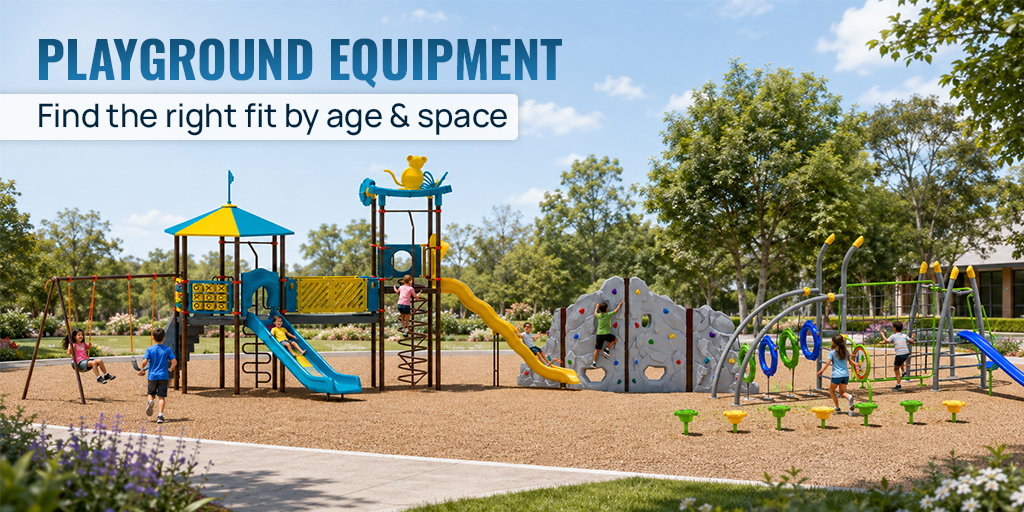
Swings, Climbers, See-Saws & More: A Guide to Choosing Playground Equipment by Age Group and Space
Choosing the right types of playground equipment by age is more than picking what looks fun. For schools, parks, and residential communities, it’s matching equipment to children’s abilities, space, and safety standards.
Large multi-activity systems often anchor a playground, but real variety comes from individual pieces. Swings, climbers, see-saws, spring riders, thrillers, and merry-go-rounds are examples of these. They each serve a purpose, meeting different age ranges, skill levels, and site constraints.
This guide breaks down each category, showing how to select equipment that fits your space and meets certification requirements.
For how certification connects to equipment selection, see our playground safety standards guide.
Swings
Swings are a top choice when selecting types of playground equipment by age group. Planners should match seat styles to age ranges. Bucket seats work best for toddlers who need support. Belt seats are ideal for older children who can swing independently.
Space planning is a critical choice to remember when selecting swings. They require clear zones in front and behind the seat to cover the full arc of motion. The frame footprint alone is not enough.
When installing a swing, you also have to think about visibility. Your best choice is to place swings where supervisors can see the area without obstruction. Collisions with moving swings are common, so monitoring should be part of the design.
See-Saws
See-saws add a social element to playground design. They only work when two children play together, which makes them a tool for cooperation and turn-taking. Modern spring-based models are the preferred choice for planners. They soften sudden drops and reduce the impact that made older rigid-pivot designs a source of minor injuries.
Age fit begins once children can sit upright and hold on without help. They remain a good option through primary school years, as long as paired users are close in size. When placing see-saws, planners should allow space for movement around the equipment and ensure visibility for supervision.
Spring Riders
Spring riders are designed for the youngest age group. They suit toddlers who are not yet ready for the required coordination of swings or climbers.
The bounce-based, single-user design gives very young children a safe way to play independently. Their small footprint makes them practical for filling gaps in layouts, especially in residential or clubhouse settings.
Thrillers
Thrillers cover high-activity equipment for older children. They deliver faster, higher, or more dynamic play than standard fixtures. Because activity levels are greater, planners must allow the largest safety clearances and use high-spec impact-absorbing surfacing. Age and weight guidance from manufacturers should be followed closely. Thrillers fit well in larger parks and school playgrounds but are not suited to small residential spaces.
Merry-Go-Rounds
Merry-go-rounds add group play capacity. Several children can use them at once, making them a strong fit for playgrounds that serve larger groups. Rotational equipment carries higher risk than static fixtures, so adult supervision is recommended for younger or mixed-age users. Space needs are moderate to significant. Clearance must cover the full rotational radius, not just the resting footprint.
Comparison Table
Here's a quick side-by-side view of how these six equipment types compare on the factors that matter most when planning a layout:
| Equipment | Age Range | Space Needed | Best-Fit Setting |
|---|---|---|---|
| Swings | 3+ years (seat-dependent) | Large - fore/aft clearance for arc | Schools, parks, residential |
| Climbers | 2-12 years (height-dependent) | Moderate to large, scales with height | Schools, parks |
| See-Saws | 4-10 years | Moderate, linear clearance | Parks, residential, schools |
| Spring Riders | 2-5 years | Small, single-unit footprint | Residential, small parks |
| Thrillers | 8+ years | Large, high-clearance | Schools, larger parks |
| Merry-Go-Rounds | 4-12 years | Moderate to large, rotational radius | Parks, schools |
FAQs
Can these equipment types be mixed into one multi-activity system?
Yes - many layouts combine several categories, either as standalone units around a central structure or partially integrated into it, as long as clearance zones for each piece are respected.
How does certification apply differently to each equipment type?
Certification typically addresses fall height, structural safety, and entrapment risk per equipment type, since these vary across categories, have a look at our playground safety standards guide.
What's the minimum space needed for a good mix of equipment types?
It depends on which types you're combining, since clearance requirements vary by category - our team can advise on layout once we know your space through a quote request.
Which equipment types need the least supervision?
Spring riders and low-height climbers generally require the least active supervision for their target age groups, while swings, thrillers, and merry-go-rounds typically warrant closer attention.
Do all equipment types need the same flooring underneath them?
No - flooring impact ratings should match each piece of equipment's fall height, which varies even within one playground. Our flooring and fall-safety guide covers this in detail.
Where can we see specifications for a specific equipment type?
Each category has its own product page: Swings, Climbers, See-Saws, Spring Riders, Thrillers, and Merry-Go-Rounds.