



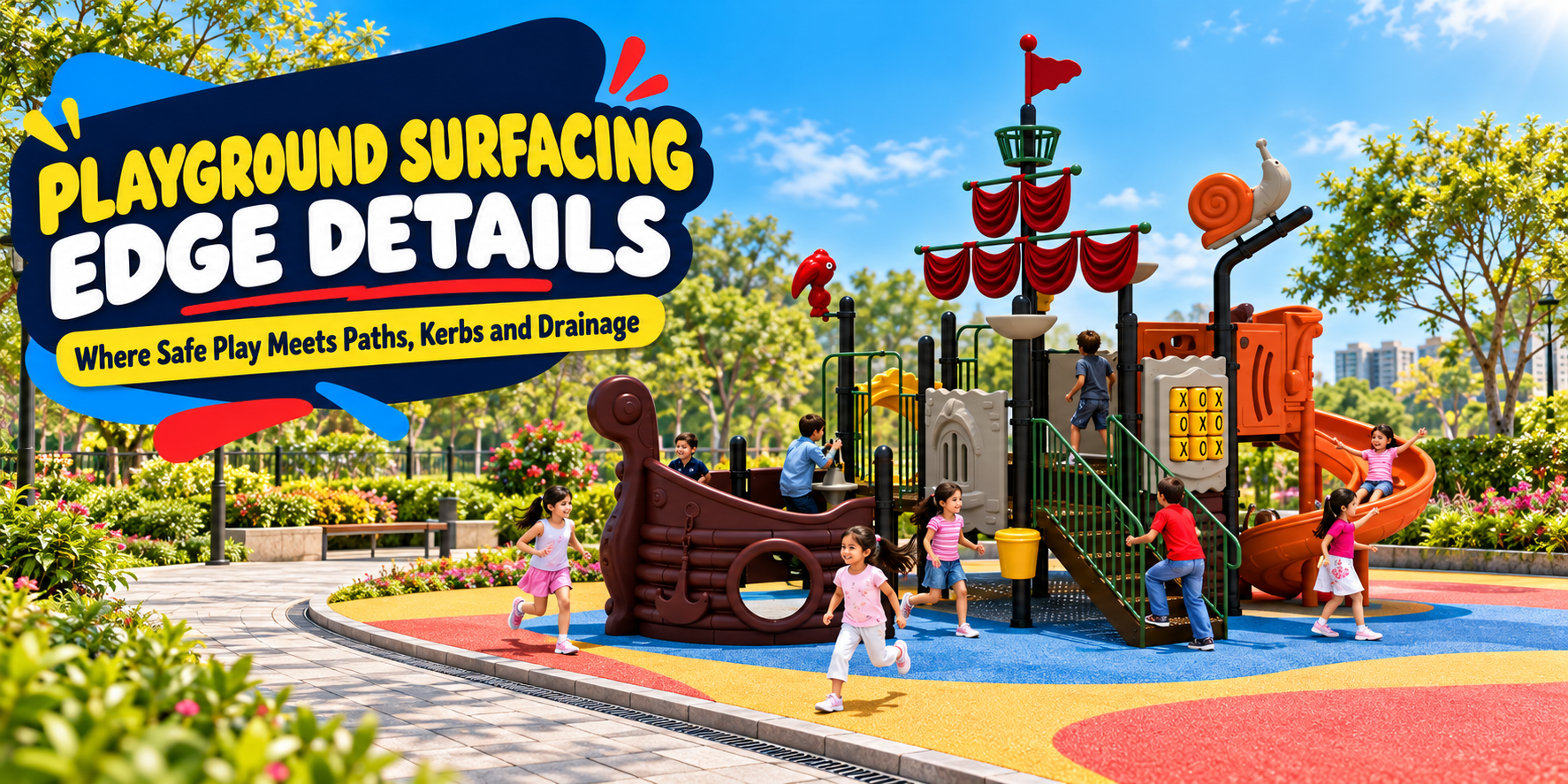
Playground Surfacing Edge Details: Where Safe Play Meets Paths, Kerbs and Drainage
The boundary deserves a drawing of its own
Imagine a child running from a climbing frame toward a path. One foot lands on the rubber play surface; the next crosses a narrow seam into a harder paving material. That seam must carry movement, shed water and remain smooth enough to use. It is also where two teams’ work often meets: the playground installer and the landscape contractor.
A specification that says “rubber flooring, colour blue” does not settle what happens at this boundary. The designer needs to identify the play equipment’s use zone, the required surface performance, finished levels, drainage route and how each material terminates. The edge is an engineering detail and an everyday user experience.
Arihant Play lists rubber flooring among its playground products. This guide helps clients ask better questions when that surface meets a resin-bound garden path, concrete walkway, kerb, planting bed or drain. It does not assume that every product uses the same build-up: obtain the system-specific section and test evidence for the proposed installation.
Start by defining which ground is part of the fall area
Before choosing an edge trim, draw the playground equipment and its required protective surfacing. The U.S. CPSC Public Playground Safety Handbook discusses protective surfacing, use zones and age-appropriate layouts. ASTM F1292 addresses impact attenuation of surfacing within equipment use zones, including critical fall height and installed-surface performance. These are useful technical references; confirm applicable Indian project requirements separately.
A decorative resin-bound path, stone paving or plain concrete should not be presumed suitable beneath a climbing structure because it looks smooth. A rubber product’s colour and nominal thickness alone are also insufficient proof. Ask which complete surface system was tested, at what thickness and over what base, and how its documented performance relates to the installed equipment and relevant fall height.
The transition should sit outside the required protective area unless the adjoining material itself has suitable evidence for its intended position. Do not shift the boundary inward during value engineering to save a strip of rubber. Its location belongs on a dimensioned plan agreed by the equipment supplier and surfacing contractor.
Distinguish a decorative path from a protective play surface
Resin-bound aggregate is often used for landscaped paths because it can provide a continuous appearance. Its properties depend on the exact aggregate, binder, base and drainage design. Playground rubber flooring is a different system with a different performance brief. They may meet neatly at one site, but they are not interchangeable simply because both are described as “bound” surfaces.
In a quotation, ask the contractor to label every zone: impact-attenuating surfacing, circulation path, sports surface, planted area and any temporary access route. Record the base, finish and performance requirement for each. This prevents a renderer’s uniform colour from obscuring a material change with safety implications.
A playground equipment manufacturer can give the equipment’s intended use zone and fall-height information; the selected surface supplier should provide the corresponding surface specification and installation conditions. The architect or project engineer coordinates the interface. If responsibility is split, write down who owns the edge detail and who signs off the finished levels.
Set levels from the user’s route
A kerb may restrain a surface, but a projecting lip across an accessible path can also block wheels or catch a foot. A recessed seam can collect dirt and water. Start with the route people will actually take: from the main path through the play entrance to the relevant ground-level play experiences and seating.
The U.S. Access Board’s play area guide explains the role of accessible routes, ground surfaces and manoeuvring space in play areas. Use it as a design reference, then check current Indian accessibility requirements for the project. A flush-looking transition on a rendering should be tested against the constructed detail and the ground conditions around it.
Draw a section through the entrance. Mark the finished levels, slope direction, edge restraint, substrate and both surfacing thicknesses. Consider what happens after settling, cleaning and repair. If an upstand is required along a planted perimeter, it need not be repeated across the access route. Different edge conditions can use different details on the same site.
Give water a complete journey
Water does not disappear because a finish is called permeable. If a resin-bound path allows water through but the base below holds it, the edge can remain wet and the ground can weaken. A rubber surface may shed water across its top or drain through a designed build-up, depending on the system. The solution is a coordinated surface, base and outlet, not a generic claim about materials.
On the site plan, follow water from the highest point to its destination. Check roof runoff, landscape irrigation, monsoon flow and nearby soil levels. At a drain, show the grate level, support beneath each surface and how debris can be removed. Avoid putting a drain exactly where users must cross if another workable location is available.
Ask what happens when the drain blocks during heavy rain. Will water pond at the play entrance, erode the planted edge or run over the protective surface? A small level or channel error can affect access long before the central area shows distress. The contractor should demonstrate drainage during handover and include outlets in the owner’s cleaning schedule.
Coordinate movement and existing bases
A resurfacing project may inherit a concrete or asphalt base with cracks and movement joints. Covering a visible crack with a new finish does not diagnose why it formed. Identify joints, weak patches, settlement and drainage defects before specifying the new layer. Ask the surfacing specialist and project engineer how existing movement will be accommodated in the proposed system.
At a joint, the detail may need to continue through the new build-up; the correct treatment depends on the material system and substrate. Do not borrow an unverified gap width, depth or edge height from a different manufacturer’s detail. The installer’s written specification and an approved site section should set those dimensions.
Foundations for swings or climbers complicate the work. Surfacing must meet anchored posts without creating a trap for water, a loose collar or a trip edge. Ask who seals, finishes and later inspects those interfaces. During renovation, protect equipment anchors from demolition damage and confirm whether resurfacing changes the effective height of the equipment above the finished ground.
Make the edge maintainable
Many edge failures begin with ordinary operations: a mower clips the trim, a pressure washer lifts an unbonded corner, a drain remains blocked, or a repair leaves a proud patch. Design for the cleaning and landscape equipment the owner actually uses. Protect exposed terminations, make drain covers removable and document which repair material is compatible with the installed system.
Inspect the transition after the first monsoon and then as part of routine playground checks. Look for lifting, cracking, missing aggregate, loose rubber, differential levels, pooling water and vegetation pushing into the boundary. Mark any trip hazard for repair. If the affected edge falls within a required protective area, assess the surfacing performance rather than treating it as cosmetic damage.
Keep as-built drawings, product data and any installed-surface test results. A school or society may change its caretaker or contractor over the life of the play area; the next team needs to know what was laid beneath the surface. Good documentation makes targeted repair more feasible than a guess based on its top colour.
What to put in a procurement drawing
Ask for a plan plus sections at every distinct interface: rubber to path, rubber to planting, rubber at a drain, surfacing around equipment anchors and the accessible entrance. Note use-zone boundary, material build-up, tested performance where required, finished levels, edge restraint, drainage route, joint locations and inspection responsibilities. A single standard cross-section rarely fits all five locations.
The quotation should identify who supplies and installs each layer, who prepares the base, who checks drainage and who accepts the completed work. If the job has separate playground and landscape contractors, schedule a joint set-out meeting before either starts laying surface. Resolve level differences on paper or at setting-out, not after one contractor has finished.
Arihant Play’s rubber flooring category can start a discussion about surface options alongside playground equipment. Ask for the exact proposed system and site-specific details. A well-drawn edge keeps the protected play area, accessible route and surrounding landscape working as one place.
Frequently asked questions
1. Why are playground surfacing edges important?
The edge is where the play surface meets another condition: a path, kerb, drain, planted bed, equipment post or existing pavement. It needs to maintain the intended protective surfacing area while accommodating movement, drainage and everyday traffic. A small lip can become a trip hazard or block a mobility aid; an unsupported edge can lift and invite water below the surface.
Begin with the equipment’s use-zone drawing. Mark exactly where the impact-attenuating surface is required and ensure that an adjoining path does not intrude into it without appropriate test evidence. Then draw the transition in section, showing finished levels, base layers, restraint and water flow. The best-looking line on a plan may be difficult to build if adjacent contractors have assumed different finish heights.
The edge also determines repair practicality. Can a damaged strip be replaced without cutting into a foundation or blocking a drain? Will the owner know which material to order? Ask the playground equipment manufacturer, surfacing supplier and landscape contractor to review the same drawings before installation.
A good detail is mostly invisible to users. Children can move freely, caregivers can cross comfortably and maintenance staff can see and repair wear before it becomes a larger problem.
2. Is resin-bound surfacing safe beneath playground equipment?
Do not assume so from the material name. A resin-bound aggregate path can be suitable for circulation or landscaping, but the surface beneath and around playground equipment may need demonstrated impact attenuation for the equipment’s use zone and fall height. The ASTM F1292 specification addresses impact performance of playground surfacing. The exact complete system, not a generic material category, must be assessed for its intended use.
Ask the supplier for model-specific surface testing, the tested build-up, thickness, base conditions and any installed-surface results required by the project. If a resin-bound product has an engineered cushioning system and relevant evidence, evaluate that particular assembly with the project’s safety specialist. A decorative path specification alone is not enough.
On the plan, draw a clear boundary between the required protective zone and the path. Check that the boundary is still correct after equipment is repositioned or a swing is added. If the surface material changes inside the play area, verify the performance of each section and the transition between them.
Arihant Play’s rubber flooring range should likewise be checked for the specific installed system and required performance; no colour or product label replaces documentation.
3. How do you join rubber playground flooring to a resin-bound path?
Start with two questions: where does the protective use zone end, and what finished level should the accessible route have? The two surfacing contractors need a coordinated plan and section showing their respective bases, thicknesses, edge restraint and the desired final junction. The rubber’s tested protective area must not be shortened to create an easier line of work.
A firm transition may need a compatible edge profile or other approved restraint, but its shape and fixing depend on the systems selected. The designer should consider thermal and substrate movement, drainage, cleaning and repair. A proud metal strip across the main entrance may be unsuitable even if it gives a tidy line in a section drawing.
Set out the edge jointly on site before laying. Confirm the base elevation, slope and drain positions, then check the completed finish with the intended route in mind. Water should not pool in a narrow seam, and a wheelchair or pushchair should not have to negotiate an unnecessary lip.
Document the installed products and any sealing detail for future repair. The correct junction is a project-specific detail signed off by the design and installation team, not a universal dimension copied from another surfacing system.
4. Should a playground surface be flush with the adjoining path?
Where an accessible route enters the play area, a smooth transition is generally an important design aim. The detailed solution must also preserve the required surface depth and the edge stability. A perimeter beside planting may need a different treatment from an entrance, so “make all edges flush” is not a complete specification.
The U.S. Access Board’s play area guide explains how accessible routes and ground surfaces connect play components. It is a useful reference for asking design questions; verify the Indian accessibility rules applicable to the site. Look beyond the entrance: the route should continue to relevant play experiences and seating without a raised threshold or soft, eroded patch.
Draw the path and play surface in section, including base, finished levels and drainage. Then inspect the as-built transition with wheels and on foot. Check it again after the first period of use, since settlement or a lifted corner can turn a formerly smooth detail into a barrier.
If the surface is repaired, the same access requirement still matters. An apparently minor replacement strip should not create a new step at the junction.
5. What should architects show in a playground edge-detail drawing?
Show the location first: equipment, use-zone limit, paths, drains, kerbs, planting and access points on a dimensioned plan. Then provide sections for each different junction. Identify every material layer, substrate, finished level, slope, edge restraint, joint, drain connection and the contractor responsible for it. An edge at a drain needs a different solution from an edge beside lawn.
For protective surfacing, reference the required impact performance and tested system configuration rather than merely stating a nominal thickness. Indicate the equipment fall-height information used to select it. Ask the surface supplier to confirm whether the specified base and installation method match its performance documentation.
Include existing conditions on refurbishments. Cracks, movement joints and uneven bases need decisions before a new finish covers them. Detail equipment post penetrations and check whether raising the surface affects the equipment’s effective height or access.
Finally, include a handover requirement: as-built drawings, product information, inspection instructions and the record of any site performance tests. A beautiful drawing has limited value if the installed edge differs from it and nobody records the change.
6. How should a playground surface drain during monsoon rain?
Drainage depends on the exact system and base. Some surfaces are designed to move water through layers to a prepared drainage course; others shed water across the finished surface to a channel or gully. Neither approach works if the outlet is blocked or the surrounding landscape sends runoff into a low point at the play entrance.
Ask the designer to trace water on the site plan from arrival to discharge. Include roof downpipes, planting irrigation and the levels outside the playground. At drains, show grate height, support for neighbouring surfacing and access for cleaning. A drain that cannot be opened easily may remain blocked for months.
The contractor should check levels during setting-out and demonstrate that water can leave the completed area. The owner should maintain channels and gullies, especially before and during monsoon periods. Standing water can limit access, accelerate damage at edges and contribute to slipping or deterioration depending on the material.
Do not claim a resin-bound path or rubber surface is automatically permeable; ask for the exact system’s technical information and the base design. A surface can admit water yet still sit over a base with no workable route to an outlet.
7. Can we lay new rubber flooring over an old playground surface?
Sometimes a renovation can use part of an existing base, but it needs inspection and approval for the proposed system. Check for cracks, loose areas, settlement, trapped water, contamination and failing edges. A new top layer can conceal a problem without fixing the cause. The surfacing supplier and project engineer should decide which material can remain and which sections need removal or rebuilding.
Check levels carefully. Adding thickness can change thresholds, block drainage, bury the bottom of equipment posts or alter the effective height from a platform to the finished surface. Reconfirm the required impact performance for the final installed build-up; the old and new layers together should not be assumed equivalent to a tested assembly.
Identify existing movement joints and ask how the proposed system handles them. Repair or reconstruct weak edges rather than hiding them behind a trim. If the existing installation lacks useful records, consider investigation or testing before pricing the new work.
Have the contractor document the preparation, installed materials, final thicknesses and any required performance checks. A reliable quotation should state assumptions and exclusions, including how unforeseen damage to the old base will be priced.
8. What causes rubber playground flooring to lift at the edges?
Possible causes include weak or contaminated substrate, water reaching the bond, inadequate edge restraint, incompatible materials, settlement, repeated cleaning impacts or movement between adjoining surfaces. The visible lifted corner does not identify the cause by itself. Investigate whether the problem is local or part of a longer failing seam.
Inspect the area while protecting users from a trip hazard. Check drainage outlets, nearby irrigation, surface cracks, kerb condition and signs of moisture beneath the finish. Review the installation records and the supplier’s detail for that edge. If the damage falls inside the equipment use zone, consider whether the protective surface remains fit for use; seek competent inspection where needed.
Repair should address the reason for movement. Simply bonding down a wet or unstable edge may fail again. A sound repair may require drying and preparing the base, replacing damaged sections, correcting a drain or installing an appropriate termination detail. Follow the surface manufacturer’s method and record the work.
An owner can reduce recurrence with routine checks, prompt drain cleaning and careful maintenance equipment use. A playground equipment supplier or installer should be told when repairs intersect posts or safety clearances.
9. How do edge details affect playground accessibility?
A route may meet its nominal width yet fail in daily use at a seam: a raised strip stops a small wheel, loose aggregate builds up against a threshold, or ponding forces a detour. The transition between play surface and path must therefore be checked as a continuous user journey, not just as two separate material specifications.
Start at the site entrance and travel to seating, ground-level play components and any other required destinations. Note slopes, changes in level, firmness, drainage and space to turn. The U.S. Access Board play area guidance provides a technical reference for accessible routes; the project team should check applicable Indian rules and user needs locally.
Detail the accessible entrance separately from an edge against planting or a service kerb. The right restraint at one location may be a barrier at another. Ask installers to check the constructed junction with a wheelchair or pushchair where appropriate, and involve users with disabilities in the site review.
Maintain the transition afterward. A surface that met the drawing at handover can become difficult to cross when a drain clogs, an edge lifts or an ad hoc patch leaves a ridge.
10. What should buyers compare when sourcing playground flooring in India?
Compare complete surface systems and installation scopes, not only a price per square metre. Ask for the proposed materials, full layer build-up, base preparation, edge details, drainage treatment, intended use, test evidence, colours, warranty terms and repair method. If the material sits within equipment use zones, check its documented impact performance against the relevant equipment and site requirements.
Give bidders a plan marking the protective play area, circulation paths, adjoining resin-bound or paved surfaces, drains, equipment foundations and accessible entrances. Ask each bidder to identify exclusions. Some quotations include the prepared base and edge restraints; others may include only the final top layer. An inexpensive quote can become costly if level corrections and civil works are left for later.
Request samples and a site-specific detail rather than relying on a photograph. Confirm who measures and signs off finished levels, who documents any installed-surface tests and who repairs the edge if it lifts. Ask how replacement materials can be obtained in the future.
Arihant Play lists rubber flooring products alongside playground equipment. Buyers can use the same technical questions with Arihant Play and other suppliers to compare proposals fairly and secure a maintainable installation.