



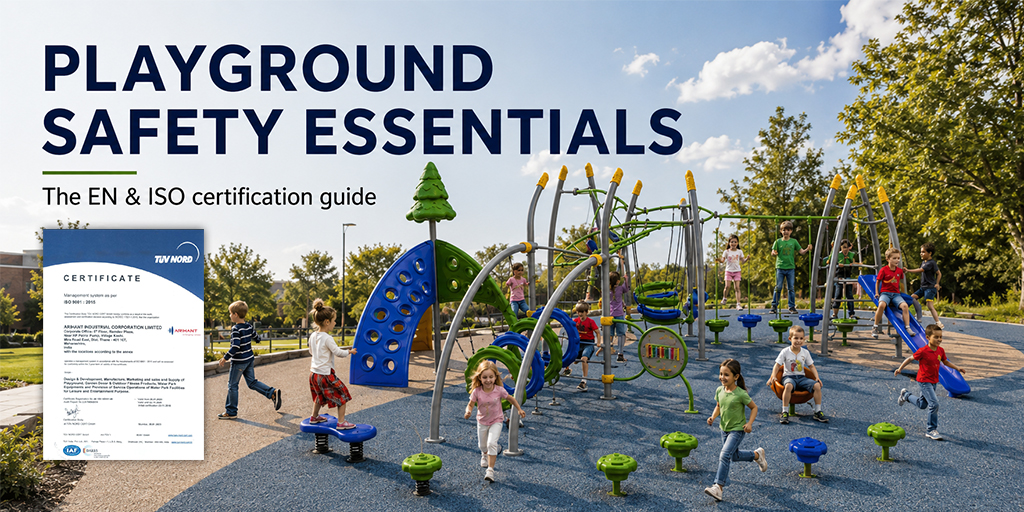
Playground Safety Standards Explained: What EN & ISO Certification Actually Means for Your Project
Most playground equipment vendors will say their products are "certified." The trouble begins when you ask what that certification actually covers, which standard it was issued under, or how you can verify it. Answers often drift into vagueness. For school administrators, municipal project officers, housing society committees, and developers, that lack of clarity is more than frustrating. It can expose projects to liability, complicate insurance claims, and even block bids.
Procurement teams already manage tight budgets, compliance rules, and community expectations. Playground safety standards certification adds another layer of responsibility. Tenders and RFPs now specify EN or ISO compliance as mandatory. Insurers may require proof before covering play areas. Liability in the event of an accident might depend on whether the installed equipment genuinely met the standards under which it was sold.
This guide explains what EN safety standards and ISO certification mean, how they differ, and what institutional buyers should demand from vendors before approving a project. It also connects certification to broader design choices, including the types of playground equipment by age, so compliance aligns with developmental needs and long-term safety.
Why Certification Matters for Institutional Buyers
For a private buyer, certification might feel like an added reassurance. For institutions, though, it often becomes a requirement. The reasons for certifications go beyond the equipment itself.
Liability is often the first concern. As a school, municipal body, or housing society committee, you don't want to face a situation where uncertified play equipment causes harm to a child. In that case, you could be held legally responsible alongside the manufacturer. To safeguard yourself, it's best to keep documented proof that reasonable care was taken during procurement and that current certifications are in place.
Insurance is important too. When you have certification in place, it helps with easier approvals for claims in case of accidental damage to the physical structures of your playground equipment. In fact, insurance policies covering play areas require proof that installed equipment meets recognised safety standards.
Tender and RFP compliance is another factor to consider. Public procurement processes for schools and municipal playgrounds increasingly list certification as mandatory. If your vendor cannot produce current, product-specific certificates, he may be disqualified from bidding, regardless of how strong the equipment looks on paper.
Put together, these factors show that certification is important to institutional buyers. It is a compliance requirement, and not having it could result in legal, financial, and procurement consequences.
What EN Safety Standards Cover
EN or European safety standards lay out the technical requirements for the entire playground equipment system. It mandates design, construction, and installation. The safety standard is designed to protect the well-being of users. It broadly addresses three areas that matter most for child safety:
Structural safety
This covers how the equipment is engineered and built. The primary framework must be built to withstand heavy dynamic forces, focusing on verified load-bearing capacities for maximum child density, fatigue-resistant materials that handle repeated stress, and mechanically secured welds and joints that prevent sudden structural failure or loosening over time.
Fall height requirements
For fall height requirements, the EN safety standard mandates setting limits on how far a child can fall from any given piece of equipment. It determines directly what kind of impact-absorbing surfacing is required beneath and around it.
Entrapment risk assessment
This safety standard sets mandates for gaps and openings throughout the structure. It also pays attention to spaces between rungs, railings, and moving parts. The safety standard should be maintained to make sure a child's head, limbs, or clothing is safe from entrapment during normal or foreseeable use.
Entrapment risk is one of the more technical parts of the standard, and it's also one of the easiest areas where poor manufacturing can fail without being obvious during a site inspection.
This overview is only a high-level summary of what EN safety standards cover. It's not a full technical breakdown.
This is one of the more technical parts of the standard, and it's also one of the easiest for a non-compliant or poorly manufactured product to fail without it being visually obvious to a buyer during a site inspection. Always confirm the specific standard numbers and clauses with your vendor, and cross-check them against current certificates instead of relying on general descriptions.
What ISO Certification Signals About a Manufacturer
EN standards apply to the product, specifically the individual piece of equipment being installed. On the other hand, the ISO certification applies to the manufacturer. It focuses on the quality management systems and processes behind how that equipment is designed, built, and tested.
A manufacturer with recognised quality management certification shows that its production process follows documented, auditable procedures. That means consistent material sourcing, repeatable manufacturing steps, and structured quality checks at multiple stages.
For buyers, ISO certification matters because EN compliance on a prototype does not guarantee that every unit shipped later is built to the same standard. ISO-certified process controls make that consistency more likely across an entire order, not just the sample that was originally tested.
Simply put, the ISO certification confirms the manufacturer has the discipline to keep building it that way, order after order.
How to Verify Certification When Evaluating Vendors
Certification claims are easy to make in conversation but harder to prove on paper. Verification should be part of standard due diligence. Here is what to ask for:
- Ask for actual certificates. A vendor confident in their certification will provide documentation without hesitation.
- Check the scope. Certification can apply to a product line, a facility, or the company. These are not interchangeable. A certificate for one product range does not automatically cover every item in a catalogue.
- Confirm validity. Certificates carry renewal dates. An expired certificate offers no assurance.
- Cross-check the issuing body. Certification should come from a recognised, independent authority, not an internal or self-issued document.
- Get details in writing. Include certificates in procurement or contract documentation, not just verbal assurances.
Remember, a vendor that treats these questions as routine is generally a good sign in itself.
Certification & Age-Appropriate, Impact-Safe Design
Certification connects directly to two other decisions in most playground projects: the equipment chosen and the surface installed beneath it. These choices are often reviewed separately on procurement checklists, but in practice, they work together.
Selecting the right types of playground equipment by age is a big part of safety. Certified products are tested for specific age groups, and using them outside those ranges, even when they carry certification, can weaken the safety assumptions the certification is based on.
To see how this plays out across specific equipment types, our guide to choosing playground equipment by age group and space breaks down swings, climbers, see-saws, spring riders, thrillers, and merry-go-rounds individually.
Fall-safety flooring is the other half of the equation. A certified piece of equipment installed on the wrong surface, or on flooring that doesn't match its fall-height rating, weakens the safety case the certification was built on.
Our guide on playground flooring and fall-safety standards compares rubber flooring, sports courts, and jogging tracks against these requirements in detail.
Treating playground safety standards certification, equipment selection, and flooring as one connected decision rather than three separate purchases is what sets a safe, compliant playground apart. When these elements are aligned, audits and insurance reviews tend to pass smoothly. When they're handled in isolation, projects are far more likely to run into problems later.
FAQS
Is certification required for private residential installations?
Requirements vary by project type and location, and private installations often have more flexibility than institutional ones. That said, certified equipment is generally the safer and more future-proof choice even where it isn't strictly mandated, speak to our team via a request for a quote for guidance specific to your project.
How often is certification renewed?
Certification validity periods vary by certifying body and certificate type, so this should always be confirmed directly against the specific certificate in question rather than assumed. Our certifications page has current details for our product range.
Does EN certification cover installation as well as the equipment itself?
EN standards primarily address equipment design and construction; correct installation, including surfacing and fall-zone clearances, is a separate but connected requirement covered in our flooring and fall-safety guide.
What's the difference between EN compliance and ISO certification?
EN standards apply to the product itself, its design and safety performance. ISO certification applies to the manufacturer's quality management process, which affects consistency across every unit produced.
Can a vendor be ISO certified but not have EN-compliant products?
Yes, the two certifications assess different things, which is exactly why institutional buyers should verify both rather than treating one as a substitute for the other.
Who should we contact to verify a vendor's certification before finalising a tender?
Request certificates directly from the vendor and, where possible, confirm them with the issuing body. For our equipment, you can get in touch with our team, who will provide all the information you need for your play equipment requirements.