



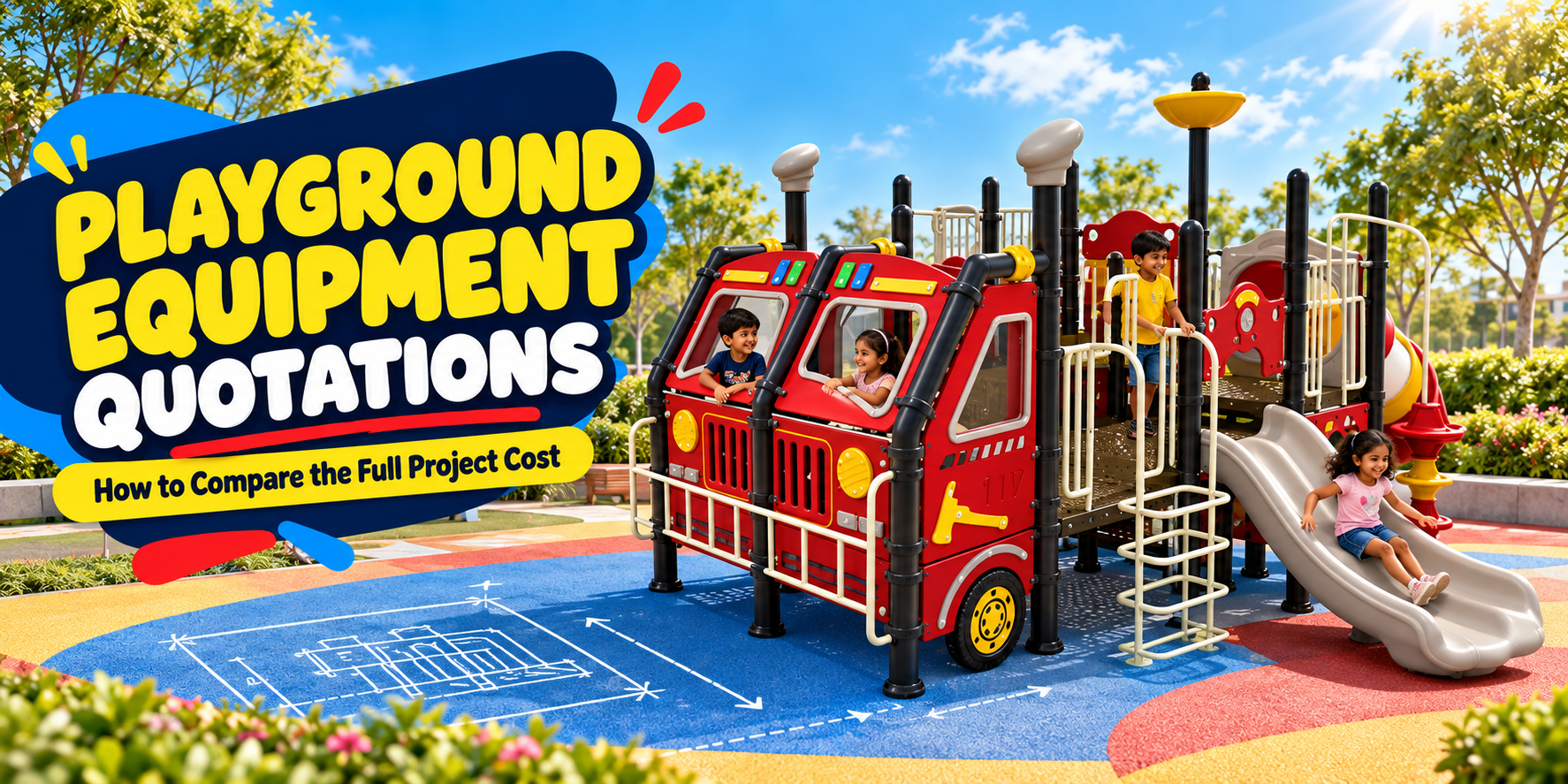
Playground Equipment Quotations: Compare the Playground, Not Just the Price
Two suppliers quote for a school playground. One proposal looks cheaper and shows a bright multi-activity unit. The second includes fewer dramatic images but specifies protective surfacing, foundations, delivery, installation and a measured layout. Which is better value? Without a common scope, the prices cannot answer that question.
For architects, schools, housing developers and resort operators, buying outdoor playground equipment is a small construction procurement exercise. The installed result must suit actual children and the site; it must also be maintained. A useful quote therefore describes a complete decision, including what the supplier will deliver and what the client must organise separately.
Here is how to brief a playground equipment manufacturer and compare proposals on equal terms.
Start with a site brief the supplier can price
Give each supplier the same measured site plan. Show boundaries, levels, gates, underground services, drains, trees, walls, nearby paths and access for unloading. Photographs help, but dimensions and constraints are more reliable than a wide-angle image. If the area is on a podium or rooftop, identify it immediately so the building's engineer can review loads, anchors, waterproofing and access.
State who will use the playground: ages, likely busiest period, school or public access, supervision arrangements and desired types of play. Distinguish the total population served from the number expected on equipment simultaneously. The brief might prioritise climbing and social play, or lower-level activities for younger children. State any inclusion and landscape goals too.
Without a common brief, one playground equipment supplier may price a single product while another has planned a working play environment. The resulting figures look comparable only because both are called quotations.
It also helps to say what you will decide first. The buyer may need a concept option for internal approval, followed by a technical offer once the site survey is complete. Ask for those stages explicitly. This keeps early estimates useful without treating them as fixed prices for unknown ground conditions.
Ask for the safe play area, not only product size
The dimensions of a structure are not the dimensions of the playground it needs. Space around slide exits, swings and other equipment must be accounted for on the layout. Arihant Play's Boxy MAPS product page, for example, lists a product area of 13.3 × 11 feet and a safe play area of 19.3 × 17 feet. Those rectangles are roughly 146 and 328 square feet. They illustrate why a buyer should request the full current drawing rather than assuming the frame footprint is sufficient.
Ask every bidder to show the product footprint, required use zones, accessible routes, entries and exits, circulation and nearby obstructions on the same scaled plan. The U.S. CPSC Public Playground Safety Handbook explains why spacing and protective surfacing matter. It is a design reference, not an Indian approval for a particular installation. Confirm the local project requirements and the selected model's documentation.
A plot that cannot hold the full proposed layout may need a different product. Cutting clearance to preserve a quoted price is a false saving.
Separate equipment from the supporting works
A complete playground may require demolition, grading, foundations, drainage, anchoring, surfacing, edging, access paths, fencing, shade, seating and landscaping. A supplier may price some of these and leave others to the client or civil contractor. Neither approach is inherently wrong; ambiguity is the problem.
Ask for an inclusions and exclusions schedule. For protective surfacing, request the proposed system, tested performance relevant to fall height, area, thickness, base, drainage detail, edge treatment and installer responsibility. Arihant Play lists rubber flooring as a product category, but a category name is not a project specification. The final system must be matched to the selected equipment and site.
Clarify whether lifting equipment, permits, power, water, storage, waste removal and site restoration are included. On a school site, also establish how construction will be separated from children. A quote becomes meaningful when the interfaces between trades are visible.
Compare the play value promised
A larger structure is not automatically better. Ask what children can actually do: climb, slide, balance, imagine, cooperate, observe or rest. How many routes remain usable when the site is busy? Is there meaningful ground-level play? Do the components suit the intended ages?
Arihant Play offers multi-activity systems, climbers, slides and other categories. A buyer should compare exact models and layouts rather than count products by category. Ask suppliers to explain their age and user guidance and how they expect children to circulate.
Accessibility belongs in this comparison. The U.S. Access Board's play-area guide discusses accessible routes and varied ground-level opportunities. Its legal framework applies in the U.S.; Indian designers need to check applicable local obligations. The broader procurement point is to ask how children with different abilities can participate in the same setting.
Check materials and evidence against exact products
Terms such as “premium,” “weatherproof” and “certified” need supporting detail. Request material grades, finish methods, component specifications and the documents relevant to the selected model and stated standard. Ask what was tested: a complete product, a component, a surface system or a manufacturing process. These are different kinds of evidence.
Arihant Play's FAQ describes its material approach, quality-control process and customization capability. Use those statements to begin a technical discussion, then obtain the current project-specific material schedule and applicable evidence. If the design changes after quotation, ask whether the documentation still covers the changed configuration.
The site affects durability. Sun, monsoon exposure, coastal air and heavy school use can influence finish selection and inspection frequency. Ask how fasteners, ropes, moving parts and surface edges will be checked or replaced. A specification that can be maintained is more valuable than an impressive adjective.
Read commercial terms as carefully as drawings
Compare a clear itemised price, taxes including GST treatment, freight, unloading, installation, site work, validity, payment milestones, lead time, warranty and exclusions. If a figure is provisional, record what could change and how the change will be approved. A price range without a model and scope is not a substitute for a quotation.
Ask what happens if the site is not ready on delivery day, if access is restricted, or if a civil dimension differs from the approved drawing. Clarify who owns the final setting-out and whether the supplier's installation team or another contractor performs the work. When custom colours or graphics are requested, obtain a signed schedule of finishes and lead times.
If bids arrive in different currencies or tax formats, normalize them before comparing totals. Record the date and assumptions beside each figure. An attractive price with an expired validity period or an unresolved freight charge should remain provisional in the approval note.
Avoid relying on generic market price tables. An honest supplier cannot price foundations or surfacing correctly without knowing the ground, selected equipment and access conditions. The relevant comparison is the total delivered and usable project, not the first number in an email.
Make handover and upkeep part of the purchase
The quote should state what happens after installation. Ask for as-built drawings, manuals, product and surface care instructions, inspection records, spare-parts contacts, warranty documents and a handover check. Define who signs off the completed installation and how any defects are resolved before opening.
The CPSC handbook includes inspection and maintenance guidance that can help an owner frame questions, while the selected manufacturer's manuals and applicable project rules govern the actual programme. The owner needs a plan for cleaning, visual checks, periodic inspection, repairing surfacing and temporarily restricting use when something breaks.
A cheap-to-buy unit can become expensive if a proprietary part is difficult to obtain or the site must close for routine repairs. Ask about availability, expected service needs and realistic response arrangements. Do not assume “warranty” means every problem, including wear or misuse, will be covered.
Use a one-page comparison sheet
Place the bids side by side under identical headings:
| Compare | Ask each supplier to show |
|---|---|
| Play proposal | Exact model, age group, activities and expected simultaneous users |
| Site fit | Scaled layout, product footprint, safe play area and routes |
| Technical scope | Materials, fall heights, surfacing and evidence for stated standards |
| Site works | Foundations, drainage, edging, access and trade responsibilities |
| Commercial terms | GST, transport, installation, exclusions, validity and milestones |
| After-sales | Warranty scope, manuals, inspections and replacement parts |
Mark a blank or “by others” as an action item rather than silently assigning it zero cost. Send the same clarification questions to each bidder. Then compare value, not just price: usable play, technical fit, total installed cost and the ability to maintain the result.
For a site-specific proposal, contact Arihant Play with the survey, project brief and expected use. A good quotation should help you make a confident design decision before you make a payment decision.
Frequently Asked Questions
1. What details should I send to get an accurate playground equipment quotation?
Send a measured plan with dimensions, levels, boundaries, gates, services, trees and drainage, plus recent site photographs. Identify whether the area is ground-level, on a podium or on a rooftop. Explain how delivery vehicles and installers will reach it. A supplier needs this information to assess more than the physical playset.
Describe the intended ages, expected busy-period users, desired play experiences, supervision and any accessibility or theme requirements. State whether you want equipment alone or a complete installed play area with surfacing and civil work. Share the target opening date as a planning constraint, not an assumption that manufacture and installation can fit any schedule.
If you do not have a formal survey, say so. A preliminary budget can be useful, but it should be marked as subject to measured drawings and site verification. Give identical information to each playground equipment supplier so proposals can be compared. Ask each to identify unanswered questions and provisional allowances. The more specific the brief, the less likely a low initial number hides important work that emerges after you place an order.
Keep the brief in one document and issue revisions to all bidders together. Equal information matters more than the number of quotations received.
2. Why is the equipment footprint smaller than the area I need?
A product footprint describes the dimensions of the structure. The surrounding area accounts for children approaching, exiting and potentially falling from it, as well as the protective surface and circulation the design requires. Different activities have different conditions, so the full safe play area cannot be inferred from a photo.
Arihant Play's Boxy MAPS page separates its 13.3 × 11-foot product area from a 19.3 × 17-foot safe play area. This is a useful example, not a universal formula for other products. Obtain the current drawing for every selected item, especially swings and slides whose movement or exit zones may shape the layout.
Put the complete required areas on a site plan together with gates, paths, trees, seating and walls. The CPSC handbook offers a reference for understanding use zones; the governing project requirements and manufacturer's instructions should determine final placement. If the layout overlaps a fixed obstruction, ask for another model or arrangement. A quote based only on frame dimensions can seriously understate surfacing area and total project cost.
Ask the landscape architect to confirm the surrounding path and seating. A compliant product area can still produce a congested overall site.
3. Is playground safety flooring usually included in the quoted price?
Never assume so. Some proposals include equipment only; others include protective surfacing, while a third may list it as an option. Even when a line says “rubber flooring included,” it may omit the base, edge detail, drainage or the full required area. Request a separate, dimensioned surface specification and price.
The surface should be selected for the equipment and its fall heights, with relevant tested performance and installation information. Ask who prepares the substrate, installs the system, checks the finished levels and maintains it. A pleasing colour or a generic thickness is not enough to judge suitability. Arihant Play lists rubber flooring, but the actual surface package must be specified for the project.
The CPSC safety handbook explains why protective surfacing needs attention; applicable local requirements and exact product data should guide approval in India. Compare bids on the same surfacing area and scope. Otherwise one supplier may appear cheaper simply because the client is expected to pay for a major part of the playground separately.
Get a plan showing surface boundaries and transitions. A total square-foot price alone cannot show whether the correct areas have been covered.
4. How can I compare quotes for two very different playground designs?
First establish a common brief: intended users, site, play priorities, acceptable area, surface and operating conditions. Then make each supplier provide a scaled plan, exact product list, age guidance, use zones, material specification, included civil work, installation and after-sales terms. Different designs can then be judged against the same outcomes.
Compare what children can do rather than counting slides or towers. One connected unit may offer several routes and serve the brief better than scattered pieces; another design may provide more accessible ground-level activity. Look at circulation during a busy period and whether adults can supervise effectively. Price the complete playable area, including paths and surfacing, rather than equipment alone.
Ask both bidders to clarify omissions in writing. A “by client” foundation or freight line is a cost even if it is not in that supplier's total. Use a comparison sheet with a column for assumptions and unresolved questions. This approach does not always select the cheapest bid. It helps reveal which proposal best meets the design intent and whose final installed cost and operating needs are understood.
Ask operators and teachers to score each option against the same play priorities. Their daily-use perspective may reveal differences a commercial table misses.
5. Which certifications or safety documents should I request?
Ask what standards have been specified for the project, then request evidence relevant to the exact proposed products and protective surface. A general company certificate, a material test and a complete equipment assessment do different jobs. They should not be treated as interchangeable proof that every design and installation is compliant.
Request current product drawings, intended age ranges, fall heights, use zones, installation instructions and documentation supporting stated safety claims. For a modified or custom design, ask whether the evidence covers the final configuration. Request surfacing performance evidence matched to the equipment and the complete installation method. Have the project's qualified professionals identify which Indian standards, local rules and approval conditions actually apply.
Arihant Play describes its quality-control and material practices on its website. Those statements can inform due diligence, but the buyer should still ask for product-specific documentation. The CPSC handbook is a useful international technical reference, not an Indian certification. If a supplier makes a broad “certified safe” claim, ask exactly what was certified, by whom, when and for which product version.
Record the document revision and the product version it covers. Evidence for a similar model or an earlier design should be clearly identified as such.
6. What should a quotation say about installation and civil works?
It should identify which party surveys and marks the site, prepares the ground, constructs foundations, installs anchors and equipment, provides power or water if needed, handles drainage, lays the protective surface and removes waste. Include responsibility for unloading, lifting equipment, temporary storage and access protection. On occupied school and residential sites, the plan should address work-zone separation.
Ask for a construction sequence and tolerances where the equipment interfaces with foundations or surfacing. If civil work is “by others,” request drawings and a clear handover point for that contractor. Someone must check that the finished levels, foundations and equipment location match the approved play layout before surfacing is installed.
For rooftop or podium projects, structural capacity, anchoring and waterproofing require review by the building's qualified professionals. A playground supplier's quote does not replace that approval. The written scope should also say who conducts the final installation inspection and resolves punch-list items. A price that omits these interfaces is not necessarily wrong, but the buyer must budget and manage them elsewhere before the playground can open.
Agree how site changes will be priced before work starts. A written variation process avoids disputes when the ground differs from the preliminary survey.
7. How do warranty and maintenance affect the real cost?
The purchase price is only the beginning of ownership. Equipment needs inspection, cleaning and occasional repair; protective surfaces and drains also need attention. Warranties commonly contain scope, time and use conditions, so ask what components are covered, what is excluded, how a claim is made and whether labour, transport or replacement parts are included.
Request the inspection and care manuals before approval, along with a list of wear parts and their availability. A supplier should explain how damaged panels, ropes, moving parts or surface sections can be repaired. The owner should assign a person to record faults, restrict use when needed and verify repairs. The CPSC handbook includes maintenance prompts that help frame those questions.
Compare lifecycle implications rather than assuming the strongest-looking unit has the lowest upkeep. Coastal exposure, heavy school use and frequent cleaning may change service needs. A clear handover with as-built drawings and parts information makes future repair faster. If maintenance responsibilities remain vague, a lower quote can become a more costly or less usable playground over time.
Ask who pays for a site visit and how quickly a critical part can be supplied. Those details can affect the actual downtime after a failure.
8. Can a playground quotation be prepared without a completed site plan?
A preliminary budget can be prepared from approximate dimensions, photographs and a project brief, but it should carry clear assumptions and exclusions. It is not equivalent to a firm, installable quotation. Missing levels, utilities, soil conditions or access restrictions can change foundations, transport and surface work substantially.
Ask the supplier to label what is indicative and what is fixed. Request a proposed next step: site measurement, architectural survey, concept plan or joint review with the civil team. Establish when the price will be revised and what information is needed for a final offer. Avoid committing to a product because an early sketch appears to fit; the required use zone may extend beyond the available land.
If the project is in a school or housing development still under construction, coordinate the play area early enough to reserve its full footprint and access. A useful preliminary quote can compare broad options, but procurement should rely on a reviewed site layout and agreed technical scope. The difference is transparency, not a reluctance to provide pricing.
Use the preliminary budget to reserve space and funding, then update it after verification. Do not hide uncertainty by presenting one precise number.
9. How should a school or society plan its playground budget?
Begin with the total delivered, installed and maintainable area, not a per-product target. Reserve budget for the equipment, protective surfacing, civil preparation, drainage, access paths, shade, transport, installation, inspection and future upkeep. Ask suppliers to itemise those components and note GST and other applicable charges clearly.
Prioritise what children need from the space. A school might value varied play and supervision during concentrated breaks; a society may need mixed-age opportunities and comfortable evening use. When funds are constrained, preserve the required surface and safe layout. Optional scenic details can be considered separately. Avoid borrowing money from drainage or access to add one more visual feature.
Get a measured plan and at least one option that meets the essential brief. Compare the cost of operating each design, including replacement parts and likely maintenance. There is no reliable nationwide budget number for every small school or housing project; site conditions and scope vary too much. An itemised quote gives the management team a defensible basis for approvals and later decisions.
Ask the facility manager to review the long-term care allowance. A capital approval without an operating budget can leave repairs unfunded.
10. What should I check before approving the final playground purchase order?
Check that the approved drawing, product codes, age ranges, use zones, surface schedule, finishes and price all refer to the same revision. Review inclusions, exclusions, GST treatment, delivery location, site-readiness conditions, installation responsibilities, payment milestones, warranty and lead time. Confirm who can authorise changes and how variation costs will be agreed.
Ask the operator to review the arrangement. Can staff see children clearly, maintain drains and access parts for inspection? Is there meaningful play at ground level and an accessible route? Have the project professionals signed off any structural, civil and accessibility interfaces? The U.S. Access Board guide is useful background for accessible play planning, while the applicable Indian requirements must govern the project.
Set handover deliverables in the order: as-built drawings, manuals, inspection records, warranty documents and spare-parts contacts. Do not rely on an informal promise that those will be supplied later. A well-written purchase order turns an attractive proposal into responsibilities that everyone can verify when the playground is installed.
Make the final inspection a milestone for acceptance rather than assuming delivery of boxes means completion. Record any open issues and deadlines.