



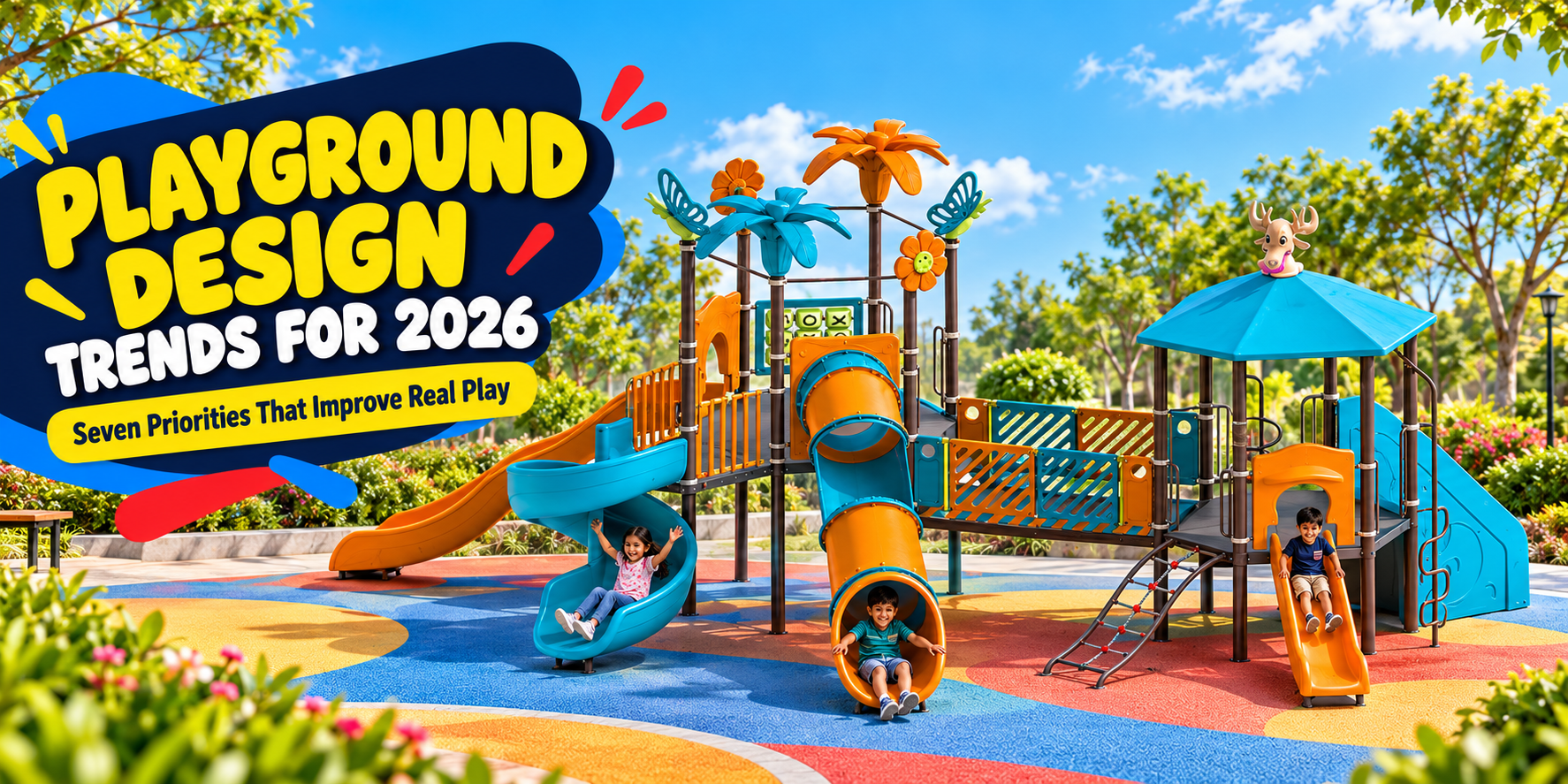
Playground Design Trends for 2026: What Will Still Matter in Ten Years?
A playground opens with a fresh colour scheme and a striking tower. Six months later, the shade falls on the wrong side, a path floods after rain, and children queue at one ladder while a large part of the site sits unused. It may have looked modern on opening day. It was not designed for everyday play.
For architects, schools, developers and park operators, the strongest playground design trends in 2026 are better understood as priorities to test on real sites. They include inclusive participation, comfort in the local climate, meaningful challenge and the ability to maintain what has been built. None requires an automatic purchase of the newest-looking product.
This distinction matters because “trending” can sound like a sales forecast. There is no single public dataset that ranks all these ideas by adoption in India. What can be checked is the design rationale: whether a feature improves access, play opportunities, climate comfort, safety or long-term operation for the people who will use that particular space.
Below are seven directions worth considering, with questions that make each one useful in an Indian project.
1. Inclusive play becomes a whole-site decision
Adding one accessible-looking feature is a start, but inclusion depends on the journey from entrance to activity and on whether children can play together. A child needs a usable route, appropriate surface, room to turn or transfer where relevant, and an interesting reason to arrive. Ground-level play should sit within the main social setting rather than apart from it.
The U.S. Access Board's play-area guide describes accessible routes and varied ground-level components. Its legal rules apply in the U.S.; check India's applicable requirements for the project. The design principle extends further than a compliance drawing: ask children and carers what they can actually reach and enjoy.
A useful 2026 brief asks each outdoor playground equipment manufacturer to show several ways of joining the same play narrative. One child might climb, another operate a reachable panel, and friends might meet at a shared destination. The question is not “Does the scheme have an inclusive product?” It is “Who can participate, and with whom?”
2. Climate comfort is specified alongside the equipment
Shade is most valuable where children and carers need it, at the hours they use the playground. A tree on the perimeter may look attractive from a balcony while providing little relief over the slide or waiting area. The U.S. EPA explains that trees and vegetation can lower surface and air temperatures through shade and evapotranspiration. The effect on a particular playground depends on the actual canopy, materials and conditions.
In India, a climate-aware plan also examines monsoon drainage, surface transitions and maintenance. Where will rainwater go? Can the protective surface drain and dry as specified? Will mulch wash onto an access route? These questions require the civil engineer, landscape architect and playground supplier to review one coordinated drawing.
Ask for a shade study at realistic play times and a drainage section, not a fixed claim that the completed playground will be a certain number of degrees cooler. UNICEF's urban green space review supports improving children's access to green areas, but planting must not occupy required equipment use zones or obstruct supervision.
3. Challenge is deliberate rather than merely higher
Children return to a space when it offers choices: an approachable route, something to try next and a way to retreat and begin again. A taller tower may have visual impact, yet a low set of varied crossings can offer richer decisions to some users. Match the experience to ages and abilities rather than treating maximum height as the measure of excitement.
The UK's Health and Safety Executive supports balancing play benefits with risk while controlling serious, unnecessary hazards. It is an international perspective, not Indian legal guidance. A visible, age-suitable climbing choice can be part of play; an unexpected sharp edge or inadequate fall surface cannot.
For a buyer, the practical request is a route diagram alongside the product rendering. Show easy and demanding choices, entries, exits, likely queues and the protective area. Arihant Play offers climbers and multi-activity systems; assess exact models and drawings for the intended users.
4. Social play receives as much attention as individual movement
Children often use equipment as a meeting place. They plan games, watch friends, take turns and invent stories. A design that maximises separate slides may miss where those interactions happen. Leave space for gathering without putting it in a landing zone or access route.
Look for more than one activity point so children are not forced into a single queue. Consider a structure with routes that meet, an open area for group games and ground-level prompts for imaginative play. Provide seating where carers can see the space without becoming obstacles. This approach does not mean every feature needs a group label; it means the site should make interaction possible.
UNICEF India describes play as involving motor, cognitive, social and emotional development. A playground can offer opportunities for these interactions, but it cannot guarantee a specific developmental result. Observe how children actually use the area and adjust operations or future phases accordingly.
5. Flexible layouts replace promises of effortless modularity
Sites and users change. A young residential community grows; a school adjusts class sizes; a public park gains new pedestrian connections. Designing with future change in mind is sensible. Promising that any modular playground can be moved or expanded at will is not.
Reserve room for another activity and consider how routes, drainage, trees and protective surface would connect to it. Ask the manufacturer which additions are approved for the specific model and what new engineering or assessment would be required. Moving a platform or bridge can change loads, fall heights and use zones. A planned phased layout can be flexible without being casually reconfigurable.
Arihant Play's product range gives options at different scales. The design decision is to choose a system for today's children while keeping the site legible if needs change. Document drawings and buried services so future work does not begin by guessing.
6. Material claims move from slogans to evidence
“Eco-friendly,” “maintenance-free” and “certified safe” are not specifications. A thoughtful buyer asks what material is used in each component, where it came from if a sustainability claim is made, how it performs in the local climate, and what can be repaired or replaced. The same scrutiny applies to surfacing: colour, thickness and material name alone do not establish its suitability for a particular fall height.
Arihant Play's FAQ describes its materials and quality-control process. Ask for current model-specific schedules and the evidence relevant to the project standard. The U.S. CPSC Public Playground Safety Handbook covers material durability, surfacing, installation and maintenance; use it as a technical reference while the applicable Indian requirements are confirmed separately.
A longer-lasting product that can be repaired may be a better investment than a fashionable feature with a difficult-to-source part. Avoid sweeping environmental claims without a documented basis, and compare the complete service life rather than a single purchase price.
7. Maintenance is designed before opening
The most useful trend may be the least photogenic: inspectability. Can a worker reach the fasteners, moving parts, ropes, drains and underside of the structure? Can a damaged surface section be repaired without closing the entire amenity for weeks? Who keeps the drawings and service manuals after the installer leaves?
Make these questions part of concept approval. Request a maintenance schedule, spare-parts information, warranty terms and handover inspection. The CPSC handbook includes maintenance guidance; the selected manufacturer's instructions and local operating requirements should determine the actual programme.
A school with short, intense breaks may need a different inspection rhythm from a lightly used resort space. A public park needs durable decisions and clear responsibility for closing a faulty element. A good playground design anticipates that real children will use the equipment repeatedly and weather will act on it every day.
How to choose among the priorities
Do not buy all seven as add-ons. Walk the site, talk to intended users and decide which issue is most likely to keep children from playing well. For one project it may be access; for another it may be heat, crowding or maintenance. Then brief shortlisted playground equipment suppliers against the same priorities and compare their full site plans.
The latest playground is not necessarily the one with the newest silhouette. It is the one whose route, play choices, surface, landscape and operations work together. Explore Arihant Play's equipment range and share your site brief to test which design priorities matter most on your project.
Frequently Asked Questions
1. What are the most useful playground design trends for 2026?
For a buyer, the most useful directions are inclusive participation, climate comfort, age-suitable challenge, space for social play, planned flexibility, verifiable material claims and maintenance designed from the start. These are design priorities, not a ranked list of sales growth or a claim that every playground must include the same features.
Choose according to the site. A school courtyard with hard afternoon sun may first need shade and drainage. A public park may need accessible routes, robust components and a reliable inspection system. A residential development may need mixed-age play without blocking pedestrian circulation. Ask the supplier to show how each selected priority changes the plan and equipment choice.
Use reputable guidance as a check: the U.S. Access Board discusses access, the CPSC handbook addresses safety and maintenance, and UNICEF explains why green play environments matter. Those sources do not certify a specific Indian project. The right “trend” is the one that solves a genuine problem for children who will use the space.
Ask every designer to distinguish an observed user need from a fashion. The best-supported idea can still be the wrong one for a particular plot.
2. Is inclusive playground design only about ramps and adaptive equipment?
No. Ramps and particular products may be important, but inclusion also depends on the route to the site, ground-level play opportunities, surface transitions, space to maneuver and the chance to join friends. A child who can enter but cannot reach any interesting activity is still excluded in practice.
Ask for a plan showing how users travel from the gate to several forms of play. Consider shared imaginative games, tactile exploration, low-level movement and places for carers to remain near the activity. Locate those opportunities within the main play setting instead of a detached corner. Speak to intended users and families where possible; they can reveal barriers that a drawing misses.
The U.S. Access Board's guide gives detailed examples of accessible routes and ground-level components. Its rules apply in the U.S., so Indian architects must identify the requirements relevant to their project. Inclusion does not promise that every child can use every feature in the same way. It means the design offers meaningful choices and shared participation across different abilities and interests.
Check the route at busy times and after rain. An inclusive drawing is only useful if its surface and circulation remain usable in operation.
3. Are nature-based playgrounds becoming more important?
Greenery and access to nature are significant design priorities, particularly where urban children have limited outdoor space. UNICEF's review of urban green space discusses potential physical, mental and social benefits. However, there is no single statistic proving that every market is buying more nature-themed playground equipment in 2026.
An effective nature-based space does more than use green panels or imitation logs. Trees may shade activities; planting can create opportunities to observe seasonal change; open ground can support self-directed games. The landscape architect should coordinate roots, visibility, maintenance, drainage and equipment use zones. Natural grass cannot simply replace a specified protective surface beneath elevated equipment.
For a buyer, ask what children will do with the landscape. Can they explore or gather safely? Is the route usable after rain? Will a mature tree provide shade where people need it? Nature-inspired appearance can be valuable, but a site design that works in the local climate offers more than an earthy palette. Verify the selected product and landscape plan together.
Maintenance belongs in the nature brief: water, pruning, litter, roots and visibility all affect whether children can continue to enjoy the space.
4. Does a taller playground structure develop more skills?
Height alone is not a measure of play quality or developmental benefit. Children can practise balance, route choice, cooperation and coordination on a variety of equipment and at different levels. A taller structure may suit some age groups and sites but also brings different fall-height, surfacing, supervision and access considerations.
Ask an outdoor playground equipment manufacturer to map the play routes and intended ages. Are there easier and harder choices? Can a child stop and return? Where do children queue and descend? Is there meaningful activity at ground level? Compare those answers with the site plan and maintenance capacity rather than a perspective render.
The UK Health and Safety Executive's statement on play supports offering worthwhile challenges while managing serious hazards. It is useful perspective, not Indian legal guidance. The CPSC handbook covers fall height, surfacing and age considerations as a technical reference. Select a structure that gives the intended children engaging options and can be installed correctly on the actual site. Higher is sometimes appropriate; it is not automatically better.
Observe the play rather than inferring outcomes from equipment height. Children may invent more complex games on an approachable structure than on a taller one.
5. Should playgrounds include digital or interactive technology?
Digital elements can be considered if they solve a real play or operating problem, but they are not necessary for a modern playground. Start with the child experience. Does technology encourage movement, cooperation or discovery outdoors? Does it remain usable when power or connectivity fails? Can it be maintained, cleaned and repaired within the operator's resources?
A simple physical prompt can sometimes support more imaginative play than a screen with fixed instructions. If sensors, audio or lighting are proposed, review electrical safety, weather protection, accessibility, vandal resistance, data collection and replacement costs with qualified professionals. Ask who updates software and how long the parts will be supported. Do not label technology as educational without explaining the activity children actually undertake.
The WHO physical activity guidance provides context for active time among children aged 5–17, but it does not endorse a particular gadget. Compare a technology proposal with a non-digital alternative on play value, total lifecycle cost and reliability. The best choice may be a robust play structure that lets children invent the interaction themselves.
Get a written plan for replacing electronic parts. An attractive feature becomes a costly closed area if only one unsupported controller can operate it.
6. How can a small playground follow current design priorities?
Prioritise the few decisions that most improve the specific site. A small courtyard may benefit from one connected play structure, meaningful ground-level activity, a clear accessible route and shade where carers wait. It rarely benefits from trying to squeeze every current-looking feature into one plot.
Measure the land and plot equipment footprint, use zones, entrances, exits and surfacing on the same plan. The CPSC handbook explains why these clear areas matter as a design reference. Then trace how several children move at once. If a slide exit overlaps the only access route, revise the equipment arrangement rather than reducing necessary clearance.
Make room for social and imaginative play as well as fixed equipment. Choose age-suitable variety rather than a tall feature selected for its photograph. Ask suppliers for the selected model's current technical drawing and exact requirements. A small playground feels generous when children can choose routes and move without constant conflict, even if the equipment list is short. The priorities are tools for deciding what to omit as much as what to include.
Count free space as a design choice. Children need somewhere to meet, invent games and move between activities without blocking equipment exits.
7. How do I assess a manufacturer's sustainability claim?
Ask for a specific, documented statement. “Sustainable playground” can refer to recycled content, responsible sourcing, material durability, repairable components, lower maintenance or site landscaping. These claims are different and cannot be proved by the same badge. Request relevant material information, documentation and the product version to which it applies.
Consider service life, too. A component that can be repaired or replaced without scrapping an entire play system may offer practical value. Ask about spare parts, coatings, cleaning, disposal and the effect of local weather. Examine the protective surface and civil work as well as the visible equipment. A small recycled component does not establish the environmental performance of the whole installation.
Arihant Play outlines material and quality-control practices in its FAQ, but a buyer should still ask for model-specific evidence before publishing or repeating claims. Avoid assuming a natural appearance means a lower environmental impact. A well-supported specification lets clients compare actual choices and prevents marketing language from outrunning the facts.
Ask what happens when the finish wears. A repairable component and an available replacement can be more useful than a vague promise of permanence.
8. Are modular playgrounds easy to expand or relocate?
Some systems offer configurable components, but no buyer should assume an installed play structure can be altered or moved without technical review. Adding a platform or slide can change structural loads, fall height, circulation and the required protective surface. Relocation can require new foundations and inspection even when the product itself remains intact.
If future growth is likely, tell the playground equipment manufacturer at concept stage. Ask which changes are approved for the exact model, whether compatible parts will remain available and what new drawings or assessments would be needed. Reserve space for a future phase and coordinate trees, utilities and drainage so they do not block it.
Arihant Play describes customization of many multi-activity systems in its FAQ; that is a reason to discuss options, not proof that every model can be reconfigured after installation. Keep current and as-built drawings at handover. Planning for change is useful, but the promise should be specific: which component, where, under what engineering conditions and at whose cost?
Write a future phase into the original site plan. Without reserved use zones and routes, an expansion could crowd out the play that already works.
9. What role does protective surfacing play in a modern playground?
It remains fundamental regardless of visual trends. A playground may have nature-inspired planting, bold graphics or advanced equipment, but the surface under and around play structures must be specified for the selected equipment and fall heights. A colour swatch or generic statement that “rubber is safe” is not enough.
Ask for the complete surface system: tested performance, thickness, base, drainage, edges, installation scope and maintenance requirements. Check that the quoted area covers the necessary use zones and connects to accessible routes. The CPSC Public Playground Safety Handbook provides a technical reference for protective surfacing; the applicable Indian project standards and selected manufacturer's information should guide the actual specification.
The surface also affects everyday use. Edges can trip, water can pond and a poorly maintained route can exclude children. Design and operations therefore belong in the same conversation. Arihant Play lists rubber flooring among its products, but the correct choice depends on the specific site and equipment, not on a fashionable colour or material label.
Inspect surfaces regularly after installation. Tested performance on paper does not replace proper installation, cleaning and repairs over the playground's life.
10. How should a school or developer decide which trends to adopt?
Write down the site's actual problems before viewing products. Is access difficult? Does the playground overheat? Are younger children displaced by older users? Is maintenance difficult? Rank those issues with educators, carers, operators and, where possible, children. A trend is useful only when it addresses one of them.
Ask shortlisted playground equipment suppliers for options against the same brief. Each proposal should show the equipment and safe play areas, circulation, intended ages, surface, shade and after-sales plan. Compare the whole site and lifecycle cost. A school may prioritise busy-break capacity and supervision, while a residential project may favour a flexible mix for ages that change over time.
Use sources such as the Access Board's accessibility guide, EPA's heat guidance and CPSC safety handbook as design references, then verify local requirements. Choose a small number of priorities and deliver them well. A project that stays usable, inclusive and maintained will outlast an impressive but short-lived feature list.
Keep a short record of why each feature was selected. That helps future managers preserve the design intent when budgets or users change.
References and publication checks
- Arihant Play products, climbers, multi-activity systems and FAQ
- U.S. Access Board: Guide to Play Areas
- U.S. EPA: Benefits of Trees and Vegetation
- UNICEF: Urban green space and children's development
- UNICEF India: The science of play
- UK HSE: Children's play and leisure
- U.S. CPSC: Public Playground Safety Handbook