



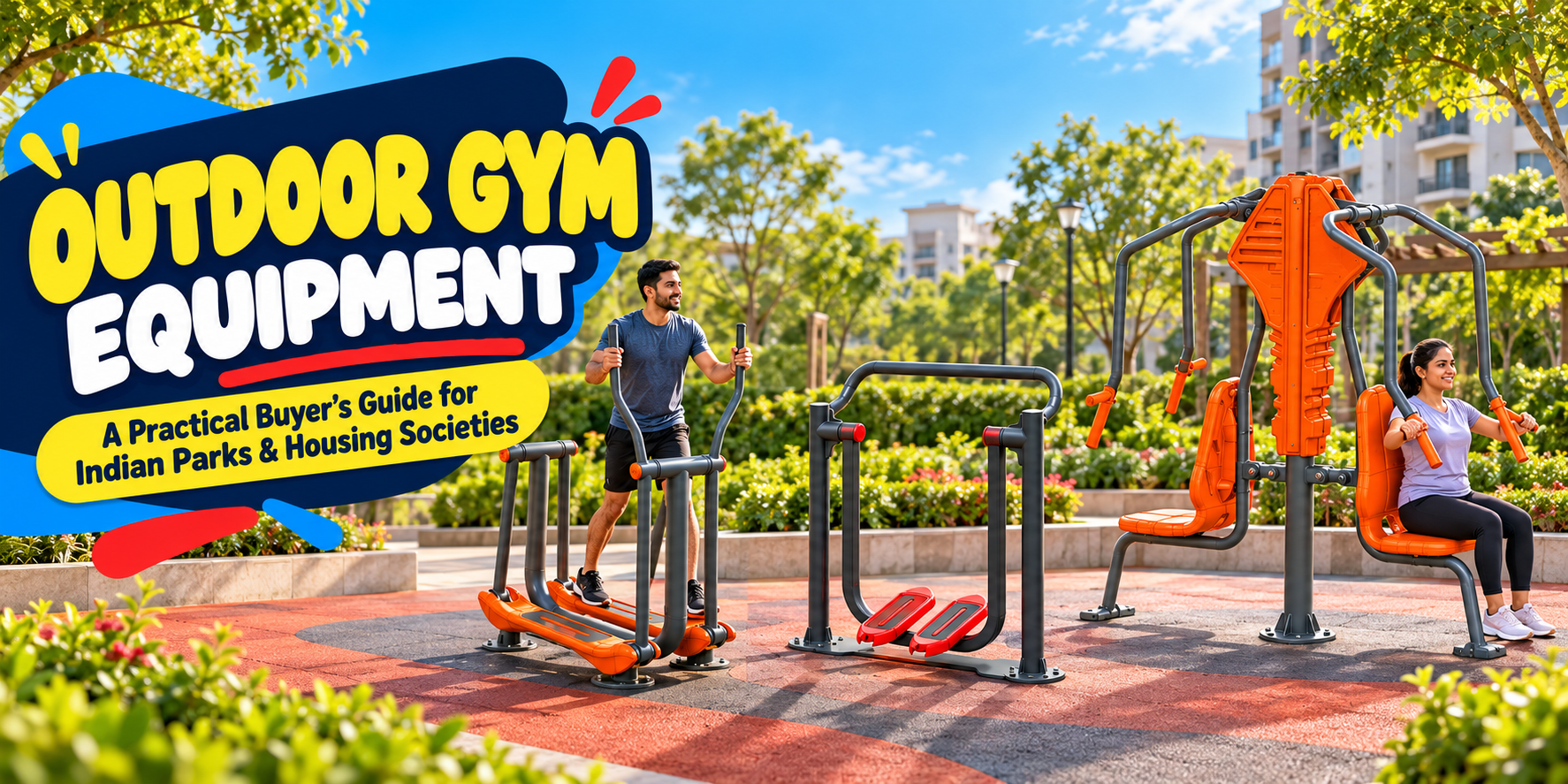
Outdoor Gym Equipment for Indian Parks and Housing Societies: A Practical Buyer’s Guide
The best outdoor gym is the one people can use again next year
Picture a housing society at 7 a.m. One resident wants a gentle warm-up. Another wants a demanding strength session. A third has never used a gym machine and wants to know where to begin. If every station is selected for the imaginary “average user,” the site may serve none of them particularly well.
That is the central challenge in buying outdoor gym equipment. The installation must suit real users, available space, Indian weather and the committee that will maintain it. Shiny equipment on handover day is easy to photograph. Equipment that remains comfortable, safe and useful through several seasons takes a more thoughtful brief.
Arihant Play lists an outdoor fitness range alongside its playground equipment and site surfacing. For a project serving both children and adults, that combination can help buyers plan a coherent amenity. This guide explains the decisions to make before choosing individual machines.
Start with the people and the training they want
Ask who will use the space, when and for what. A municipal park may attract walkers, older adults and people already exercising regularly. A residential society might need short workouts before work and accessible movements during quieter hours. A school campus has a different supervision and age brief. Count likely users at peak times; a single popular machine may become a queue.
Then build a movement list: walking or cardiovascular activity, pushing, pulling, lower-body work, balance and mobility. The World Health Organization recommends that adults include muscle-strengthening activities involving major muscle groups on at least two days each week. A row of similar twisting machines will not deliver that variety. Neither will a strength-only circuit serve residents who want gentler movement.
Write a simple user brief before asking any outdoor gym equipment manufacturer for a quotation: expected ages, training experience, opening hours, supervision, accessibility needs and the caretaker’s maintenance capacity. This gives suppliers a problem to solve rather than a vacant rectangle to fill.
Understand resistance before comparing machines
Outdoor fitness equipment is often described as “strength equipment,” but stations can work differently. A bodyweight station uses the user’s weight and position. A fixed-resistance machine follows a preset mechanism or geometry. Some commercial machines have selectable resistance, including plates or enclosed weight systems. The exact design matters more than the label.
Adjustable resistance can help two users train at different levels on one station. It also adds questions about the starting load, maximum load, plate security, pinch points, moving parts and access control. A plate-loaded machine designed for a supervised gym should never be assumed suitable for an unattended public park. Conversely, a fixed or bodyweight station can be effective when the movement is appropriate and users can vary technique, repetitions or intensity.
Ask suppliers to demonstrate the full movement under the lightest and heaviest intended loads. Can a newcomer get on and off easily? Does the machine return smoothly? Are instructions visible? Can an unsupervised user remove or mishandle parts? These questions are more valuable than a claim that one resistance system is inherently better.
Arihant Play’s published range includes outdoor fitness stations such as leg presses, presses, pull stations, walkers and rowers. Buyers should request current drawings and specifications for the precise models offered. Do not assume a listed station is plate-loaded or adjustable unless its datasheet says so.
Lay out a circuit, not a collection of objects
Sketch a route through the gym before deciding quantities. People need room to enter, perform the full movement, leave and pass someone working out. A seated leg press has a different operating envelope from a walking station. Machine dimensions alone are therefore an incomplete space estimate.
Separate active movement zones so users cannot swing into someone on an adjacent unit. Keep circulation routes and accessible approaches clear. Give beginners a visible place to read instructions without blocking others. If the gym adjoins a children’s playground, distinguish the fitness area with a deliberate path and clear signage; adult workout machines are not children’s play equipment.
Consider sun angles and monsoon drainage at the site visit. A west-facing metal seat can be unpleasant in the late afternoon; pooling water at a foundation can shorten service life and make approach routes slippery. Shade is helpful, but tree roots, falling debris and maintenance access also matter. Benches, drinking water where feasible and a nearby walking loop make the zone easier to use as part of a real exercise routine.
A useful procurement drawing shows each station, movement clearance, route, finished surface level, drainage direction and foundation position. It should be understandable to the owner, installer and future caretaker.
Specify safety by equipment category
Public-access outdoor fitness equipment has its own design concerns. ASTM F3101 addresses permanently anchored fitness equipment intended for unsupervised outdoor use. EN 16630 covers manufacture, installation, inspection and maintenance of permanently installed, freely accessible outdoor fitness equipment. These are reference standards for discussing a specification; the applicable Indian project requirements and any claimed product compliance must be verified for each installation.
EN 16630 distinguishes outdoor fitness equipment from children’s playground equipment. That distinction matters in a mixed amenity: a playground certificate is not automatically evidence that an adult machine has been assessed for its intended use. Ask for model-specific documentation, age and height guidance, installation instructions, inspection schedule and evidence of any claimed conformity.
Inspect handholds, seat edges, moving joints, stops and exposed fixings on the actual sample. Read the usage graphic from a standing position. Ask how an injured or fatigued person exits a station. Good design reduces avoidable hazards, but no machine or standard eliminates the need for sensible use and ongoing inspection.
Plan for heat, rain, dust and misuse
Weather resistance is a system, not a single powder-coat claim. Ask what steel is used, how joints and hollow sections are protected, how water drains, what fasteners are specified and whether bearings or bushes can be replaced. Different sites present different exposures: coastal salt, urban pollution, constant sprinklers, hard monsoon rain and long periods of direct sun.
Foundations need engineering attention too. Request anchoring details appropriate to the site’s ground conditions, finished levels and expected loading. The installer should document any deviations from the approved drawing. A wobbly base or a trapped pool of water cannot be repaired by a better marketing description.
For machines with moving resistance or detachable components, ask where replacement parts come from and how quickly they can be supplied. Check whether special tools are required. If a society has no trained attendant, complexity increases the responsibility to provide clear inspection instructions and dependable service arrangements.
Compare quotations on whole-life value
Two suppliers can quote the same number of machines while offering very different projects. Request an itemised proposal covering model codes, material and finish, installation, civil work, surfacing, freight, taxes, signage, warranties, spare parts and planned inspections. Identify exclusions. A low headline price can hide essential groundworks or leave the owner with no service plan.
Ask what the quoted installation includes: site survey, foundation setting-out, anchoring, commissioning, user instructions and handover documentation. Specify who repairs a defect and how an unsafe station will be isolated until it is fixed. For municipal purchases, check tender and local authority requirements before finalising the specification.
A useful comparison is cost per serviceable station over its expected life, not simply price per machine today. That is a planning lens, not a guaranteed saving: actual life depends on use, exposure and upkeep. Budget for routine cleaning, inspection, replacement parts and eventual refurbishment from the start.
Make adoption part of handover
Installation day is the beginning of use, not the end of the project. A short demonstration can show residents how to adjust or approach each station. Clear pictorial instructions should state intended users, movement and any limitations. A caretaker needs the same handover in a different form: a checklist, contact numbers and the procedure for closing a faulty station.
After opening, observe the gym at several times of day. Which station creates queues? Which is avoided because its starting effort is too high or the seat gets hot? Are women and older residents comfortable accessing the space? Feedback can guide signage, shade or the next procurement phase. Avoid promising usage simply because a machine resembles an indoor gym; measure what happens on this site.
For real estate developers, resident committees, schools and municipal teams, Arihant Play’s outdoor fitness catalogue is a starting point for a product discussion. Bring the site drawing and user brief to that conversation. A worthwhile outdoor gym begins with the people who will return to it, and it succeeds when the design, installation and care plan make that return easy.
Frequently asked questions
1. What equipment should a housing society outdoor gym include?
Start with the users rather than a standard package. Many societies benefit from a mix of approachable cardiovascular movement, upper-body push and pull movements, lower-body strength, and balance or mobility options. A walker, rower or similar station may appeal to some residents; a press or leg station may meet a different training need. Exact selections depend on the population, available footprint and the intended level of supervision.
Walk the space at peak use times. A compact area with six nearly identical machines may provide less useful choice than a smaller, balanced circuit with safe movement space around every station. Consider seating, shade, a clear route into the space and easy-to-read instructions. A person recovering from inactivity may need a different starting point from a regular exerciser. A single station rarely meets both needs equally well.
Ask an outdoor gym manufacturer to show model-specific dimensions, movement envelopes and foundation requirements. Compare the equipment mix against the actual training brief, then check the site drawing with the installer and maintenance team. If children share the larger amenity, give the adult fitness zone its own location and age guidance. The best answer is a layout that residents can approach confidently, use without crowding and maintain after the initial excitement wears off.
2. Is plate-loaded outdoor gym equipment better than fixed-resistance equipment?
Neither system is automatically better. Plate loading can provide a wider choice of resistance, which can matter when stronger and less experienced users share a station. Its value depends on a suitable starting load, sensible increments and safe operation. Public access raises further questions: are the plates retained, can they be removed, what stops the moving parts, and who checks the mechanism? A conventional plate-loaded indoor machine should not be installed outdoors simply because its frame can tolerate rain.
Fixed-resistance and bodyweight equipment can be useful where simplicity, lower maintenance demands and straightforward operation are priorities. Progress can also come from better technique, more repetitions or more challenging body positions where the station permits them. The limitation is that some fixed movements may offer too little or too much effort for particular users.
Ask the supplier for a practical demonstration rather than accepting a generic “progressive” claim. Compare actual resistance range, usable range of motion, product documentation, applicable safety assessment, durability and service support. Arihant Play’s published outdoor fitness pages should be checked model by model; they do not by themselves establish that Arihant offers plate-loaded stations. Choose the system that fits the site’s users and operating capacity.
3. How much space does an outdoor gym need?
There is no reliable universal square-metre figure for an outdoor gym. The footprint of each machine is only the beginning. Allow for its full operating movement, access and exit, paths between stations, any specified safety space, foundations and the place where users pause to read instructions. A seated press and a walker have very different envelopes even if their frames look similar in a catalogue.
Start with a scaled site plan. Mark trees, drainage channels, doors, ramps, utilities and the path people actually take across the site. Place the most popular stations so waiting users do not block the circulation route. Add room for a companion or caregiver where needed. If the zone is next to a playground, plan a clear separation that prevents a child from walking into an active machine movement.
Then ask the manufacturer or installer to overlay the current installation drawings for the selected models. The exact clearances must come from the equipment specification and applicable project standard, not an arbitrary rule of thumb in a blog. If the layout becomes cramped, remove a station before shrinking operating space. A usable four-station circuit is more valuable than a crowded six-station photograph.
4. Can children use outdoor gym equipment in a public park?
Do not assume they can. Outdoor fitness and children’s playground equipment are different product categories with different intended users and hazards. The published scope of ASTM F3101 refers to unsupervised outdoor fitness equipment intended for people aged 13 and older; EN 16630 distinguishes outdoor fitness equipment from children’s playground equipment. A particular machine’s manufacturer instructions may set additional conditions. These references do not replace local project requirements.
In a shared park, locate the adult exercise zone away from the natural run of play. Show intended ages or heights on clear signage and avoid placing a machine where a child can reach its moving parts while someone else exercises. Paths, seating and visual supervision can connect the spaces without treating them as interchangeable.
For a school or family destination, specify genuine age-appropriate playground equipment for children and a separate fitness brief for adults or eligible older students. Ask the supplier to identify the intended user group for every product and show the documentation behind that claim. Supervision policies also matter: a sign does not compensate for a poor layout or a station likely to attract unsupervised child play.
5. What should an outdoor gym manufacturer provide before purchase?
Request a model schedule with codes and drawings, material and coating specifications, intended age or height group, user instructions, foundation and anchoring requirements, maintenance instructions and evidence for any safety-standard claim. If the proposal includes adjustable or removable resistance, ask specifically about its retention, adjustment limits and inspection points. A rendered image alone cannot answer those questions.
Ask for a site-specific layout, including equipment movement areas, accessible approaches, drainage and existing obstacles. Have the quote itemise equipment, civil works, surface preparation, installation, taxes, delivery, signage and commissioning. Check warranty terms carefully: what is covered, for how long, who pays labour or transport, and what normal wear excludes. Request a spare-parts list and a realistic service contact.
A playground equipment manufacturer may be well placed to coordinate a larger park amenity, but the fitness machines still need appropriate technical documentation of their own. If a supplier claims EN 16630 or another standard, ask which exact models were assessed and for what configuration. Keep the final approved documents with the owner. They become essential when the site is inspected, repaired or expanded years later.
6. How do we maintain outdoor exercise machines through the monsoon?
Begin with the manufacturer’s maintenance schedule and adjust the frequency to local use and exposure. Before the monsoon, inspect drainage, anchors, coating damage, loose fasteners and all moving joints. Remove debris that can hold water around foundations or block drainage. After heavy rain, inspect again for standing water, unexpected movement, corrosion or damaged signs. Do not use oil or grease indiscriminately; follow the specified procedure for each bearing or bush.
Set a simple reporting route for users and caretakers. If a handle loosens, a moving part binds or a seat breaks, mark the station out of service until a competent person repairs and checks it. Logging the date, defect, action and return-to-service decision protects users and helps the owner spot repeated failures. A photo record can make seasonal comparison easier.
Coastal sites and areas exposed to sprinklers or heavy dust may need more attention than a sheltered inland site. Ask the supplier what replacement parts are stocked and how fast they can be delivered. The aim is not to promise maintenance-free equipment; it is to make the necessary care predictable, budgeted and straightforward to perform.
7. What is the difference between outdoor gym equipment and a playground?
A playground is designed around children’s play, including imagination, social interaction and age-appropriate physical challenges. An outdoor gym is designed around exercise movements for its stated user group, generally youths or adults. The products may sit in the same park, but they should be specified and evaluated for their own intended use. The EN 16630 description explicitly distinguishes outdoor fitness equipment from children’s playground equipment.
That distinction affects siting. Children may run unpredictably between a slide and a swing; an exerciser may be moving a lever or pressing with considerable force. Putting both movements into a single unplanned cluster creates avoidable conflicts. A well-designed shared park gives each activity a clear zone, then links them with accessible paths, seating and visibility for families.
It also affects procurement. Ask for the appropriate equipment documents and safety claims for each product category. Do not assume a playground certification covers a fitness machine or vice versa. Arihant Play’s site presents both play products and outdoor fitness products, which is useful for coordinated planning. The project brief should still specify who each item is for and how the mixed-use site will be managed.
8. Is an outdoor gym suitable for older adults or beginners?
It can be, provided the equipment and layout are chosen for their needs. Look at the ease of entering and exiting each station, the initial effort, seat height, handhold shape, pace of movement and quality of instructions. A machine that starts too heavily or requires an awkward step up can discourage use even if it is strong and well finished. Walking, supported movements and options for balance can broaden the circuit, but individual ability varies widely.
Visit the site with potential users before finalising the specification. An older resident may value shade, a bench and a short, even path as much as an additional machine. Provide enough room for someone using a mobility aid to reach the area, and ask how different body sizes will fit the stations. Avoid labelling any machine “safe for seniors” without a model-specific assessment and clear intended-use guidance.
People with a medical condition, recent injury or uncertainty about exercise should seek advice from a qualified health professional. The gym’s role is to provide usable opportunities, not medical treatment. For the owner, the practical objective is choice: a beginner should have an approachable start while regular users still find suitable challenges elsewhere in the circuit.
9. How can a developer assess the value of an outdoor gym amenity?
Treat value as more than the number of stations installed. At design stage, consider who can reach the gym, how many people can use it comfortably at peak hours, whether its movements complement a walking loop or play area, and whether it fits the development’s maintenance budget. Equipment selected solely to fill a marketing render may perform poorly after residents move in.
At handover, collect the installed drawings, model schedule, warranties and inspection instructions. After opening, observe use at morning and evening times rather than relying on a single event photo. Which machines are used repeatedly? Do people wait? Are some avoided because of heat, unclear instructions or unsuitable resistance? Ask residents for specific feedback and fix the practical barriers you can change.
A property team may wish to track service requests and downtime as well as usage. That connects amenity value with actual ownership cost. Avoid promising an increase in property prices or resident retention unless you have credible project-specific evidence. A stronger and more defensible claim is that a well-planned outdoor fitness zone adds a convenient exercise option that the development can keep available over time.
10. How should we compare outdoor gym equipment quotations in India?
Create one brief and send it to every bidder. Include the site plan, intended user groups, opening hours, any accessibility requirements, desired movement mix and the expected handover scope. Ask each supplier to identify its exact machine models and provide a marked-up layout. Without a common brief, a lower quote may simply include fewer foundations, weaker documentation or less installation work.
Compare materials, corrosion protection, moving-part design, anchoring, age guidance, spare-parts availability and inspection requirements. Request the evidence behind standard or certification claims for the exact quoted models. Clarify civil work, surface preparation, delivery, taxes, installation, training, warranties and annual care. A line-by-line comparison often reveals that two “six-machine gyms” are different purchases.
Before awarding the project, agree on who will own and maintain the area, who will inspect it and what happens when a station is unsafe. If public procurement rules apply, follow the relevant authority’s tender and approval process. Ask Arihant Play or any other manufacturer to update the proposal against the final site conditions; catalogue information alone is not a site-specific design. A good quotation should make future responsibilities as clear as today’s price.