



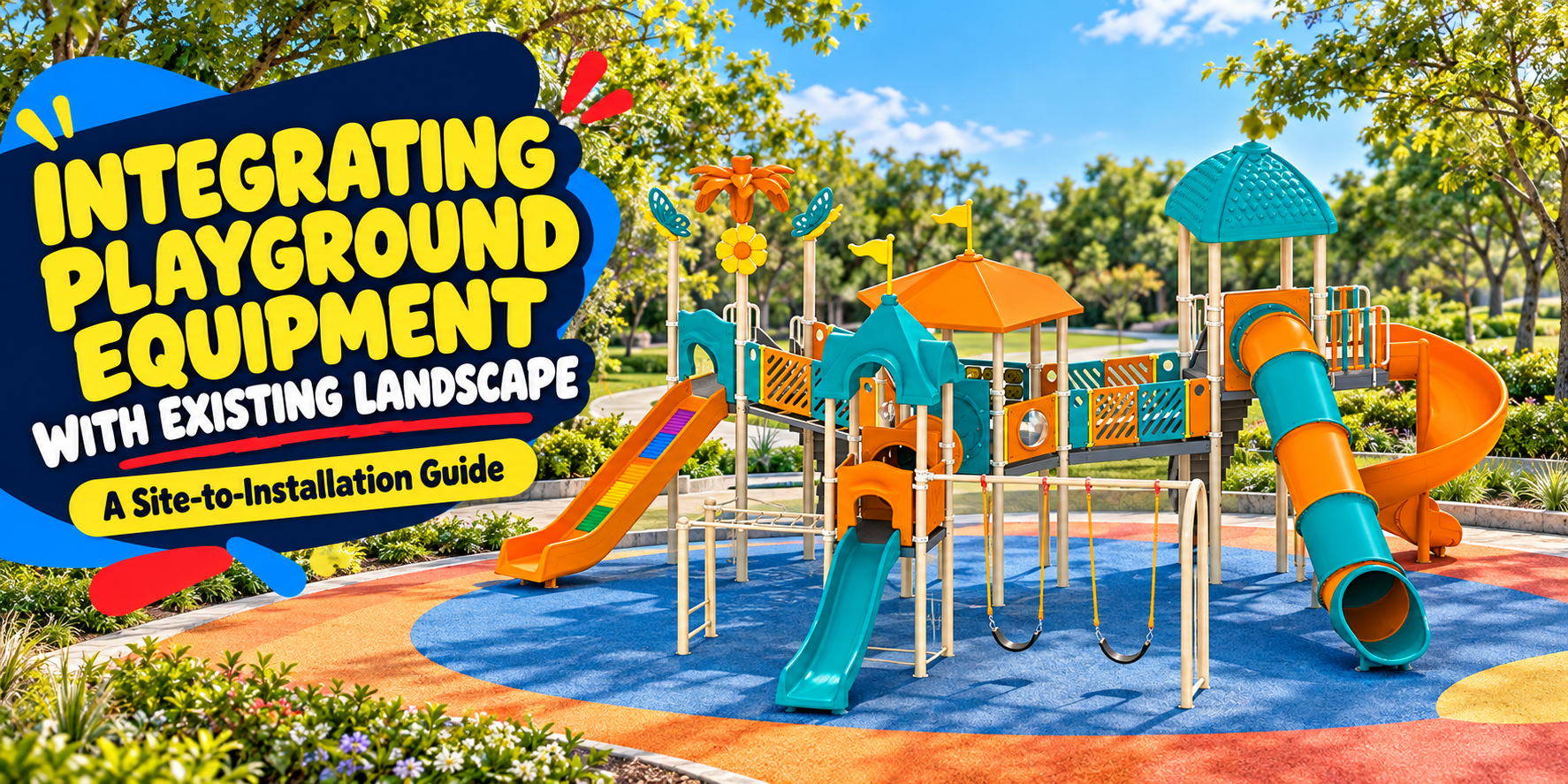
How to Build a Playground Around the Landscape Already There
A mature tree shades the centre of a proposed school play area. A designer places a climber beneath it, and the image is instantly convincing. Then the installers arrive: footings conflict with roots, a protective surface would raise the finished level, and a branch falls inside the space children need around the equipment. The landscape and playset looked compatible in a rendering, but they had never been resolved as one construction project.
Natural-landscape integration begins before an outdoor playground equipment supplier proposes a product. It calls for a surveyed site, a decision about what to preserve, and technical agreement between the arborist, landscape architect, civil engineer and manufacturer. This guide follows the decisions in the order a real project needs them.
Record the landscape as infrastructure
Commission a measured plan with levels, boundaries, drains, utilities, existing paths and all significant trees. For each tree, note its location, canopy, visible condition and relationship to the proposed play area. A qualified arborist should assess important trees and recommend which can be retained and how construction might affect them.
Roots do not stop at the edge of a neat circle around the trunk. The International Society of Arboriculture's guidance on avoiding tree damage during construction recommends that an arborist define a tree protection zone early. That zone affects where equipment foundations, trenches, stored materials and construction vehicles can go.
Photograph the site after rain and during likely play hours. Note whether runoff crosses the intended playground, where the ground remains wet, and how sun and shade change. An existing slope can offer interest, but it cannot be assumed suitable for a structure or accessible route without a level survey.
Draw two sets of boundaries on the same plan
The landscape has protection areas; the equipment has use zones. Neither should be left to the other contractor to infer. Ask the playground equipment manufacturer for the exact model's footprint, required play area, fall heights, entry and exit points and foundation positions. Lay these over the arborist's protection plan and the site's access routes.
The U.S. CPSC Public Playground Safety Handbook discusses use zones and the need to keep them free of obstacles. This is a useful international reference; the final design must meet the applicable Indian project requirements and the manufacturer's instructions. A trunk, raised root, edging stone or garden seat cannot be placed in a required clear area simply because it is “natural.”
If the plans collide, change the equipment position or model before deciding to cut roots. The choice may be a lower activity beside the tree, with more demanding play in a separate clearing. Let the measured site determine the layout, not the reverse.
Document the decision in a simple clash register: tree, root area, play use zone, path, drain or footing; who owns the conflict; and how it was resolved. This prevents the same problem from returning when a different contractor begins work. It also makes the reason for a design change visible to a client who has only seen the earlier rendering.
Choose foundations after understanding the roots and ground
Playground posts and anchors transfer loads into the ground. The location and form of foundations must be designed for the equipment, soil and site conditions. A claim that a footing is “root friendly” is not enough; the arborist and relevant engineer should assess the actual excavation, location and construction method.
Avoid driving machinery through protected soil or using the root area as storage. The Arbor Day Foundation's tree-construction advice recommends marking and fencing trees to be retained. The specification should say when protection fencing goes up, who may enter the area, and what happens if unexpected roots appear during excavation. Altering a post or anchor position on site requires the manufacturer's and engineer's review; installers should not improvise around roots.
For a sloping site, the engineer should also check retaining needs, erosion and finished levels. An attractive natural bank is not automatically a safe slide support. Every proposed natural feature used as play equipment needs assessment for its intended activity, not just its landscape value.
Make the surfacing transition a technical detail
An impact-protective surface and a planted area have different jobs. The selected equipment's fall height and use zones determine where protective surfacing is needed. Grass can serve open play and landscape areas, but ordinary turf should not be assumed adequate beneath elevated equipment. Arihant Play lists rubber flooring; the actual tested system, base, thickness and drainage detail must be selected for the project.
Draw a section through every boundary between play surface, path and planting. Will soil spill across it? Is there a trip edge? Can maintenance staff remove debris? Will raising the surface bury a tree's root flare or change drainage around the trunk? A continuous surface visually linking play and landscape is appealing, but its construction must work at all these interfaces.
The U.S. Access Board's guide to play surfaces emphasises planning an accessible route and maintaining it. Its standards apply in the U.S.; check the relevant local requirements. In any setting, a route that becomes muddy or develops a lifted edge will not serve users well.
Control water before adding “natural” drainage features
A rain garden, vegetated swale or permeable path may be useful, but it cannot be dropped into leftover ground beside a slide. These are engineered systems requiring suitable soil, levels, outfalls, overflow paths and maintenance. The U.S. EPA's description of green infrastructure explains that a rain garden collects water temporarily and lets it infiltrate or flow through an underdrain.
The civil team should show where runoff goes in ordinary and heavy rain. Keep ponding and erosion away from equipment footings, protective surface and accessible routes. A swale should not become an unexpected drop-off in a child's running path. Coordinate irrigation too: a sprinkler intended for planting may repeatedly wet the play surface or a metal connection.
In monsoon conditions, the design should be tested against the site, not a general assertion that permeable surfaces will drain. Soil investigation, finished levels and a maintained outlet are more useful than a “green” label on a drawing.
Treat natural objects as equipment when children use them that way
A boulder, balance log or slope may be a landscape feature on paper and a climbing challenge in practice. If the design invites children to climb or jump from it, specify its stability, placement, likely fall height, surrounding surface and inspection. Loose stones near an equipment exit can be obstacles; a log that rots or shifts needs a replacement plan.
Natural textures can offer rich sensory experiences without becoming a substitute for engineered play elements. Place them where children can interact safely and where carers can see them. Avoid placing an interesting object just outside a formal play area while ignoring the predictable way children will use it.
The CPSC handbook gives general principles for fall areas and hazards. A designer should assess the entire site as children will experience it, rather than declaring one patch “landscape” and leaving it outside the play review.
Coordinate one construction sequence
Drawings alone will not save a tree if construction trucks park over its roots. Set out a sequence: mark and fence protection zones, confirm services, verify equipment setting-out, construct approved foundations, install the structure, complete drainage and surfacing, and plant or restore disturbed areas. The sequence may differ by project, but protection must begin before heavy site work.
Give each contractor a shared drawing and a named contact for conflicts. If an unexpected root, utility or ground condition appears, stop the affected work and agree a revision. A site-specific change to equipment anchors, protective surface or play layout should be documented and reviewed by the responsible professionals.
Set a hold point before pouring foundations and another before covering drainage with the surface base. Photos and measurements at those stages preserve evidence of work that will later be hidden. Make sure the completed playground is checked against the approved plan, not just against the installer's on-site marks.
At handover, inspect the play equipment and accessible route, verify surfacing and drainage, record tree condition and deliver as-built drawings. Assign future inspection of both the play system and landscape. Without these steps, a technically coherent design can still fail in construction.
What to ask Arihant Play
Arihant Play's equipment range includes multi-activity systems, climbers and other outdoor products. Ask for model-specific drawings showing use zones, falls, anchors and maintenance access. Share the tree survey and landscape protection plan before a product is selected; a catalogue image cannot show whether it fits among the actual roots and contours.
The result should feel effortless to children: shade, routes, open ground and equipment creating one place to explore. Achieving that simplicity requires careful coordination behind the scenes. Contact Arihant Play with the survey and site brief to begin a technically grounded proposal.
Frequently Asked Questions
1. What information is needed before placing equipment near an existing tree?
Start with an accurate tree and site survey, not an approximate circle on an architectural sketch. Record the trunk, canopy, ground levels, paths, utilities, drainage and proposed play boundary. A qualified arborist should assess the tree's condition and define a protection zone that takes account of roots and likely construction impacts.
Obtain the exact equipment model's footprint, use zones, foundation positions, height and access requirements from the playground equipment manufacturer. Put the tree protection and equipment information on one plan. A play structure that appears to fit beneath the canopy may still conflict with roots below ground or branches above.
Check the likely hours of play, because shade moves during the day. Also ask whether falling fruit, branches or debris will affect the surface and what tree maintenance is planned. The ISA tree-construction guide explains the value of early protection planning; the CPSC handbook gives context for clear use zones. Site-specific professionals should decide final positions. No universal trunk setback suits every species and every play product.
Keep the arborist's advice with the project records so construction and future maintenance teams understand why the final position was chosen.
2. Can playground foundations be installed without harming tree roots?
Sometimes a layout and foundation strategy can be developed around a retained tree, but it depends on the exact tree, roots, equipment loads, soil and excavation. A shallow-looking footing is not automatically safe for roots or adequate for the equipment. An arborist should define what ground can be disturbed; the structural engineer and manufacturer should design and approve the anchoring.
Mark the tree protection zone before work. Keep vehicles, excavated spoil, materials and repeated foot traffic out of protected soil where the arborist directs. If significant roots are encountered, pause excavation and obtain a revised technical solution. Do not move a playground post on site without reviewing the product's structure and clearances.
The ISA guidance stresses defining the protection zone early. A buyer should ask the supplier for foundation drawings and identify who will coordinate changes. The sensible result may be to move the equipment outside the sensitive area and let the tree shade adjacent seating or open play. Preserving a tree is valuable only if it remains healthy and the equipment can still be installed correctly.
An agreed stop-work procedure should appear in the method statement, not just in a meeting note after excavation has begun.
3. Can a slide be built into an existing natural slope?
A slope may create a compelling play setting, but a slide cannot simply be laid onto a bank and declared safe. The designer needs accurate contours, geotechnical and drainage information where appropriate, a product engineered for that configuration and an assessment of entry, exit, fall areas and access. The ground above and below the slide must remain stable and maintainable.
Ask the playground equipment manufacturer whether the selected slide is approved for slope installation. Confirm where it is anchored and how changes in soil level or erosion will be managed. The civil engineer should review retaining, stormwater flow and the effect of excavation on nearby trees. Plan a route to the top that suits intended users and does not become slippery after rain.
The CPSC playground handbook is a general reference for slide use zones and surfacing, while the applicable local standard and exact manufacturer's details should govern the installation. If the site cannot support a suitable slope slide, a separate structure beside the landform may preserve the visual idea without relying on unsafe improvisation. An appealing section drawing is a starting point, not final engineering.
Ask who will inspect the bank after heavy rain and repair erosion before children resume play there.
4. Is a tree suitable for supporting a swing?
Do not assume so. A living tree changes over time and has species-, condition- and branch-specific characteristics. A branch that holds a person briefly is not evidence that it can safely carry repeated dynamic swing loads. Attaching hardware can also damage the tree. A public-use swing requires a properly assessed support, clearances, seat and protective surface.
If a tree-mounted idea is proposed, consult a qualified arborist and structural/playground specialists and confirm the requirements of the project. In many cases an engineered freestanding swing near a tree will be easier to specify, inspect and maintain. Position it so the tree, roots, trunk and any seating do not intrude into its required use zone. The CPSC handbook distinguishes swing types and their movement areas; do not apply a generic clearance.
Plan for future growth and pruning too. A freestanding frame may be relocatable only with new design and foundations, while the tree may change the shade pattern. The goal is the experience of swinging within a green setting, not forcing the tree to act as equipment when its suitability has not been demonstrated.
Do not let a decorative image become an installation instruction. Show the actual engineered support in the approved drawing.
5. How do you protect a mature tree during playground construction?
Protection begins before contractors bring machinery onto the site. Have an arborist identify the tree protection zone, then mark and fence it in the agreed location. Include the boundary and rules in tender drawings and site induction. Do not use protected ground for vehicles, deliveries, storage, spoil or washout unless a specialist has specifically approved a method.
Survey utilities and foundation locations early so crews are not asked to solve conflicts by cutting roots. If excavation is unavoidable near a retained tree, the arborist and relevant engineer should define the method and supervision. Record tree condition before work and inspect it during construction. The ISA's construction guidance explains this approach; the Arbor Day Foundation also recommends marking and fencing important trees.
Protection does not end when the playset is bolted down. Surfacing, grading, irrigation and landscape restoration can still change conditions around roots. Leave the tree with viable growing space and an agreed maintenance plan. A saved trunk beside a damaged root zone is not a successful retention strategy.
Tree fencing should remain in place until the relevant works are finished, including surface preparation and delivery of landscape materials.
6. Can boulders and logs replace manufactured playground equipment?
They can offer different play experiences, but their natural origin does not make them automatically stable, safe or suitable for every age. If children are likely to climb a boulder or balance on a log, treat it as an intended play element. Assess movement, anchoring, likely fall height, surrounding use area, impact surface, sharp edges and long-term deterioration.
A log may rot, split or shift. A boulder may roll or present an awkward landing edge. Ask who will inspect each element and who can replace it when worn. Natural materials can also be part of the landscape without being intended for climbing; the boundary should reflect how children will actually use the site, not just how the drawing labels it.
The CPSC handbook provides general principles on obstacles, fall zones and maintenance, while local requirements and specialist design govern the project. Manufactured climbers from a supplier such as Arihant Play may be a better option for a particular challenge if documented performance, age guidance and replacement parts are priorities. Natural and manufactured elements can coexist when each is properly specified.
Specify whether these objects are intended for free play or a defined route; that decision affects their placement and inspection.
7. What happens when protective surfacing meets lawn, mulch or planting?
That meeting point needs a drawn construction detail. The specified protective surface must cover the equipment's required area and connect to circulation without a trip edge. Lawn, mulch and planting have different levels, drainage, maintenance and wear. Soil should not wash onto impact surfacing, and loose material should not spread into an accessible route.
Ask for a plan and section showing each material, base, edging, levels, drainage and future maintenance access. Check that an edge does not become an obstacle within a use zone. Ensure irrigation for plants will not repeatedly soak vulnerable surfaces or create ponding. The U.S. Access Board play-surface guide explains why an accessible route must be both designed and maintained; its legal provisions are American, so check the local project's requirements.
Ordinary grass is valuable for open play but is not automatically a tested impact surface. Arihant Play's rubber-flooring category is one option to discuss; the complete surface system must be specified for the selected equipment. The edge detail determines whether the landscaping and playground continue to work together after rain and wear.
Check the transition after construction and again after a rainy season, when settlement and erosion can expose a problem.
8. Will a rain garden or swale solve playground drainage?
It may help as part of a designed system, but it is not an automatic solution. A rain garden receives runoff, temporarily holds it and then infiltrates or drains it according to its design. Its location must reflect soil conditions, levels, overflow and maintenance. It should not create ponding, a sudden drop-off or a blocked access route beside active play.
Start with a survey and ask the civil engineer to trace water from equipment and paths through the proposed system during both ordinary rain and heavy storms. Keep overflow away from play foundations and protective surfaces. The EPA's green-infrastructure overview explains how bioretention works, but an Indian monsoon site needs its own technical design rather than a copied detail.
Clarify who will remove sediment and litter, maintain planting and check outlets. A vegetated feature that is never maintained can clog or become unusable. Sometimes a conventional drain plus planted shade is a simpler solution. Judge the choice by site performance, user safety and realistic operations, not by whether a rendering looks greener.
Ask for an overflow route on the drawing. The water still needs somewhere to go when the feature is temporarily full.
9. Who should coordinate the landscape and playground suppliers?
The project should name one design lead to maintain a coordinated plan and resolve conflicts. Often this is the architect or landscape architect, working with a civil engineer, qualified arborist where trees are important, and the playground equipment manufacturer. Each discipline supplies different information: the manufacturer provides model-specific use zones and foundations; the arborist defines tree protection; the civil team resolves levels and water; the landscape team handles planting and routes.
Issue the same current drawing to every contractor. Record product codes, drawing revisions, tree protection fences, utilities, ground levels, surfacing, drainage and access. Hold a coordination review before ordering and another before breaking ground. If unexpected conditions arise, agree a documented revision rather than allowing a trade to move equipment or edging by eye.
A CPSC handbook can help frame safety questions, but it does not assign responsibility on an Indian site. Contracts should state who designs, approves, installs and inspects each interface. The best result is not created by one profession working alone; it depends on decisions that remain consistent from concept through construction.
Give the design lead authority to issue one revision-controlled plan; informal mark-ups from separate contractors create avoidable installation errors.
10. How can an existing landscaped park be retrofitted with new play equipment?
Begin with an audit of trees, utilities, drainage, levels, routes and existing amenities. Identify what is healthy and worth retaining, where play use already occurs, and which paths people actually take. Survey the proposed equipment area rather than assuming a lawn can accept foundations without affecting roots or buried services.
Set the selected equipment's full use zone on the measured plan. Check that trunks, seating, boulders and bed edges stay outside it. Review protective surface, accessible access and water flow as a package. Ask whether works can be staged while keeping safe parts of the park open; protect retained trees before deliveries begin. The ISA construction guide is relevant when work approaches existing roots.
At handover, document the as-built equipment, surfaces, drainage and tree condition. Assign inspection to the relevant operator. A successful retrofit often involves moving a proposed unit a few metres or choosing a different model to preserve a valuable tree and a usable route. The aim is to improve the park's play opportunities without damaging the living landscape that made the site attractive.
Consult park users before closing a familiar route. A retrofit can improve play while preserving the circulation people already rely on.
References and publication checks
- International Society of Arboriculture: Avoiding Tree Damage During Construction
- Arbor Day Foundation: Saving Trees During Construction
- CPSC: Public Playground Safety Handbook
- U.S. EPA: Types of Green Infrastructure
- U.S. Access Board: Guide to Play Surfaces
- Arihant Play equipment range and rubber flooring