



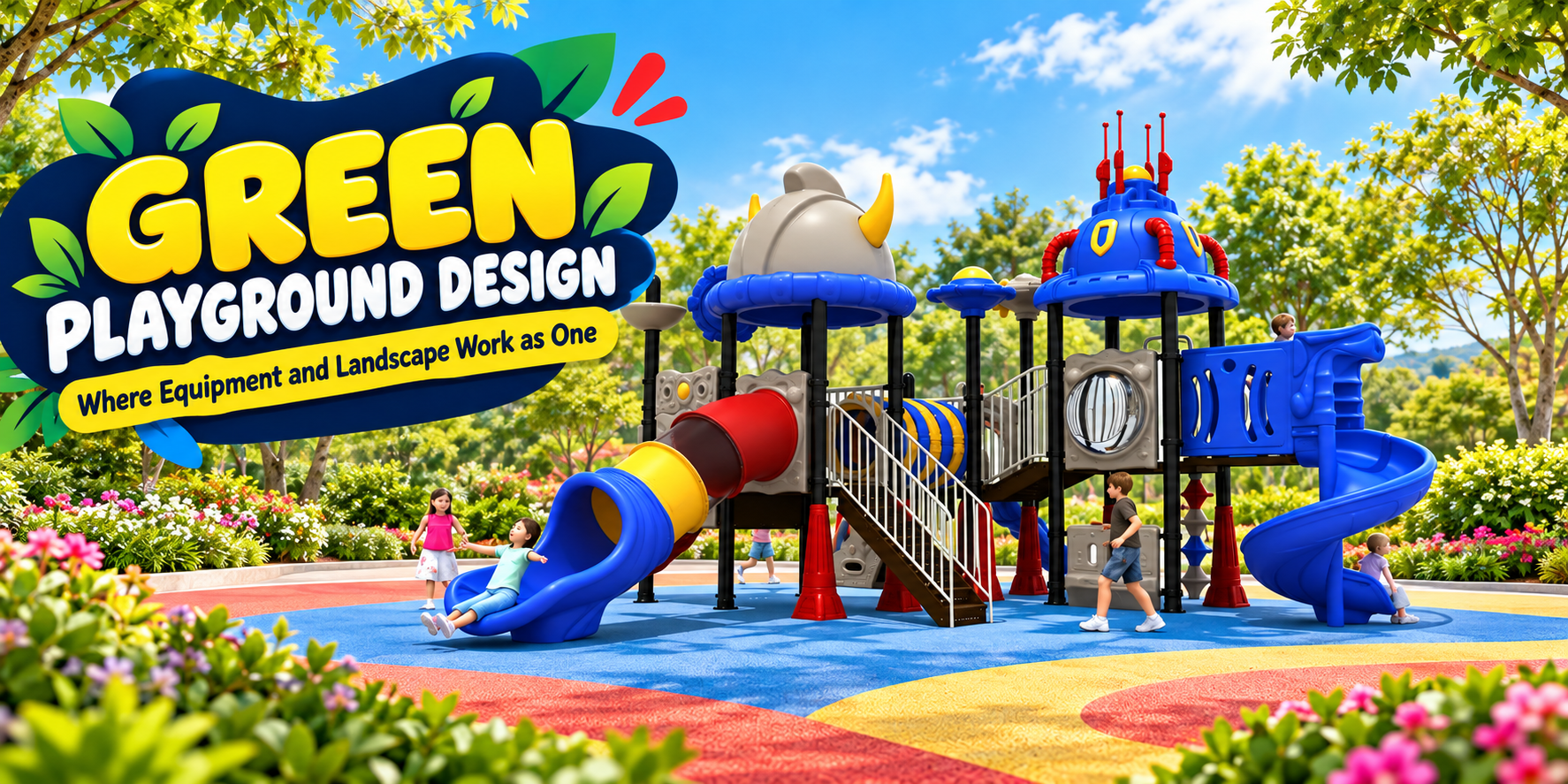
Green Playground Design: Where Equipment and Landscape Work as One
Picture a playground on a hot afternoon. There is a bright slide, an immaculate paved path and a row of trees too far away to shade either. The landscape looks green from an upper-floor balcony, yet the children crowd into the single usable patch of shade.
That is the difference between adding planting to a playground and designing the two together. A green playground starts with children's movements and the site's sun, water and existing trees. The equipment and landscape then shape one another. For an architect, school, developer or resort operator, the result can be a place that feels inviting through more of the day and is straightforward to look after.
Here is how to turn that idea into a buildable brief.
Read the site before selecting a playset
Walk the plot at the hours children are likely to use it. Record shade in the morning and afternoon, low spots after rain, prevailing traffic through the site, existing mature trees, irrigation lines, utilities and views from seating. Draw these conditions on the same plan as the available play area.
A mature tree can be an asset, but its trunk is not a convenient support for a swing and its root area is not spare excavation space. An arborist or qualified landscape professional should assess valuable trees before foundations and grading are fixed. The design team should also check overhanging branches, falling debris and maintenance access.
Agree on the desired experiences before the equipment shortlist: vigorous climbing, imaginative group play, tactile exploration, a quiet pause, or a circuit connecting several activities. Green space is especially valuable when it creates a reason to explore rather than merely filling the strip outside the equipment fence. UNICEF's review of urban green space and children's development makes the broader case for access to green environments; a single project's benefits will still depend on its design, accessibility and use.
Draw the invisible boundaries first
The defining technical challenge is coordination. Every selected item of outdoor playground equipment has a physical footprint and a surrounding area needed for use. Mark those areas, slide exits, moving arcs, accessible routes, drains and service access before drawing planting beds. Keep trunks, raised edging, boulders and shade supports out of required use zones.
The U.S. Consumer Product Safety Commission's Public Playground Safety Handbook gives detailed guidance on use zones and protective surfacing. It is an international reference, not an automatic approval for an Indian project. The applicable standards, equipment manufacturer's instructions and project drawings should decide the final layout.
This sequence prevents an expensive mistake: landscaping installed beautifully in a space later needed for a slide landing or safe circulation. It also gives the landscape architect and playground equipment manufacturer a shared drawing to review, rather than separate plans that conflict on site.
Let shade follow the play
Trees lower surface and air temperatures through shade and evapotranspiration, according to the U.S. Environmental Protection Agency. For a playground, the important question is where and when the shade falls. A tree behind a seat may do little for a climbing route used at 4 p.m.; a canopy over a waiting area can make a noticeable difference to the people who spend time there.
Map projected shade for the season and use hours, allowing for how newly planted trees will grow. Keep canopies and roots compatible with structures, paths, visibility and irrigation. Where mature canopy cannot provide timely shade, a properly designed shade structure may be useful, provided its supports and fixings respect equipment clearances and engineering requirements.
Do not promise a fixed temperature reduction. Species, canopy density, ground material, wind and time of day change the outcome. The CDC advises shade and other sun protection for children outdoors. Comfort should be assessed on the actual site, not inferred from the number of trees in a rendering.
Choose equipment to complement the ground
A nature-themed playground need not imitate a forest. The better question is what children can do between features. A climber near an open lawn can invite a sequence of climb, descend, run and regroup. A compact multi-activity system can anchor a landscaped clearing while leaving enough unstructured space for games. Arihant Play's multi-activity systems bring several actions into one connected structure; its climber range offers another way to build a more focused challenge. Compare each product's intended ages, use zone, fall height and capacity before deciding where it belongs.
Use planting to frame an experience, not to conceal it. A low border beside a path may suggest a route. A planting pocket next to a seating place can invite observation of leaves, seasons or insects. Avoid dense screens at the exact point where carers need to see children, and allow room for plants at their mature size rather than their nursery size.
Playful colours can work with greenery; there is no requirement to paint every structure brown or green. A clear, welcoming play landmark is often easier for children and families to find than a structure camouflaged into the landscape.
Keep soil, lawn and protective surface in their proper roles
Grass is useful for open games and resting. It is not automatically an adequate impact surface beneath elevated playground equipment. Repeated landings also wear grass into bare soil, which can become hard, muddy or slippery. Protective surfacing must be selected and installed for the equipment's fall height and required area, then maintained.
Treat the boundary between surfacing and landscape as a detail worth drawing. Where does rain go? Can soil wash onto the play surface? Will a raised planter edge become an obstacle? Can a wheelchair user travel from the main path into the play area? Arihant Play lists rubber flooring among its product categories, but the specification for any site should be checked against the selected system's tested performance and the relevant project requirements.
The CPSC playground checklist underscores the role of protective surfaces and routine inspection. A green appearance does not replace this work.
Give rainwater somewhere sensible to go
A greener playground can reduce hard paving, but “permeable” is not a substitute for a drainage plan. Different soils drain at different rates; heavy rain can carry mulch into routes and leave water standing near foundations. The civil and landscape teams should coordinate finished levels, subsurface drainage, tree irrigation and the surfacing base.
Rain gardens or vegetated edges can receive runoff where site conditions allow. The EPA describes green infrastructure such as rain gardens, bioswales and permeable pavement as ways to capture water where it falls. In a children's play setting, keep such features away from equipment use zones, avoid unexpected drop-offs, and check water depth, ponding and maintenance with qualified designers. The point is to manage water safely, not to assume every green feature belongs beside a slide.
Make natural play accessible and visible
Children should be able to enjoy the greenery without needing to climb a high platform or cross an unstable surface. A level loop, reachable planting, ground-level play elements and places to sit can make the landscape part of shared play. Keep the route usable after watering or rain, and avoid placing the only engaging nature feature beyond a loose or steep path.
The U.S. Access Board play-area guide explains the relationship between accessible routes and ground-level and elevated play components. Its legal framework is American; use it as design insight while checking India's applicable project requirements. A landscape should support supervision as well as inclusion: an adult should be able to see a child moving behind planting or towards a boundary.
Specify plants for children and maintenance teams
Plant choice deserves more than a label saying “native greenery.” Ask a local horticultural professional to shortlist species for the region, soil, water availability, mature canopy, pruning needs and likely contact with children. Keep thorny, toxic or highly irritating plants out of touch zones, and avoid fruit or seed drop where it will make surfaces slippery. Verify species rather than relying on common names.
Decide who waters young trees, replaces failed planting, prunes branches and removes litter. This is particularly important at a school during holidays and at a resort during peak season. A landscape that is easy to maintain will retain its play value longer than one that depends on constant rescue.
A single plan for three specialists
Before approval, ask the architect or landscape architect, civil engineer and playground equipment supplier to review one coordinated plan. It should show trees at mature size, equipment use zones, accessible routes, shade, drainage, protective surfacing, lighting if required, seating and maintenance access. A section drawing should resolve levels, foundations, root protection and the surfacing base.
Then ask the people who will operate the space what happens on a rainy day, during a full school break or while one component is closed for repair. Their answers often expose more than a polished visualisation does.
The best green playground does not make children choose between nature and play. It allows the two to meet safely and naturally, with room to move, discover and return tomorrow.
Explore Arihant Play's equipment range or contact the team with a site plan and landscape brief for a coordinated proposal.
FAQs
1. Can playground equipment be installed directly on natural grass?
Natural grass can be part of a playground, especially in open areas for running, group games and rest. Its suitability under equipment, however, depends on the equipment's fall height, the required protective surfacing and the performance of the installed ground system. Ordinary turf should not be assumed to provide adequate impact protection beneath elevated equipment. High-wear areas near slide exits and access points can also lose their grass and become compacted or muddy.
First obtain the manufacturer's use-zone drawing and fall-height information. Then specify a protective surface for those areas that meets the applicable project requirements. Place turf where children can use it without undermining the safety surface. Resolve the transition between the two, including drainage, level changes and maintenance access.
The CPSC handbook explains the purpose of protective surfacing, and its checklist calls for regular inspection. These are U.S. references; the project's qualified team should verify the standards relevant in India. An outdoor playground equipment supplier should provide dimensions and installation information, but the landscape and civil designers must coordinate the ground design. Green space works best when turf is given the job it can actually perform.
2. What is the best way to add shade to a playground?
Begin with a shade study for the hours when the playground will be used. Mark the places where children wait, climb, gather and rest, along with where carers sit. Existing mature trees may offer immediate shade, while new trees often take years to grow enough canopy. Locate new planting with its mature spread, root space, irrigation and pruning needs in mind. A shade canopy can fill a gap, but its columns and anchors must be coordinated with use zones and circulation.
Trees can cool through shade and evapotranspiration, as the EPA explains. Yet a fixed claim such as “this playground will be ten degrees cooler” cannot be made from a planting plan alone. Surface materials, local climate, canopy coverage and measurement conditions matter. The CDC recommends shade as part of sun protection, together with other practical measures.
Ask designers to show shade on the actual equipment at expected play times, not just to count trees. Keep canopies clear of moving equipment and maintain sightlines. A successful shade strategy improves comfort without placing trunks, planters or canopy supports where children need clear space.
3. How close can trees be planted to play equipment?
There is no responsible universal distance for every tree and every play product. A tree's mature trunk and canopy, root growth, leaf or fruit drop and maintenance needs vary by species. Equipment types also have different use zones. A stationary climber, slide and swing cannot all be assessed with one generic setback.
Have the playground manufacturer provide a dimensioned use-zone plan and the landscape designer show each tree at mature size. Keep trunks, raised roots, irrigation fixtures and planting edges outside required use zones; review overhanging branches and access for inspections. For an existing mature tree, an arborist can advise on root protection and whether proposed excavation or grading would harm it. Do not attach a commercial swing to a tree merely because the tree appears strong; the support and the whole installation need proper engineering and approval.
The CPSC Public Playground Safety Handbook is useful for understanding obstacles and equipment use zones. The final separation should be based on the selected product, applicable local standards and site conditions. Plan enough room for both things to succeed: children need clear movement space, and trees need uncompacted soil, water and future maintenance.
4. Which plants are suitable near a children's play area in India?
Start with locally appropriate species, rather than a generic nationwide plant list. A landscape professional should evaluate the site's climate, rainfall, soil, available irrigation, light and pollution exposure. Near children, also check thorns, toxicity if parts are ingested, skin irritation, brittle branches, heavy fruit or seed drop, and the effort needed to keep paths clear. Common plant names can refer to different species, so specify and verify botanical names before procurement.
Place robust, low planting where children may brush past it, and reserve delicate beds for areas outside everyday movement. Trees intended to shade a playground should be assessed for eventual canopy and root needs, not selected because a nursery specimen looks attractive. Avoid creating dense planting that blocks supervision or a hiding place immediately beside a site boundary.
A “native” label can guide discussion, but it does not automatically guarantee safe placement or low upkeep. Write a maintenance plan for watering, pruning, replacement and litter removal. If the scheme includes nature observation, choose planting that can be reached and studied without inviting children into equipment use zones. Ask the designer to present the plant schedule alongside the playground layout, with notes on mature size and management, before the order is placed.
5. Can a green playground also be accessible and inclusive?
Yes, if accessibility is designed from the first site sketch. Provide a usable route from the entrance to meaningful play experiences, with suitable transitions between paving, protective surfacing and landscape. Ground-level activities should invite interaction with other children, rather than sit apart as a token addition. Consider a variety of ways to play: moving, touching, listening, observing, pretending and taking a break.
An open lawn may offer freedom for some children but be difficult to cross for others, especially when soft or wet. Planting at a reachable height, well-positioned seating and a path through shaded parts of the site can make the green setting useful to more families. Watch for root heave, edging and drainage features that create unexpected obstacles as the landscape matures.
The U.S. Access Board's guide gives practical information on accessible routes and play components. It is an American reference, so the project's designers must check the accessibility requirements that apply locally. Ask children, carers and operators how the proposed routes will work in ordinary use and after rain. Inclusive design is more than an accessible entry: it is the chance to take part in the same playground.
6. How should drainage be planned in a landscaped playground?
Start with a site survey showing existing levels, soil conditions, outlets and known areas of ponding. The equipment supplier, civil engineer and landscape architect should coordinate the grading and subsurface detail before foundations or protective surfacing are installed. Water must drain away from critical play surfaces and footings without carrying soil or mulch over accessible paths.
Vegetated swales, rain gardens or permeable paving may be appropriate in some projects. The EPA's green infrastructure overview explains how these features help manage runoff. But they need suitable soils, safe overflow routes and maintenance. A rain garden placed inside an equipment use zone, or a depression that holds water where young children gather, is a design problem rather than an environmental achievement.
Detail the edges carefully. Paths should remain usable after a monsoon shower; planting beds should not wash out onto the impact surface; drainage points should remain accessible for cleaning. Ask for a drawing that shows both normal drainage and where water goes during heavy rain. No green feature compensates for a poorly graded playground. Review local stormwater rules and the site's operational capacity before selecting a system.
7. How do you keep planted areas safe without fencing off all the greenery?
Use layout and visibility first. Position planting so it gives children opportunities to notice and explore nature without leading them into roads, service areas, water edges or equipment use zones. Low, durable beds can define a route while keeping the view open. Where a real hazard exists, use an appropriate protective boundary, gate and supervision strategy rather than relying on shrubs as a barrier.
Design for what plants will become, not only how they look on opening day. A dense hedge may later hide a slide exit; a raised planter can become an unintended obstacle. Specify pruning access and inspection responsibility. Keep sharp edging, exposed irrigation parts, loose stones and thorny or toxic species away from places children touch and run. Check the CPSC playground handbook for general principles concerning obstacles in use zones, while applying the actual project's governing standards.
Let children interact with safe, reachable elements such as leaves, seasonal changes or a designated sensory bed where the design supports it. Greenery need not be locked behind a fence to be well managed. The safest arrangement usually makes routes and boundaries obvious to a child, while allowing a carer to see across the space.
8. Is artificial turf a good substitute for living grass in a playground?
Artificial turf may suit some landscape or activity areas, but it is not a simple substitute for living planting or a universal safety surface. It does not provide the ecological functions of living soil and vegetation, and its temperature, wear, cleaning and drainage characteristics need examination for the site. Where equipment requires impact protection, the complete tested system—including any underlay and installation details—must meet the relevant performance requirement.
Compare alternatives by use, not appearance. A living lawn can support open play if it has adequate sunlight, irrigation and recovery time. A specified protective surface is needed where the equipment and fall height require it. A path may need a different finish again to stay usable after rain and accommodate different users. Mixing these areas can be sensible if their edges and maintenance responsibilities are clearly detailed.
Ask the landscape architect and playground equipment manufacturer for the full ground specification, not just a sample swatch. Check the surfacing plan against the CPSC handbook's protective surfacing guidance as an international reference and confirm the applicable Indian project requirements. The right answer may combine materials, each doing a particular job rather than one finish covering everything.
9. What should a developer ask a playground manufacturer when planning a green amenity?
Share a surveyed plan that shows boundaries, levels, existing trees, utilities and nearby pedestrian routes. Tell the manufacturer who will use the playground, their likely age ranges, expected busy periods and desired activities. Ask for a coordinated proposal with product footprints, use zones, platform and fall heights, intended user ranges, anchoring, surfacing and access. The plan should also show where landscaping cannot intrude.
Request product-specific material and finish information, installation scope, maintenance manuals, replacement-part availability and evidence relevant to the claimed standards. Have the landscape designer check mature planting, irrigation, root protection, shade and visibility; have the civil team check drainage and foundations. A quote that covers only equipment leaves substantial site costs and coordination risks unresolved.
For example, Arihant Play offers multi-activity systems, climbers and rubber flooring, but any selection must be verified against the exact site and current technical drawings. Ask the team to compare options on usable play, lifecycle maintenance and the space left for trees and unstructured play. An amenity is successful when it works for residents after opening, not only in the sales brochure.
10. How much maintenance does a green playground need?
It needs two connected maintenance programmes: one for the equipment and protective surface, and another for living landscape. The first covers inspections of fixings, moving parts, wear, surfacing, drains and damaged components. The second covers watering, pruning, plant health, root effects, fallen debris, irrigation and seasonal replacement. Assign clear responsibility for both, particularly where a society, school or resort uses different contractors.
Maintenance demand depends on plant choice, climate, footfall and site detail. A young tree may need establishment care before it can provide useful shade; a heavily used lawn may need rest or repair; a poorly detailed planter may repeatedly wash soil onto the play route. Design can reduce avoidable work by giving staff access, choosing locally suited plants and keeping irrigation away from vulnerable equipment.
The CPSC handbook includes general inspection prompts for playground equipment and surfacing. Combine those principles with the manufacturer's maintenance instructions and a horticultural schedule tailored to the site. Record faults, decide when a feature must be closed and verify repairs before reopening. A green playground is a living asset. Budgeting for care is part of the design, not a surprise expense after the planting matures.
Research references
- Arihant Play equipment categories
- Arihant Play multi-activity systems
- Arihant Play rubber flooring category
- UNICEF: The Necessity of Urban Green Space for Children's Optimal Development
- U.S. EPA: Benefits of Trees and Vegetation
- U.S. EPA: Green and Gray Infrastructure Research
- CDC: Outdoor Play and Safety for Children
- CPSC: Public Playground Safety Handbook
- U.S. Access Board: Play Areas Guide