



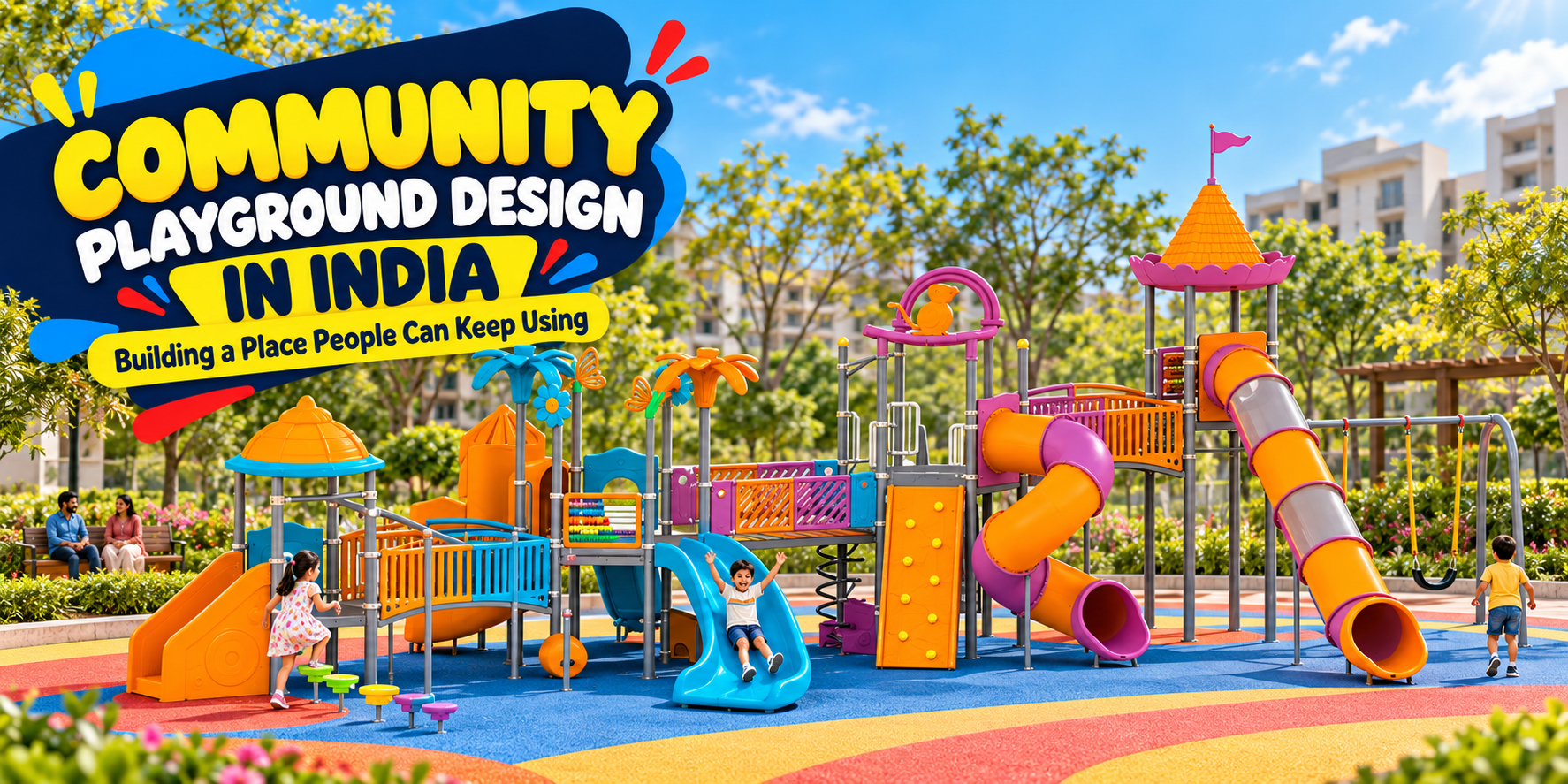
Community Playground Design in India: Building a Place People Can Keep Using
The first time is in drawings, foundations and equipment. The second is in daily use: a child asks to go down, a grandparent finds a shaded seat, friends start a game, and a caretaker notices that a loose part needs attention. Only then does the playground become a dependable neighbourhood place.
For a housing society, municipal team, school or developer, this is a useful distinction. Buying a slide does not by itself create a community playground. The play must suit local children; the route must work for families; the space must remain welcoming and maintained after the launch photographs are taken.
UNICEF and UN-Habitat's guidance on child-responsive urban policy calls for children's needs and voices to be included in decisions about urban spaces. That principle can be put to work at the scale of a single play area. Here is a practical route from community brief to long-term operation.
Ask who the space is really for
Start with a map of users, not a catalogue. Which age groups live nearby? Where do children currently play? Who accompanies them: parents, grandparents, childcare workers, older siblings? Can a child with a mobility aid reach the area? Does a teenager have any reason to stay nearby without occupying equipment intended for young children?
A short listening exercise can be simple. Speak to families at the times they already use the site; ask children to draw a favourite game or show where they gather. Include households that rarely attend formal resident meetings. Ask what stops people using the current space: access, heat, opening hours, poor maintenance or lack of age-appropriate activities.
Avoid treating the loudest preference as the entire community's need. A popular request for a large swing may leave no room for a toddler area or open games. Record the different needs and explain how the proposed design responds.
Choose a site people can reach and use
The strongest location may be a modest patch near everyday paths rather than the largest leftover corner of a development. Walk the route from homes, a bus stop or the school gate. Look for vehicle crossings, gates, uneven paving, steps and poor visibility. Check the space at likely play hours and after rain.
A community playground needs a clear boundary where roads, service areas or water present hazards, while avoiding an enclosed feel that isolates children from carers. Seating should let adults watch active play without standing in a slide exit. Shade and drinking water access can affect how long families can comfortably stay.
The U.S. Access Board's play-area guide explains the importance of accessible routes and integrated ground-level activities. Its legal standards apply in the U.S.; Indian projects must check their own requirements. The design lesson is broader: an activity is not available to a family that cannot reach it.
Give the place several reasons to visit
A community will include children with different interests and abilities. Balance active movement with opportunities to talk, invent a game, explore and pause. A climber can invite physical challenge; a ground-level interaction point can support children playing together; a clear open area leaves room for games no supplier designed.
Arihant Play offers multi-activity play systems, climbers, swings and other categories. Choose exact products only after the age mix and site are understood. Request model-specific intended ages, user guidance and safe play areas. A dramatic structure that serves one age group while the rest watch may be the wrong investment for a shared neighbourhood.
Do not make the accompanying adult an afterthought. A shaded seat with a good view can help carers remain while children play, and a path that supports a stroller or wheelchair benefits more than one visitor. The surrounding space makes the equipment usable.
Plan for the busiest hour
An empty rendering can make any layout look spacious. A community playground has peaks: after school, on weekends or during holidays. Imagine several children arriving at once and trace how they approach, queue, descend and gather. Keep fast movement away from gates and quiet seating. Separate activities for very different ages where the site and supervision allow.
Plot the equipment footprint and full use zone on a measured plan. The U.S. CPSC Public Playground Safety Handbook offers guidance on use zones, surfacing, age suitability and maintenance. It is an international reference, not a site-specific Indian approval. The selected manufacturer's drawings and locally applicable standards must guide final design.
Ask the playground equipment manufacturer to show the complete site, not only its products. Protective surface, drainage, paths, planting and supervision points belong on the same drawing. If the busy-hour plan feels crowded, simplify the equipment mix before reducing required clearances.
Share the design decision with children
Community consultation should have a visible outcome. Show two or three realistic options, explain the trade-offs and ask children what they would do in each. A child may identify the place where a chasing game would cross a slide exit or where a younger sibling cannot join. Those observations are different from asking which rendering looks prettiest.
UNICEF's child-responsive urban guidance supports listening to children in decisions that affect their spaces. Adults remain responsible for engineering, safety and budget, but children can inform the activities and routes. Share back what changed because of their input. That makes participation meaningful rather than ceremonial.
For a society, run discussions at more than one time so working parents and childcare helpers can contribute. For a public park, reach nearby residents and groups who may not normally attend planning meetings. The eventual operator should participate too.
Agree on access and behaviour before opening
A community space needs clear, fair operating rules. Decide hours, age guidance, whether adults accompany younger children, how repairs are reported and who can temporarily close unsafe equipment. Avoid rules so restrictive that the intended children cannot actually play. Explain them plainly on site and through the channels residents already use.
If a school is considering opening its grounds after hours, address safeguarding, staffing, boundaries, insurance and maintenance with the responsible authorities before doing so. If a municipal park has multiple contractors, state who owns inspections and repairs. No playground equipment supplier can settle governance on the client's behalf.
Provide a contact route for problems and a process for responding. A damaged swing should not wait for the next annual residents' meeting to become someone's responsibility.
Budget for care, not only installation
Price the complete playable environment: site preparation, equipment, impact-protective surfacing, paths, drainage, seating, shade, landscape, installation and inspections. Then budget for replacement parts, surface repairs, cleaning, pruning and periodic technical checks. Ask for product manuals and an as-built plan at handover.
The CPSC handbook includes maintenance prompts that owners can use to frame a programme. The applicable Indian standards and manufacturer's instructions should govern the actual site. Assign named responsibility and keep a log of faults and actions.
Arihant Play's FAQ describes its design and material approach; a project buyer should request the current model documentation, maintenance instructions and support terms. A lower headline price can lose its appeal if the resulting playground is difficult to repair or frequently closed.
See whether the place is working
After opening, visit at different times. Are children using several activities? Is a path blocked by queues? Do carers have a place to sit? Are some age groups or families absent? Ask why. A new shaded bench, a corrected gate or a repaired route might improve the space more than another piece of equipment.
Observe without turning every conversation into a claimed social outcome. A playground can create opportunities to meet; it cannot guarantee friendship or resolve every community divide. Measure what the operator can actually see and improve: access, use, maintenance response and children's choices.
A community playground succeeds when people trust it enough to return. Explore Arihant Play's range and share your site brief to develop a proposal that serves the children and the people who care for the place.
Frequently Asked Questions
1. What is a community playground?
A community playground is a shared place designed for children from a neighbourhood, housing development, school community or public catchment. Its value depends on more than equipment. Families need a practical route, children need age-appropriate and varied play, and an operator needs a plan to inspect and maintain the space.
“Community” describes who can use it and how it is run. A gated society amenity serves a defined group; a municipal park may be open to a wider population. A school yard opened to nearby residents after hours needs a separate agreement for access and safeguarding. The design should honestly reflect its actual users rather than assuming one layout works for all three.
Begin by identifying ages, peak hours and barriers faced by families. Provide meaningful ground-level play, circulation, seating and shade where appropriate. Seek children's views before the plan is fixed; UNICEF and UN-Habitat encourage child-responsive decisions in urban spaces. The finished playground should have an owner, maintenance budget and clear route for reporting faults. A collection of products becomes a community asset when people can use it reliably over time.
2. How do we choose a site for a neighbourhood playground?
Look beyond the largest vacant plot. Trace the routes from homes, schools and nearby paths. Note vehicle crossings, gates, changes of level, lighting, drainage and whether carers can see the play area. Visit at the times children are likely to play and after rain. A site may look generous on a plan yet feel inaccessible or uncomfortable in daily use.
Measure the land and identify utilities, trees and any emergency or service access that must stay clear. Then test candidate equipment with its complete use zones, not only its frame footprint. The CPSC handbook explains these areas as an international reference; apply locally relevant requirements and exact manufacturer drawings to final placement.
Ask whose needs the site serves. A location that works for older children on bicycles may be difficult for a grandparent bringing a toddler. Consider seating, shade and an accessible approach from the start. If the best site cannot accommodate a large playset, a smaller, more varied place that families can reach may serve the community better. Site choice should be tested by real journeys as well as land area.
3. How can children participate in designing their playground?
Give children ways to express what they like doing, not merely a vote between polished pictures. They can draw a game, mark favourite routes on a simple plan, describe where they feel comfortable or walk the site with an adult. Different ages and abilities should be included so the outcome is not determined only by the most confident speakers.
Present two or three viable options with honest constraints. Explain that some ideas may need more land, money or engineering. Ask what children would do first, how friends could join and where younger siblings might play. Their answers can reveal useful details about queues, social games and places adults overlook.
Adults remain responsible for compliance, safety and budget. The UNICEF–UN-Habitat guidance supports children's participation in decisions affecting urban spaces. Close the loop by showing what their input changed and why some requests could not be included. This avoids token consultation and helps residents understand the final choices. The playground manufacturer and design team can then translate the play brief into a technically workable layout.
4. Which equipment suits a community playground with mixed ages?
There is no universal equipment list. Begin with how many children of different ages are likely to use the space at once, then select play experiences that do not force everyone into the same route. Younger children may need lower, more approachable activities; older children may want varied climbing or group challenges. Ground-level imaginative and social play can offer common ground.
Arihant Play lists multi-activity systems, climbers, swings and other options. Ask for the intended age range, safe play area, height and user guidance for each exact model. Do not assume a catalogue label of “all ages” means children of all ages can safely play together on one unit.
Plan the route between activities. Fast older children should not cross a toddler's entrance or a slide landing. If the plot is small, it may be more honest to prioritise the main users and provide a different nearby opportunity for others. The best community mix is a set of compatible choices, not the longest list of equipment.
5. How can a playground help neighbours connect?
A playground can give people a regular reason to occupy the same place. Children meet through games, while carers may talk as they supervise. Design can support this by making the area comfortable to stay in: seats with good sightlines, shade, a clear entrance and space where children can play together without constant queues.
Do not promise that a playground will create friendships or solve social isolation. Those are personal and community outcomes influenced by many factors. The design team can create opportunities, then observe whether people actually use them. A seating area too far from play may be empty; a bench in a slide exit is badly located. The social edge of a playground needs as much thought as the central structure.
Include people with different roles. Grandparents, parents, childcare workers and older siblings may use the perimeter in different ways. A clear accessible route and comfortable waiting point help them participate. Ask the operator about fair access rules and opening hours. When the site is welcoming and dependable, recurring visits and conversations become possible without trying to manufacture them.
6. What should a housing society plan beyond the play equipment?
Plan the whole area and its management. The site needs safe approaches from residential blocks, circulation, protective surfacing where required, drainage, shade, seating, lighting if used after dark and a way to keep service vehicles separate. The layout should show gates, use zones, trees and sightlines on one drawing.
Clarify who owns cleaning, inspection, repairs, tree care and reporting. A residents' association may take over after the developer's handover, so provide manuals, as-built drawings, warranties, spare-parts contacts and an operating budget. Agree how a broken element will be temporarily closed and reopened. The CPSC handbook offers inspection prompts as an international reference; the actual site programme should follow applicable requirements and manufacturer instructions.
Ask the playground equipment supplier to quote the complete scope or clearly list what the society must procure elsewhere. A cheap product price may exclude the surface or civil work. Invite future facility managers to review the proposal before installation. They will know whether staff can reach drains and inspect the equipment. The best resident amenity is one the association can keep open and usable.
7. Can a school playground be shared with the wider community?
It may be possible, but it requires an operational agreement, not only an open gate. The school and relevant authorities need to resolve access hours, staffing or supervision, safeguarding, boundaries, toilets, insurance, maintenance and responsibility for incidents. A route used by community visitors should not create access to restricted school areas.
Review whether the equipment and site suit mixed users. The school may design around scheduled breaks with staff present, whereas outside-hours use may bring different ages and a different approach path. Inspect the equipment before pupils return and budget for additional wear. If shared use cannot be managed responsibly, partners may consider a nearby public play area instead.
Consult families and neighbours about demand, but be candid about limits. The UNICEF–UN-Habitat guidance supports children's needs in urban decision-making; it does not remove the school's duty to manage the site. Shared play can improve access when there is a clear written framework and an operator able to deliver it consistently.
8. How can a community playground include children with disabilities?
Begin with the journey to the playground and continue through the activities. A gate, path and surface must allow children and carers to arrive; the play area needs meaningful options that are integrated with other children's activities. One isolated “accessible” item may offer little social participation.
Provide varied ground-level play, clear circulation, suitable transitions and places to pause. A child may prefer a tactile or imaginative activity, a movement challenge or a shared game. Consult children and carers to identify barriers that are not obvious from a catalogue. The U.S. Access Board play-area guide explains the relationship between accessible routes and play components; its legal provisions apply in the U.S., so check the relevant Indian requirements separately.
Maintain access after opening. Roots, loose material, ponding or a damaged edge can make a once-usable route difficult. Include these checks in the operator's inspections. Inclusion means different children can make real choices and meet friends in the same place, even when they use different parts of the equipment.
9. Who pays for maintenance in a public or society playground?
The answer depends on who owns and operates the site. A housing society may pay through its common-area budget after developer handover. A municipal site may have a local authority or contracted operator. A school must identify its own facilities responsibilities. These arrangements should be written before purchase, because the equipment manufacturer does not automatically maintain the playground forever.
Budget for routine inspection, cleaning, surfacing repairs, drainage, landscape care and replacement parts. Ask the supplier for warranty conditions, manuals and realistic spare-parts information. Warranties may exclude wear or misuse, so a reserve for ordinary upkeep is still needed. Assign someone to receive fault reports and decide when equipment must be closed pending repair.
The CPSC Public Playground Safety Handbook provides general maintenance guidance, but local requirements and the selected product's instructions govern the actual plan. Record inspections and actions. A community playground's value depends on reliability; even excellent equipment loses that value when a small fault remains unresolved for months.
10. How can we measure whether a community playground is successful?
Use evidence the operator can actually collect. Observe the space at different hours and seasons: how many children arrive, which activities they choose, where queues form, whether carers remain and whether some groups are absent. Note recurring faults, closures and how quickly repairs happen. Ask children and families what they enjoy and what prevents them from coming.
Avoid claiming that equipment alone caused stronger community bonds or measurable health outcomes without a suitable study. A playground creates opportunities; many outside factors shape the result. Simple measures such as regular use, varied participation, accessible routes and a maintained site are meaningful for local improvement.
Review the findings with the community after opening. Perhaps the entrance needs a safer approach, the seating needs shade or a quiet play feature is missing. Keep a record of what changes and revisit the area later. UNICEF's child-responsive urban guidance supports hearing children's voices. A good community playground remains a project people can improve, not a fixed installation declared complete on handover day.