



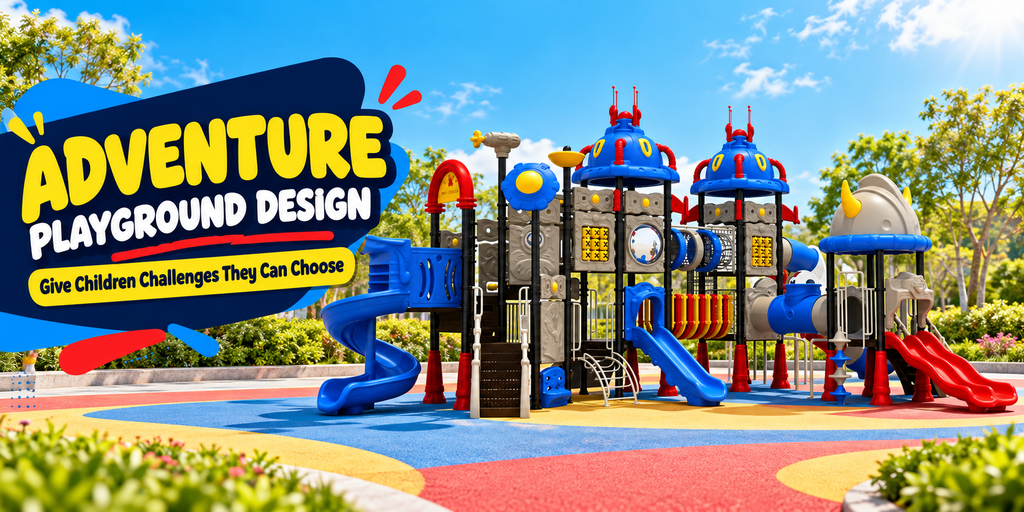
Adventure Playground Design: Give Children Challenges They Can Choose
A child reaches a fork in a climbing structure. The rope route looks difficult; the stepping route looks possible. They try one, come down, watch a friend and return by the other. In a minute of play, they have made decisions, moved their body, judged a challenge and changed their plan.
That small sequence is the case for an adventure-inspired playground. Its value does not come from making every structure taller or more intimidating. It comes from offering inviting choices that children can attempt at their own pace. For architects, schools and developers, the design task is to make those challenges varied, age-appropriate and properly engineered.
Research helps explain why. UNICEF India describes play as supporting motor, cognitive, social and emotional development. The American Academy of Pediatrics also links play with relationships and learning. Those are reasons to protect good play opportunities, not promises that a particular climber will deliver a measurable skill gain to every child.
Start with a ladder of choices, not a list of equipment
Before selecting a playground climber or obstacle unit, describe the children and the challenge you want them to meet. Are beginners learning to step and balance? Are older children looking for more complex routes and group play? Is this a school break where many children arrive together, or a housing society where ages overlap throughout the evening?
Sketch a progression: an easy entry, an intermediate option and a harder choice, with a clear way out at each stage. A child should be able to watch, join, retreat and try again without being trapped in a queue or forced to finish the entire sequence. A circuit of small challenges can work better than one feature whose only appeal is height.
The useful question is, “What can a child do next?” rather than “How many components are in the catalogue?” That leads to a playground that invites repeat visits and different kinds of play as confidence and ability change.
Make each movement teach the designer something
Movement variety matters. A sequence might ask a child to place a foot carefully, shift weight, grasp a handhold, choose a crossing and descend. These actions can involve balance, coordination, spatial awareness and strength, but the experience should still feel like play rather than a lesson.
Observe likely transitions between components. If children must cross a slide exit to reach a balance feature, the sequence creates conflict. If a difficult climber has only one narrow access point, children may spend their time waiting instead of experimenting. Add parallel routes or distribute activities when the site and budget allow.
Arihant Play's climber range includes several forms of climbing equipment, while its multi-activity play systems connect movement types within a larger structure. These are starting points for a site-specific selection. Request each model's age range, dimensions, user guidance and technical drawings rather than assuming similar-looking products perform the same way.
Design decisions, not just obstacles
A good adventure route leaves room for judgment. A child might choose a lower crossing before attempting a higher one, ask a friend for help or invent a game around the structure. Small forks and visible alternatives can be more engaging than a compulsory path with a single “finish” point.
This is where challenge and hazard must be separated. Choosing whether to try an age-suitable crossing is part of play; an unseen sharp edge or inadequate impact surface is not a useful learning opportunity. The UK's Health and Safety Executive supports considering the benefits of challenging play alongside risks. Its statement is a helpful design perspective, while local standards and product-specific safety requirements still govern the project.
Ask what the child can perceive. A stable foothold and a visible landing let a child decide whether to proceed. Hidden pinch points, confusing exits and unexpectedly intersecting routes give them no fair chance to make that judgment.
Engineer the route around the fall, not the rendering
The exciting illustration is only part of the specification. The design team must coordinate platform and fall heights, protective surfacing, use zones, foundations, anchors, structural loads, entrapment risks and the relationship between adjacent components. A change to the route can affect all of them.
The U.S. Consumer Product Safety Commission's Public Playground Safety Handbook addresses age-appropriate equipment, surfacing, spacing, openings, installation and maintenance. It is a technical reference, not an Indian compliance certificate. Ask the outdoor playground equipment manufacturer for the exact model's drawings and evidence relevant to the standards specified for your project. Have a qualified professional review unusual site or structural conditions.
Materials matter in use. A handhold should be comfortable to grasp and maintain; rope connections should be inspected; coatings and fasteners should suit the site's exposure. A structure beside the sea may demand different maintenance planning from one in a protected school courtyard. Define the inspection and spare-parts arrangements before opening, not after a component fails.
Plan for two kinds of traffic
Children move through the equipment; everyone else moves around it. A good layout accounts for both. Mark approaches, queues, exits, adult supervision positions and accessible circulation on the site plan. Keep fast descents and landing points away from gates, seating and routes used by small children.
In a busy school, a sequence with several entry and exit choices can help spread play. In a resort, a clear perimeter may help carers find children quickly without interrupting the main pedestrian path. In a residential development, lighting, visibility and nearby waiting space matter during evening use. The appropriate layout depends on actual traffic rather than a generic “adventure zone” diagram.
Avoid placing all the dramatic features in one dense cluster. Leave room for children to regroup, talk and invent their own rules. Unprogrammed space has value: it can turn a fixed set of equipment into many different games.
Offer challenge at ground level too
If the only exciting route starts high above the ground, some children will have no meaningful way to join. An inclusive design offers varied opportunities for exploration and social play at ground level, as well as appropriate routes and surfaces. Consider how a child using a mobility aid can approach an activity, make choices and play alongside friends.
The U.S. Access Board's play-area guide explains why accessible routes and a variety of ground-level components matter. It describes U.S. requirements and should be used as design guidance while project teams check India's applicable rules. Consult intended users where practical; a drawing can show compliance dimensions but not how welcome a child feels at the play feature.
Adventure can also be quiet. Making up a game, solving a route together or exploring a sensory feature creates challenge without asking every child to climb higher.
Scale the experience to the age group
“Adventure” is not an age category. Toddlers, preschoolers and school-age children need different levels of reach, movement and supervision. A preschooler's meaningful challenge may be stepping between low elements and deciding how to descend. An older child may enjoy several route choices and more demanding coordination.
The CPSC handbook distinguishes age groups when discussing suitable equipment. Use that principle to question any proposal advertised as equally appropriate for all children. If a project serves a broad range, create legible age-appropriate opportunities and consider how faster older children move through areas used by younger ones. Where space is limited, it may be better to serve a defined group well than to claim one crowded unit fits everyone.
Ask the supplier how the nominated age range was determined for each product. Separate marketing capacity from a realistic peak-use plan: can the expected number of children play simultaneously without queues that push activity into a use zone?
Make maintenance part of the adventure brief
Climbing nets, moving parts and textured routes invite repeated contact. That increases the importance of inspection. Establish who checks ropes, fixings, handholds, worn surfaces and anchor points, how often they check them, and what requires temporary closure. Follow the manufacturer's instructions and the project's operating requirements.
The CPSC handbook includes maintenance prompts. For a buyer, the practical questions are whether replacement parts are available, whether staff can reach components for cleaning and how protective surfacing will be repaired. A product that looks sophisticated but is difficult to maintain may offer less real play time over its life.
A sharper brief for your supplier
Give shortlisted playground equipment suppliers the same site survey, intended ages, busiest expected use period and desired mix of skills. Ask each for a coordinated layout with age ranges, route options, product and use-zone dimensions, fall heights, surfacing, accessible circulation, supervision sightlines, installation scope and inspection requirements.
Then review the design from a child's point of view. Where can I begin? What choice do I have? Can I stop? Can I play with someone whose abilities differ from mine? Those questions turn skill development from a marketing claim into a useful design method.
Arihant Play's product range offers different ways to combine climbing, movement and social play. Share the site brief to explore a solution grounded in the children and space it will serve.
Frequently Asked Questions
1. What is an adventure-inspired playground, and how is it different from a standard playground?
In this article, an adventure-inspired playground is an installed play environment that gives children age-appropriate choices, varied routes and manageable challenges. A conventional playground may have the same types of equipment, but a more linear layout can offer fewer ways to explore or return to an activity. The difference is in the design of play opportunities, not simply the height, theme or appearance of the products.
For example, a connected climber can give a child a simple route and a more demanding alternative, plus room to leave and try again. Ground-level activities can support children who choose not to climb. A useful design brief asks what each child can attempt, how children meet one another and whether the whole space remains visible and maintainable.
Terminology matters. Organisations such as Play England use “adventure playground” for a distinct staffed form of child-led play. A school or housing development with permanent equipment should not claim to provide that operating model unless it actually does. Whatever the name, request age-specific product information, use-zone drawings and a complete surfacing plan from the playground equipment manufacturer. The aim is meaningful freedom within a properly designed setting.
2. Which skills can children practise on climbing and adventure play equipment?
Different routes invite different actions. A climbing sequence may involve grip, coordination, balance and planning where to place the next foot. Choosing between routes can invite decision-making; taking turns or inventing a group challenge can invite communication and cooperation. These are opportunities to practise skills, not a guarantee that using one product will improve a specific developmental score.
UNICEF India describes play as part of motor, cognitive, social and emotional development. To turn that broad insight into design, look for variety rather than a single obstacle repeated many times. Give beginners an achievable entry and children with more experience a different route. Let a child watch, step away and return without blocking others.
An architect or school team can ask the supplier to map each play action to a real component: where does a child balance, where can two children cooperate, and where can a child choose a different way forward? Avoid describing equipment as a treatment or claiming that a set number of minutes will produce a measurable skill gain. Good playground design creates conditions for rich play; children's learning still depends on their own interests, experience and wider environment.
3. Is challenging playground equipment safe for children?
Challenge and preventable hazard are different design issues. A child may benefit from deciding whether an age-appropriate route is within reach. They do not benefit from a hidden pinch point, an unstable fixing, a hard landing beneath a fall or an equipment use zone blocked by an obstacle. The design team must retain the first kind of choice while controlling the second kind of risk.
Begin with products suited to the intended age group and obtain exact fall-height, spacing and surfacing information. Check installation, openings, structural details, supervision sightlines and maintenance procedures. The CPSC Public Playground Safety Handbook is a useful reference on these topics, but the final installation must meet the applicable local requirements and the selected manufacturer's instructions. Qualified review is especially important for unusual sites or custom features.
The UK's Health and Safety Executive supports balancing the benefits of play with its risks, rather than removing every challenge. That does not mean accepting avoidable hazards. It means choosing a challenge deliberately, understanding how children will use it and making the supporting engineering, surfacing and operations sound. No playground can promise zero injuries; a careful design reduces foreseeable serious hazards while preserving worthwhile play.
4. What ages are suitable for an adventure-style playground?
There is no single age that defines adventure play. A toddler's challenge, a preschooler's challenge and a school-age child's challenge are different. Lower stepping routes, simple grasp points and close adult support may suit younger users; older children may want longer routes, route choices and more demanding coordination. The correct selection comes from the actual product's intended age range and the project's supervision plan.
The CPSC handbook distinguishes equipment considerations by age group. Use it to question broad “all ages” claims, while following the standards relevant to the site in India. Mixed-age spaces need particular attention to traffic. A fast route used by older children should not cross the entrance to a younger child's activity.
Give the playground equipment supplier the expected age mix and busiest period. Ask which components serve each group, where the groups might collide and whether quieter alternatives remain available. A school can sometimes schedule age groups separately, but the equipment still must be suitable for the children using it. If the plot is small, a well-designed experience for a defined group is more honest and useful than a crowded assortment sold as universal.
5. How do you choose between a rope climber, a play tower and an obstacle trail?
Choose by the actions you want, the site plan and the children using it. A rope climber can invite multiple routes and careful movement; a play tower can connect climbing with sliding and group interaction; a trail can spread different low and high challenges across a larger area. None is inherently the “best” adventure product. Each brings distinct circulation, fall-height, supervision and maintenance implications.
Draw each option to scale with its full required use zone. Then trace a child's likely path to and from it. Does the route cross another feature's exit? Is there room for waiting? Does the structure let children choose different levels of challenge? Can staff inspect its ropes, connections or elevated parts? Ask the playground manufacturer for product-specific age range, user guidance and installation details.
Arihant Play lists climbers and multi-activity play systems that provide useful starting points for comparison. Assess the exact models against the site, not simply the category. A small courtyard may be better served by a compact connected unit; a larger park might benefit from activities distributed along a legible route. The result should feel like exploration rather than a queue through hardware.
6. Can an adventure playground be designed for a small site?
Yes, provided the site can accommodate the selected equipment's full use zones, protective surface, access and circulation. A compact arrangement may offer choices within one structure or a small sequence of distinct ground-level activities. Adding height can increase play variety, but it also changes fall height, surfacing, access and supervision. It does not make clearances disappear.
Start by mapping the site constraints: boundaries, gates, trees, utilities and routes that must remain open. Ask suppliers for both the equipment footprint and the safe play area. Sketch where children will wait, descend, regroup and move to another activity. If every path crosses the same narrow landing, the design needs simplification even if the product fits geometrically.
Instead of trying to include a slide, swing, climber and course, choose a primary play experience and support it with open space or a complementary lower feature. Browse the Arihant Play product catalogue for options, then obtain a coordinated drawing before ordering. Skill-focused play depends on room to choose and repeat, not the maximum number of objects per square metre.
7. How can children with disabilities join adventure-style play?
Design for participation from the first sketch. Provide an accessible route into the playground and to meaningful ground-level challenges. Offer different forms of choice, such as tactile discovery, social games, problem-solving and movement at a range of heights. Place these opportunities with the main play, so children can interact rather than being directed to an isolated “inclusive corner.”
Review the surface and transitions in ordinary conditions and after rain. Provide enough maneuvering room at activities and plan seating where carers can see play without obstructing access. The U.S. Access Board play-area guide explains the role of accessible routes and ground-level components. It is a useful reference, not a substitute for the applicable accessibility requirements in India.
Ask prospective users and carers which routes and activities they would actually choose. A route that appears adequate on a drawing may fail if its surface is difficult to traverse or its destination offers little to do. Adventure does not require every child to take the same physical risk. The shared experience lies in having real decisions and ways to participate with friends.
8. How do schools evaluate whether a playground supports learning?
Avoid looking for a promise that a particular product “teaches leadership” or guarantees better classroom performance. Instead, observe what children can do there. Can they choose routes, negotiate turns, invent games, repeat movements and adapt when a first attempt does not work? Does the design allow both vigorous play and less physically demanding participation?
Teachers can review the layout before purchase, then observe how it works after opening. Note bottlenecks, conflicts between ages, activities that attract sustained engagement and places children avoid. These observations can guide supervision and future changes. UNICEF's explanation of the science of play offers a useful developmental context, while the school's own observations reveal whether this particular site creates opportunities to play.
If collecting evidence for the investment, define modest, observable measures: how many children can take part during a break, whether waiting is concentrated at one access point and whether a range of abilities can use the space. Do not present these as clinical outcomes. A school playground supports learning by giving children time and room for active, social, self-directed play alongside formal education.
9. What should a playground equipment manufacturer's proposal include?
The proposal should let the buyer test a design, not merely admire a rendering. Request a scaled site layout showing exact models, intended age ranges, equipment and use-zone dimensions, platform and fall heights, access routes, exits and surfacing. Ask how many children can use the features at busy times and how that figure was assessed. A drawing should also show adjacent boundaries, drainage and supervision positions.
For engineering and procurement, request materials and finishes, structural and anchoring information, installation scope, site works excluded from the quote, standards or test evidence relevant to the selected products, warranty conditions and inspection guidance. Find out whether replacement ropes, connectors or other wear parts will be available. On a roof or podium, obtain building-engineer approval for the structure and fixing before equipment selection is final.
Give competing playground equipment suppliers the same project brief so the comparison is fair. Evaluate the variety of play, inclusive access, maintainability and complete installed cost, rather than ranking proposals by the number of advertised activities. Arihant Play's product range can inform a shortlist; ask for the current technical data for each proposed model. The complete design is the site, surface and equipment working together.
10. How should an adventure playground be inspected and maintained?
Create a schedule for routine visual checks, periodic detailed inspections and prompt repairs, aligned with the manufacturer's instructions and the site's usage. Look at ropes and net connections, handholds, fasteners, moving parts, surface wear, anchors, drainage and protective surfacing. Pay attention to places where a child changes direction or grips the same component repeatedly, because those locations may wear faster.
Assign an owner for each action: who records a defect, who restricts access if needed, who orders parts and who confirms the repair is complete. Staff should be able to reach all relevant components without improvising unsafe access. Keep manuals, product drawings and inspection records together so future operators understand the original specification.
The CPSC Public Playground Safety Handbook offers general maintenance guidance, while the applicable local standard and exact equipment manuals should determine the programme. Changing a rope, grip or surface detail with an unapproved substitute may alter the product's performance; confirm replacements with the supplier. A playground that can be maintained promptly gives children more time to play. That operational reliability is part of its long-term educational and commercial value.
References:-
- UNICEF India: The science of play
- American Academy of Pediatrics: The Power of Play
- UK Health and Safety Executive: Children's play and leisure
- Play England: What We Do
- U.S. CPSC: Public Playground Safety Handbook
- U.S. Access Board: Play Areas Guide
- Arihant Play: Climbers
- Arihant Play: Multi-Activity Play Systems